
By Robin WenReviewed
Antimony Production: The Grade Picks the Furnace
Six routes make antimony metal, and the concentrate grade decides which one runs. The route that dominates yields about 99.4%, not four nines.
On this page
Antimony production is not one process. The published metallurgy sets out several pyrometallurgical routes, and which one a plant runs is governed first by the grade of its concentrate. The review is explicit that the choice is very sensitive to concentrate type and grade
, and that a flowsheet is also built around the precious metals in the feed, mainly gold. A buyer reading a certificate does not see that decision, and it explains the numbers on the certificate.
The reference used here is a 2022 review of pyrometallurgical antimony extraction in Processes, which sets out the grade windows, the recoveries and the furnace types, and which notes that blast furnace volatilisation together with reduction smelting of the resulting oxide in a reverberatory furnace has carried more than 90% of total antimony recovered from ores since 1900.
| Concentrate grade | Route | Recovery reported |
|---|---|---|
| 5% Sb up to 25% | Conventional volatilisation roasting, rotary kiln | 90–94% typical; up to 98%, as low as 60% reported |
| 45–60% Sb₂S₃ | Liquation, then iron precipitation | 85–90% of the sulphide content, liquation step only |
| 50–60% Sb | Flash volatilisation, counter-current kiln | up to 96% |
| 60% Sb minimum | Cyclone smelting | 96% |
| Low grade through high grade; above 40% Sb more economical | Blast furnace volatilisation smelting | 97–98% |
| below 5% Sb | Hydrometallurgical leaching, not pyrometallurgy | not stated as a single figure |
How antimony production chooses a furnace
The reason is a physical limit rather than a preference. Conventional volatilisation roasting holds the charge below its melting point and drives the sulphur off as gas, and the review states that it treats relatively low-grade concentrates 15–25% Sb
, can start from 5% Sb, and is not used above 25%. Above that the charge melts, sulphur removal becomes locally incomplete, and an antimony glass forms from undecomposed stibnite and antimonates, which costs recovery and causes accretion in the kiln.
At the other end, the concentrated routes need a rich feed to work at all. Cyclone smelting requires a minimum of 60% antimony and less than 0.5% lead and arsenic combined, because those elements concentrate in the matte and recirculate. Liquation heats stibnite to 550–660 °C so the sulphide melts and drains away from the gangue, and the review puts the workable window at 45–60% Sb₂S₃: below about 45%, too much gangue is present and the antimony stays in the residue.
That is why an ore body does not come with a flowsheet. Two mines with the same mineralogy and different grades can feed different furnaces, and the review’s own exception proves the rule: the blast furnace is valued precisely because it absorbs feeds the others reject.
Roasting makes an oxide that is also a product
The first step of most routes produces a saleable material. Oxidation of stibnite gives antimony trioxide, which leaves the kiln as a vapour and is collected in flues, condensing pipes or baghouses; the review puts commercial trioxide at between 99.2% and 99.5% Sb2O3
with arsenic, lead and iron varying by the application.
That matters because antimony trioxide is the flame-retardant product and a catalyst for polyester production, and it can be sold before any reduction happens. A smelter can therefore stop at the oxide. The USGS statistics count oxide and unwrought metal as separate import categories, and the customs schedule keeps them on separate lines, 2825.80.0000 and 8110.10.0000, so the split is visible in two places without either document explaining why it exists.
The blast furnace won on feed flexibility
Volatilisation smelting in a blast furnace was first developed in China in 1963 and has been improved since. It operates between 1,300 and 1,400 °C, needs the concentrate mixed with lime and agglomerated, and takes a charge of agglomerate, iron ore, limestone and coke. The review gives its advantages as adaptability across oxidic, sulphidic and mixed feeds, tolerance of both low and high grades, a recovery of 97–98% and a large treatment capacity.
That combination is why it dominates. A rotary kiln is fussier about grade and about temperature, and a cyclone furnace demands 60% antimony; a blast furnace can absorb slags, residues and mixed concentrates that the others reject, which matters more than thermal efficiency when the feed is whatever the mine and the market happen to supply.
The same furnace carries a cost the review states plainly: producing one tonne of antimony takes about 1.2 tonnes of coal, and the sulphur dioxide comes off at a concentration too low for a sulphuric acid plant.
What leaves the furnace is 90 to 92% antimony
The second stage reduces the collected oxide with carbon at about 1,200 °C in a shaft, reverberatory or short rotary furnace. The review’s numbers for that step are specific: carbon at 8–12% of the charge, 15–20% of the trioxide volatilised again and lost to the off-gas unless it is captured, a yield of 95–98%, and a metal containing 90–92% Sb, 5–7% Fe
with arsenic and lead alongside.
Everything above that is refining, and refining is a separate skill from smelting. The review devotes a section to it because each impurity has its own removal step:
| Stage | What comes out | What is still in it |
|---|---|---|
| Reduction smelting | 95–98% of the antimony in the charge | 5–7% iron, plus arsenic and lead |
| Refining | A saleable ingot | Depends on which removal steps the plant runs |
| Xikuangshan, as documented | About 99.4% purity | The review gives no impurity schedule |
| Traded grade | 99.65% minimum | Set by the price basis, not by the furnace |
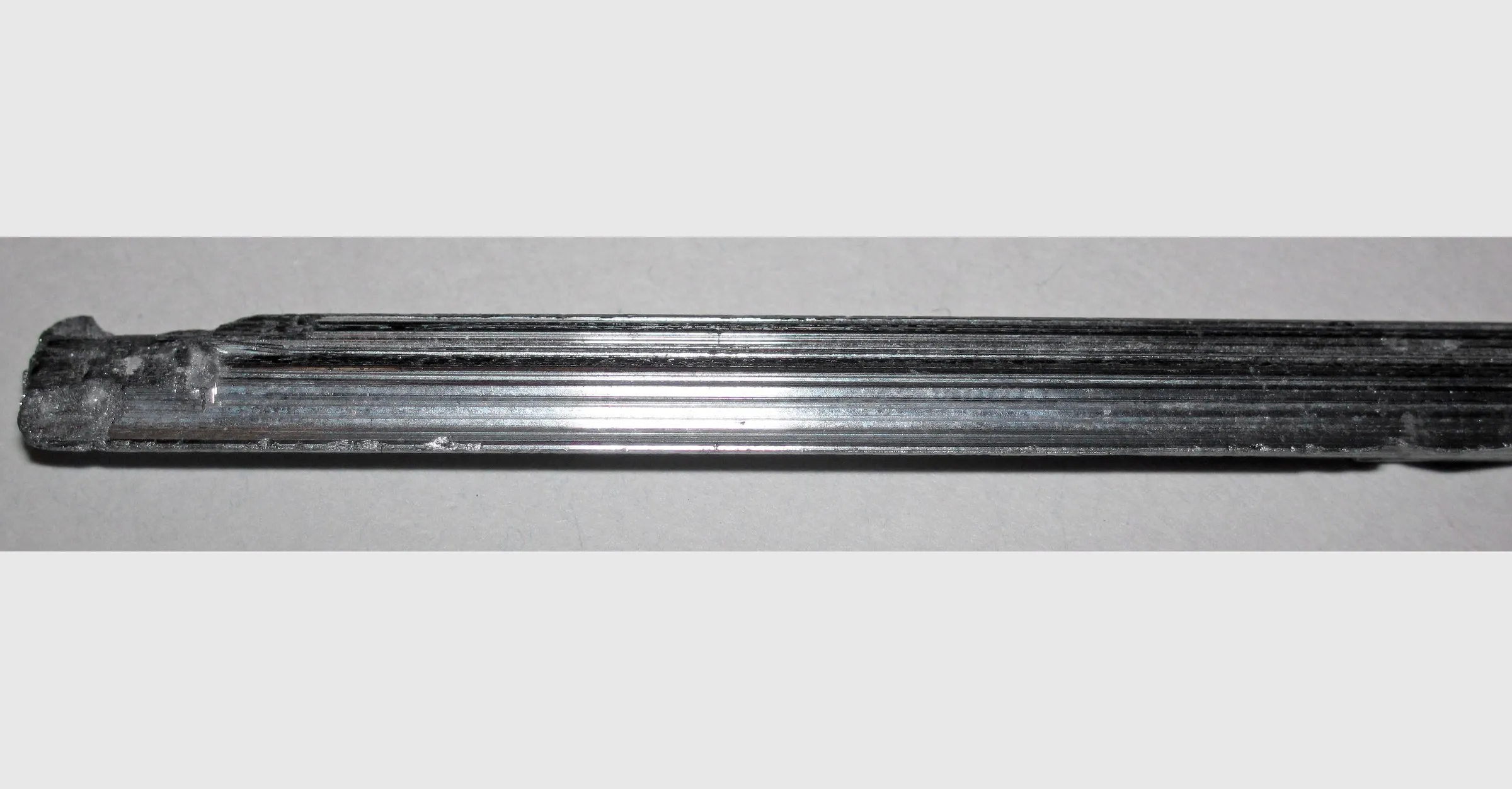
The best documented plant figure is Xikuangshan in Hunan, which the review calls the World Capital of Antimony
and where the oxides are refined at 1,200 °C with coal in a reverberatory furnace to a purity of produced antimony is about 99.4%
. Xikuangshan Flash-Antimony Industry Limited is given as producing 40,000 tonnes a year by that route.
The traded metal is quoted at a minimum of 99.65% in the current USGS summary. The review gives a commercial criterion of its own, typically at least 99% purity with no more than 0.3% arsenic, and it does not set a plant’s figure against the quotation, so the gap between the two numbers on this page is not something it explains. High-purity antimony for semiconductors, infrared detectors and diodes is treated in the review as a separate product rather than a further grade of the same ingot.
The three costs that decide where a plant sits
The review names three drawbacks of the dominant route, and all three are about what happens around the furnace rather than inside it.
Energy. About 1.2 tonnes of coal per tonne of antimony. The review also prints a figure of about 292 kJ per tonne for blast furnace volatilisation, which cannot be reconciled with the coal number by five orders of magnitude, so it is repeated here as printed and not used for anything.
Sulphur. The off-gas is too dilute for a sulphuric acid plant, so the sulphur leaves as SO₂ rather than as acid, which is both an environmental cost and a lost byproduct. This is what the newer sulphur-fixing routes are trying to fix, and none of them is past pilot scale.
Arsenic and lead. Both accumulate in the slag, which makes the slag a disposal problem rather than a saleable product. A plant’s environmental permit therefore shapes its flowsheet as much as its ore does.
| Constraint | Figure in the review | Note |
|---|---|---|
| Coal | about 1.2 t per tonne of antimony | Fuel and product are within a factor of two by mass |
| Off-gas sulphur | too dilute for a sulphuric acid plant | Abatement cost where a base-metal smelter books a credit |
| Slag | arsenic and lead accumulate | A disposal route is part of the flowsheet |
A fifth of antimony production bypasses the mine
Secondary antimony is roughly 20% of total production in the review’s figures, and it comes from lead-acid battery recycling and from residues of lead, copper and gold smelting. The USGS puts recycled material at 12% of American apparent consumption, and records that the bulk of it is recovered at secondary lead smelters as antimonial lead.
This is the one part of antimony production where the grade window is not what picks the equipment. A battery recycler is not choosing between a blast furnace and a cyclone; it is running a lead circuit in which antimony is a controlled impurity that has to be taken out and can be sold.
What to ask before specifying a route
Five questions separate a flowsheet from a quotation, and each of them changes what a route for antimony production will cost.
- What the concentrate grade is, as assayed. The route follows from it, and a plant quoting for the wrong window is quoting a different plant.
- Whether the product is oxide or metal. Trioxide at 99.2–99.5% can be sold as a flame retardant; metal requires the reduction and refining steps after it.
- Which impurities the feed carries, as assayed. The review’s route table is the fastest way to check whether a plant’s furnace matches your concentrate. Lead and arsenic above about 0.5% combined rule out cyclone smelting, and arsenic is the element that decides the refining sequence.
- What the sulphur is allowed to become. Weak SO₂ is a permit problem, not a byproduct.
- How much of the tonnage is secondary. Recycled antimonial lead enters the market without passing a mine or a smelter of its own.
Antimony covers what the 99.65% grade means and how the price path moved; antimony uses covers what the output is bought for; antimony suppliers covers who is named and why most of the tonnage has no company attached.
Methodology
This page uses the 2022 review of pyrometallurgical antimony extraction in Processes for the route-by-grade table, the recovery figures, furnace temperatures, the reduction numbers, the refining sequence, the Xikuangshan figures and the three drawbacks; and the USGS Mineral Commodity Summaries 2026 chapter for antimony for the 99.65% price basis, the separate oxide and unwrought import categories, the secondary share of American consumption and the high-purity end uses.
Three limits should be stated. The recoveries and temperatures are the review’s summary of published practice and vary by plant, so they describe a window rather than a specification. The Xikuangshan output figure is a literature citation of a company’s capacity, not an independently published production number. And this page describes pyrometallurgy, which is the dominant route but not the only one: hydrometallurgical and sulphur-fixing processes exist, and the review places the newer ones at laboratory or pilot scale.
Sources
- E. Moosavi-Khoonsari, S. Mostaghel, A. Siegmund and J.-P. Cloutier, “A Review on Pyrometallurgical Extraction of Antimony from Primary Resources: Current Practices and Evolving Processes”, Processes 10(8), 1590, 12 August 2022 (route selection by grade, recoveries, furnace parameters, reduction and refining, Xikuangshan, costs). https://www.mdpi.com/2227-9717/10/8/1590
- U.S. Geological Survey, Mineral Commodity Summaries 2026: Antimony, February 2026 (99.65% price basis, oxide and unwrought import categories, secondary share, high-purity uses). https://pubs.usgs.gov/periodicals/mcs2026/mcs2026-antimony.pdf
Related
- SpecificationAntimony Metal: What 99.65% Does Not MeanAntimony is counted as contained metal, priced on one ingot grade and controlled on another; a mine’s headline of 14 million tons is ore, not antimony.
- UsesAntimony Uses: One Oxide, Three JobsThe trioxide does three unrelated jobs: flame-retardant synergist, PET catalyst and glass fining agent. The alloy and the medicinal salts do the rest.
- SuppliersAntimony Manufacturers: One Company, WithheldWhere the antimony comes from, no company is named. Where one company makes the tonnage, the number is withheld. A suppliers list is left with the fringe.
- Metallurgy · Critical MineralsBismuth Production: Two Unlike RoutesKroll-Betterton and Betts are alternatives, not stages. Both reach four nines, and the intermediates between bullion and metal are not the same material.