
By Robin WenReviewed
Does Aluminum Rust? No, and That Is the Problem
Aluminum does not rust. It oxidises instead, and the oxide stays put, transparent, until a pit goes through the wall. Why the film holds and when it fails.
On this page
Does aluminum rust? No — rust is iron oxide and there is no iron in aluminium to oxidise. What happens instead is that aluminium reacts with oxygen within seconds of exposure and forms a layer of aluminium oxide, about 5 nm thick at room temperature, that seals the surface.
That layer is why aluminium does not need painting to survive outdoors, and it is also why aluminium fails in a way that is harder to see than rust.
Why the film stays
Whether an oxide protects a metal or falls off it is largely a question of volume. The Pilling–Bedworth ratio compares the volume of oxide formed to the volume of metal consumed:
| Metal | Oxide | Ratio | What happens |
|---|---|---|---|
| Aluminium | Al₂O₃ | 1.28 | Film is continuous and compressive; it stays |
| Iron | Fe₂O₃ | 2.14 | Film expands more than the metal can bear; it cracks and flakes |
Below 1 the oxide is too sparse to cover the surface. Between 1 and 2 it is continuous and passivating. Above 2 it tears itself apart, which is what rust does: iron oxide occupies more than twice the volume of the iron it came from, so it buckles, breaks, and exposes fresh metal underneath.
The rule has numerous exceptions, and the aluminum case is not the only one — chromium is the one that matters here: Cr₂O₃ sits at 2.07, above the threshold, and yet it is the passive film that makes stainless steel stainless. Volume ratio predicts whether a film can stay continuous; it does not decide protection on its own.
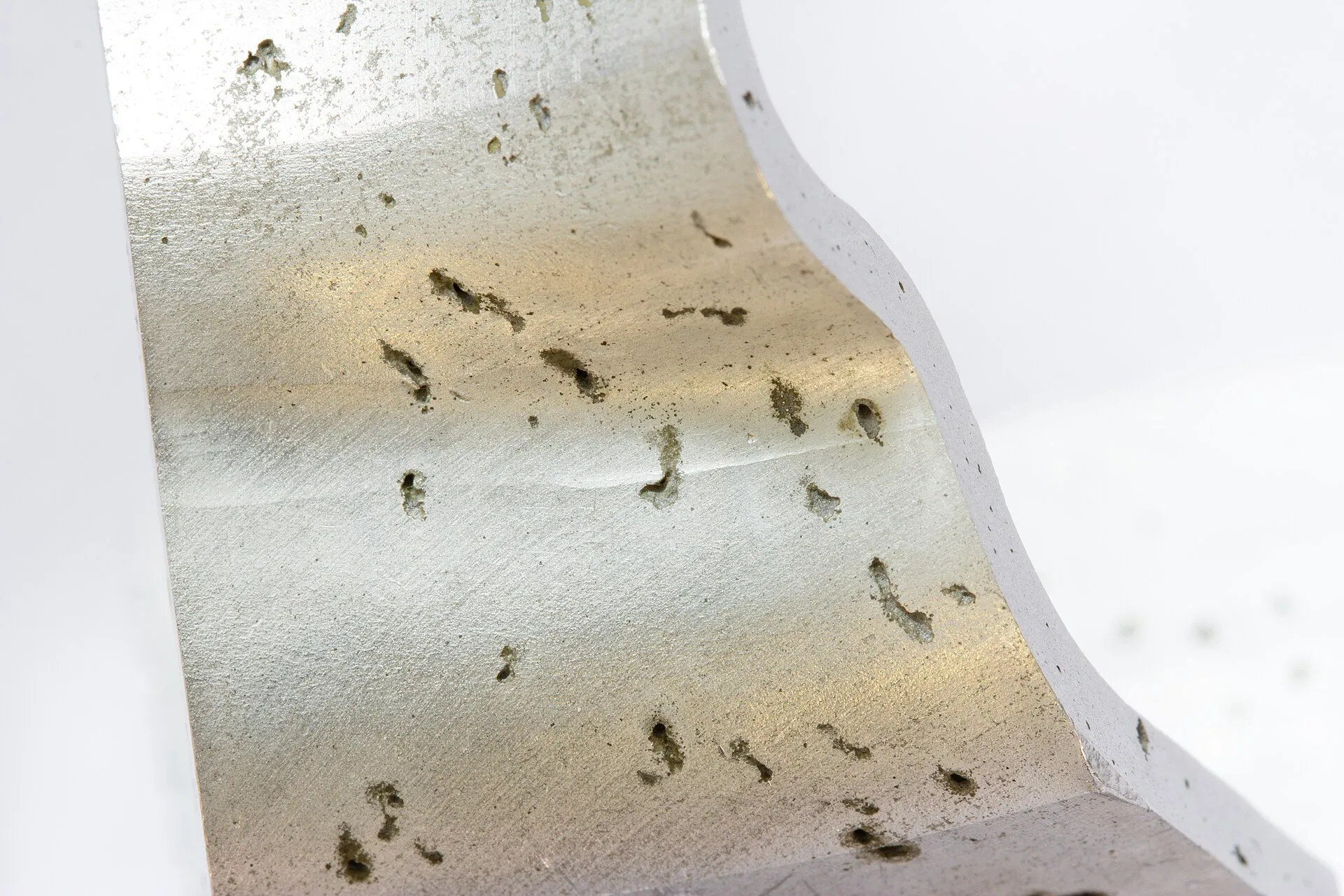
Aluminium sits at 1.28 — inside the protective band, with enough expansion to close gaps and not enough to crack. Fresh oxide is thin enough to be transparent, so an aluminium surface does not take on the orange coat that rust gives steel; what accumulates instead is a dull grey layer, visible in the photograph above where the pits interrupt it.
When does aluminum rust, then?
The oxide is amphoteric: it dissolves in acid and in alkali. Its stable window, per the Pourbaix diagram for aluminium, is roughly pH 4 to pH 9.
- Below pH 4, Al₂O₃ + 6H⁺ → 2Al³⁺ + 3H₂O. The film goes into solution as aluminium ions.
- Above pH 9, Al₂O₃ + 2OH⁻ + 3H₂O → 2[Al(OH)₄]⁻. The film goes into solution as tetrahydroxoaluminate. Older texts write the product as AlO₂⁻, which is the same reaction in a condensed notation; the four-coordinate ion is the species that actually exists in solution.
Inside the window the film is stable against the water itself; outside it, the protection is consumed as fast as it forms and the metal dissolves. Chloride, covered below, is the exception that operates inside the window.
The two directions do not fail the same way, and this matters more than the pH number. Zaid et al. report it for 6061 as follows: in acidic and slightly neutral solutions general and pitting corrosion occur together, while alkaline exposure produces general corrosion. Their measured corrosion kinetics reach a minimum at about pH 6, so the two ends of the window are worse than the middle in a way the pH figure alone does not tell you.
That is why aluminium tanks are unsuited to strong alkalis and why acidic cleaners strip the finish off an anodised part. What this page will not claim is a ranking between the two ends: the sources read here give the failure mode on each side, not a measured comparison of which destroys the metal faster.
Chloride, and the pit in the photograph
Chloride breaks the film locally rather than uniformly, and that produces the failure mode in the image above. It is also the reason “does aluminum corrode” and “does aluminum rust” have different answers: the first is yes, and the corrosion does not look like rust. A chloride ion adsorbs at a defect, displaces the oxide, and opens a small active site. The site is tiny; the current from the surrounding passive area concentrates on it, and the pit grows downward faster than sideways.
The result is a hole about 1 mm across, with the surface around it still intact and still looking fine. The pit in the photograph is the shallow end of what pitting does. Salt water, road de-icing salt and coastal air are the usual sources.
Pitting is the reason “aluminium does not rust” is a dangerous half-answer. Rust announces itself: it is orange, it stains, it flakes, and it leaves a visible scar. A pit announces nothing until it becomes a leak.
Galvanic corrosion, the other quiet failure
Aluminium is anodic to most structural metals. Bolted to steel or copper in the presence of an electrolyte, the aluminium becomes the anode and corrodes to protect the other metal — a large steel area coupled to a small aluminium area is the worst case, because the current density at the aluminium is high.
This is why aluminium fittings on steel structures use isolating washers, and why the corrosion products appear at the joint rather than on the exposed face. In cost terms it is also why galvanic protection shows up as a maintenance line rather than a material line: the aluminium is cheap, the labour to replace a seized joint is not.
The grades question
Purity shifts the corrosion behaviour, but not in the direction people expect. Commercial-purity aluminium resists attack better than many alloys, because the alloying additions that raise strength — copper especially — form second phases that set up local galvanic cells of their own. Copper-bearing 2000-series alloys are the least corrosion-resistant of the common families for exactly this reason.
So the high-purity end of the aluminum grade ladder is not just a specification for electrical or electronic use; it is also the most chemically inert version of the metal. Aluminum corrosion resistance tracks purity in that direction, which is the opposite of what a strength-first specification would suggest.
Three industries feel this concretely. In marine aluminum construction, 5000-series alloys are used for salt exposure, and their weldability is part of why: the Al-Mg family welds without heat treatment and keeps its strength at the joint. The price is paid elsewhere — the family is not heat-treatable, so its strength ceiling is set by the magnesium content. Automotive aluminum heat exchangers use 3000-series because brazing matters more than peak corrosion resistance. Electrical transmission uses 1350, where purity serves conductivity and corrosion resistance at the same time.
Three terms this page uses
- Passive film — the oxide layer that forms on its own and slows further reaction; aluminium’s is Al₂O₃ and forms in air at room temperature.
- Pitting — localised breakdown of that film in a small area, producing a deep narrow hole while the surrounding surface stays passive.
- Galvanic corrosion — corrosion driven by coupling two metals with different potentials in an electrolyte; the less noble one becomes the anode.
What to do with the answer
The short answer to does aluminum rust is no; the useful answer is conditional. If the question was whether an unpainted aluminium surface will survive outdoors, the answer is yes — for as long as it stays between pH 4 and pH 9 and away from chlorides and dissimilar metals.
If the question was whether aluminium is safe to leave alone in a marine or de-icing environment, the answer is no — and the failure will not look like rust. It will look like nothing, until it does not.
Aluminum uses covers the conductivity side of the same element, and aluminum production covers why secondary metal dominates United States supply.
Methodology
The Pilling–Bedworth values for Al₂O₃ and Fe₂O₃, and the 1-to-2 protective band, are from the standard treatment summarised in the reference below. The pH window and the aluminate dissolution above pH 9 are from the Pourbaix diagram of aluminium as reported in the corrosion literature cited.
The photograph is a genuine pitted aluminium surface, not an illustration; the pit diameter in the caption is the photographer’s own description of the specimen.
Sources
- Pilling–Bedworth ratio — values for aluminium (Al₂O₃, 1.28) and iron (Fe₂O₃, 2.14), and the criterion that ratios between 1 and 2 are passivating while those above 2 chip off. https://en.wikipedia.org/wiki/Pilling%E2%80%93Bedworth_ratio
- pH-dependent corrosion behaviour of Al alloy: comparative roles of native and surface-applied Al₂O₃ layers (ScienceDirect) — states that the amorphous Al₂O₃ passive film is chemically stable in the pH range around 4–9 according to the Pourbaix diagram of aluminium. https://www.sciencedirect.com/science/article/abs/pii/S2468023026018006
- Aluminium (Wikipedia) — states that the natural oxide layer is about 5 nm thick at room temperature. Checked 25 November 2026. https://en.wikipedia.org/wiki/Aluminium
- B. Zaid et al., Effects of pH and chloride concentration on pitting corrosion of AA6061 aluminum alloy, Corrosion Science (2008) — pitting as the acidic-condition mode and general corrosion at higher pH, as summarised in the ScienceDirect article at source 2. https://www.sciencedirect.com/science/article/pii/S0010938X08001522
Related
- SpecificationHigh-Purity Aluminum: Two ThresholdsThe term covers two different thresholds. Grade, controlled impurity and downstream step decide what a figure actually measures.
- UsesAluminum Uses: Two Properties, One MetalLightness and conductivity pull the same element apart. Structural uses alloy it freely; electrical uses cannot, and the trade costs about ten points.
- ProductionAluminum Production: The Secondary Side Is BiggerUS primary aluminum output was 660,000 tons in 2025 and secondary output about 3.6 million. The two chains differ in energy, and in what limits them.
- SuppliersAluminum Manufacturers: Output Is Not for SaleOne integrated producer reports 92,266 tonnes made and 55,346 sold. The gap is internal consumption, and it is why a producer list is not a supplier list.