
By Robin WenReviewed
High-Purity Quartz: What Crucibles Demand
How high-purity quartz becomes crucibles and quartzware, why natural and synthetic materials coexist, and what supply claims actually establish.
On this page
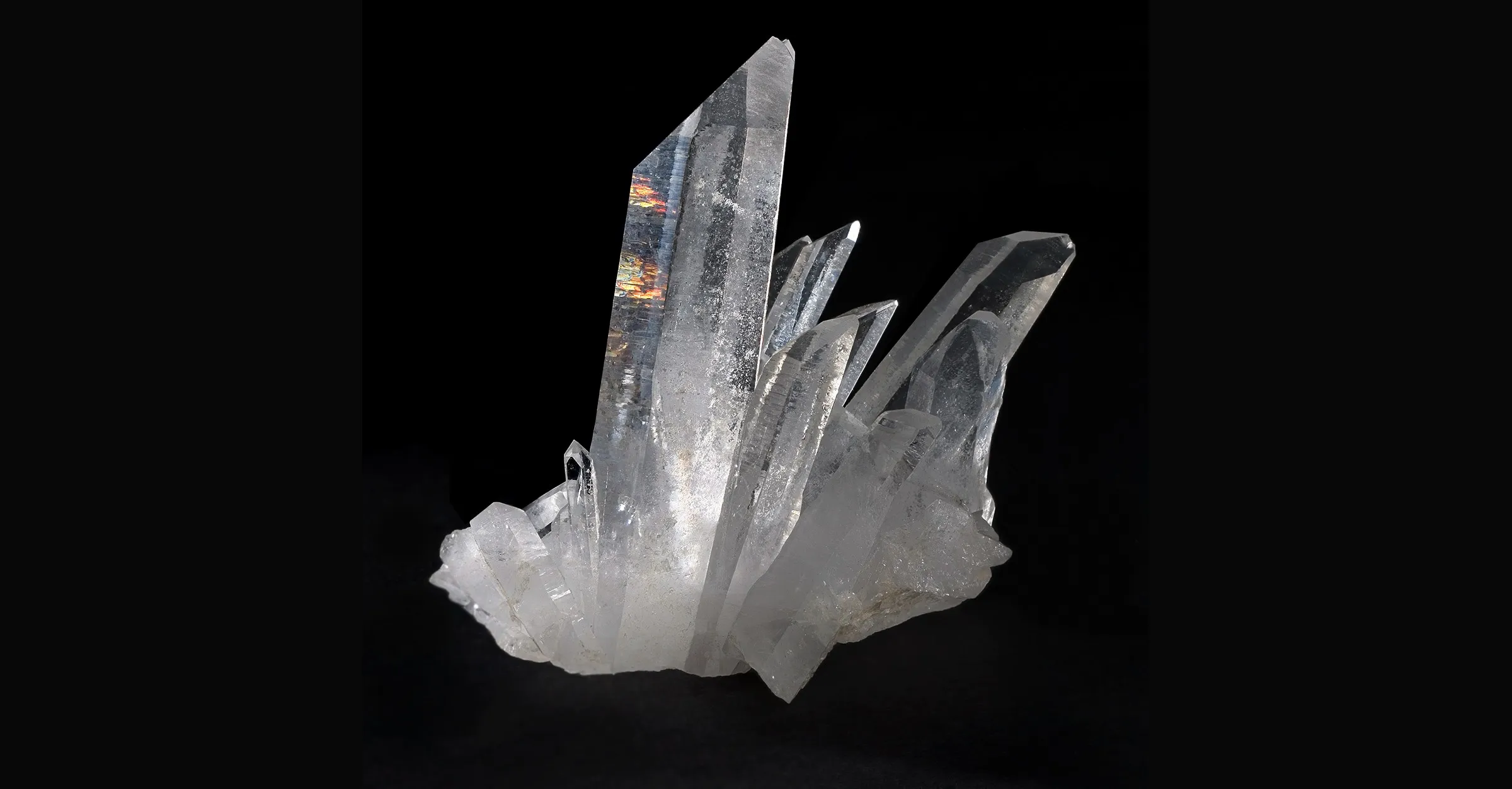
High-purity quartz (HPQ) is quartz processed to tightly control impurities for demanding applications, including silicon-growth crucibles and semiconductor quartzware. It is a silicon-dioxide material. Elemental silicon, the substance refined into wafer feedstock, is a different product.
The distinction becomes tangible inside a crystal-growing furnace. Silicon is the material being grown into a crystal; a silica-glass crucible contains the melt. Sibelco’s HPQ product description identifies crucibles for Czochralski single-crystal silicon growth as an application of its quartz sand. The container and its contents belong to related supply chains, but they do different jobs.
My assessment is that HPQ supply should be evaluated through the intended component and application. A mine discovery, a purified-sand specification and a usable crucible establish different capabilities. The industrial value lies in connecting them reliably.
A high-purity quartz figure needs an application
A named HPQ threshold must be read with its scope. In an April 2025 explanation, China’s Ministry of Natural Resources defined a newly recognised category of high-purity quartz ore as rock that, under the technical and economic conditions then prevailing, could be processed into sand containing at least 99.995% silicon dioxide. The category is a compound test rather than a single number:
- The rock must be processable into sand containing at least 99.995% silicon dioxide.
- Impurity content must meet the needs of the intended application.
- Inclusions must meet the same test.
- Particle size must meet it too.
The applications named are semiconductors, photovoltaics and optics.
That is a definition of an ore category based on what processing can produce. It does not say that the unprocessed rock already has that purity, or that the percentage alone establishes suitability for every customer. For procurement, I would retain the whole test: the processed material, its impurity and inclusion characteristics, its particle size and the intended application.
An inclusion is material trapped within a crystal, rather than simply dirt on its surface. In their December 2025 experimental study of quartz from Inner Mongolia, Shaoyiqing Qu and colleagues observed mineral and fluid inclusions in the samples. Some small inclusions remained visible after processing. The study illustrates why the form and location of contamination belong in an evaluation alongside the headline chemistry. Its results do not establish a supplier’s commercial qualification.
Quartz, silica glass and silicon
The most useful distinction is the transformation being purchased: a mineral, a refined raw material, a glass component or silicon feedstock.
| Material or product | Where it sits in the chain | What to distinguish |
|---|---|---|
| Natural quartz | Mineral raw material containing silicon dioxide | Deposit characteristics and the impurity-removal route |
| High-purity quartz sand | Processed feedstock for demanding quartz products | Impurity profile, inclusions and particle-size specification |
| Fused quartz or synthetic silica glass | Glass material formed into components | Raw-material route, forming process and end-use properties |
| High-purity silicon | Elemental silicon feedstock for crystal growth | A different chemical product from the silica container |
Heraeus Covantics’ production explanation distinguishes fused quartz made by melting natural silicon-dioxide minerals from synthetic fused silica produced from silicon-containing chemical precursors. Those names are useful when the manufacturing route is stated; a buyer should still check how a particular supplier uses them.
Our high-purity silicon guide follows the separate chain from silicon metal through chemical purification to wafer feedstock. This quartz guide focuses on materials used to make the crucibles and other quartz products that support downstream processing.
The crucible has more than a purity job
A quartz crucible must contain the silicon melt while maintaining the properties required by crystal growth. SUMCO’s JSQ division explains that a deformed crucible can touch the growing silicon crystal and interrupt pulling. Its account connects deformation to glass viscosity and surface condition. Shape retention is therefore part of the material’s function.
JSQ describes a layered design, and the two layers do different jobs:
| Layer | Material | Job |
|---|---|---|
| Inside, touching the melt | higher-purity synthetic silica | contamination control |
| Outside | natural silica, higher viscosity | shape retention Its manufacturing page describes placing the different powders into a mould before arc fusion. This is a manufacturer’s explanation of its crucibles, not a universal recipe for every semiconductor or photovoltaic product. |
The same manufacturing page describes an inner transparent layer with few bubbles and an outer bubble-containing layer for heat retention. Material origin and bubble structure are related design details, but they should not be collapsed into the word purity. JSQ also describes dimensional inspection, acid cleaning and cleanroom packaging as parts of production.
The layered example changes the substitution question. I would ask which material is replacing which layer, under which operating conditions. A higher-purity material can offer one benefit while differing in high-temperature behaviour. A claim that one sand or glass replaces another needs the component specification and relevant performance evidence beside it.
Applications beyond the crucible
HPQ also supplies material for semiconductor quartzware. Sibelco lists fused-quartz tubing and ingots that can be fabricated into quartzware used in semiconductor wafer processing. In this chain, the sand producer supplies a glass-making input; the finished component has undergone additional melting, shaping and fabrication.
Heraeus describes continuous electric fusion producing shapes such as rods, tubes and plates. Its synthetic-silica explanation also covers chemical-deposition routes used in optical-fibre production. These applications help explain the commercial interest in purified silica, but they do not make every quartz product interchangeable.
For an industrial reader, the immediate customer matters. A company buying sand for glass manufacture, a fabricator buying tubing and a wafer producer buying a crucible are evaluating different deliveries. My recommendation is to identify that transaction before comparing suppliers or calling a region self-sufficient.
Natural quartz needs a processing route
Purifying natural quartz combines mineral separation with treatment of the impurities present in a particular feedstock. Qu and colleagues’ Inner Mongolia study ran the sequence below:
- Calcination.
- Crushing and screening.
- Magnetic and gravity separation.
- Flotation.
- Acid leaching. These are the methods used in that investigation, not a processing prescription for every deposit.
The authors’ microscopy showed differences between the sampled materials and observed small inclusions remaining after treatment. Their experiments support a limited but useful conclusion: an ore’s response to processing must be examined, rather than inferred from its appearance or a regional label. Laboratory improvement is evidence of technical potential; I would require separate evidence for repeatable industrial output and customer use.
Heraeus makes a parallel point about the next manufacturing stage: fused-quartz purity depends on raw-material refinement and the production process. Geological selection, purification and glass manufacture should therefore be assessed as connected operations. None of those stages should disappear behind a single capacity announcement.
Supply geography includes processing clusters
Spruce Pine, North Carolina, is a major reference point in supplier descriptions of HPQ. Sibelco states that its IOTA products originate in ore bodies there. The Quartz Corp’s company history describes its development in Spruce Pine and Drag, Norway, including the opening of a chlorination plant in Drag in 2021. These disclosures show why the mineral source and the processing location can be separate parts of a supply map. They do not establish the route of every shipment.
Donghai county in Jiangsu, eastern China, illustrates a downstream processing cluster. A December 2024 Economic Daily report republished on the county government portal describes quartz enterprises, university collaborations and shared testing services. It discusses Jiangsu Pacific Quartz and the area’s development from raw-material processing into quartz products. I read the cluster’s value as a combination of processing experience, equipment and analytical support, rather than proof that every local company can supply every high-end application.
China’s April 2025 ministry explanation separately identifies exploration progress in Xinjiang, Henan and Anhui and reports pilot-scale purification work. Those are resource and technical-development statements. A processing cluster, a new deposit and a customer’s accepted product should remain distinct entries in an industrial map. A company’s factory address also does not establish where its ore originated.
Synthetic silica changes the alternatives
Synthetic silica provides another material route for demanding applications. Heraeus describes reacting silicon-containing precursors to form silicon dioxide, followed by deposition and glass formation. This differs from extracting and purifying natural quartz crystals, and the company describes very low metallic impurity content for the resulting synthetic material.
Synthetic material is already part of JSQ’s layered-crucible explanation. That is evidence of a specific use, not proof that synthetic silica can immediately replace all natural HPQ consumption. The natural outer layer in that design has a stated high-temperature role. Cost, manufacturing behaviour and application acceptance still need to be evaluated for the particular replacement.
The phrase synthetic quartz can also be ambiguous. This discussion concerns synthetic silica glass used in industrial components; it should not be read as a claim about every synthetic quartz crystal product. Ask for the material form and production route before comparing the alternatives.
Critical material, cyclical business
The other material guides on this site are collected under industrial materials. The wider map of what quartz is used for — bulk sand, fused glass, crystal and silicon metal — is in the quartz uses guide; this page stays on the crucible and quartzware end of that chain. Technical importance does not by itself establish a commercial shortage. On 30 June 2026, The Quartz Corp announced the indefinite closure of one quartz production facility on Altapass Highway in Spruce Pine, citing challenging high-purity quartz market conditions. It explicitly said its other US locations were unaffected.
The announcement concerns one company and one facility. It does not establish that all HPQ grades are oversupplied, or that Spruce Pine production as a whole has stopped. My reading is narrower: supply analysis has to consider the product, operating site and customer commitments, even when the underlying material is technically important.
For a supplier review, I would ask for evidence at the point where the claim becomes useful:
- Ore potential: what representative material was tested, and what processing produced the stated result?
- Sand specification: which impurities, inclusions and particle sizes are controlled, and how is consistency measured?
- Component performance: which crucible layer or quartzware application is intended, and what behaviour was demonstrated?
- Commercial supply: which facility supplies the product, and what evidence supports repeatable delivery and customer acceptance?
This is how a mineral explanation becomes an industrial decision. The next document worth requesting is the one that connects a supplier’s claim to the actual material or component being bought. A deposit announcement and a purity percentage are starting points for that work.
Methodology
This guide uses government explanations, an experimental mineralogical study and manufacturers’ descriptions of their own materials and processes. China’s ore definition is dated to April 2025; JSQ’s layered crucible is a specific manufacturer example. The regional reporting and operational announcement retain their dates and scope. No current global market-share ranking, reserve estimate, price forecast or universal substitution timetable is inferred. Experimental purification results are not treated as evidence of commercial customer qualification.
Sources
- Sibelco, high-purity quartz applications (company product description). https://www.sibelco.com/en/materials/high-purity-quartz
- Ministry of Natural Resources, high-purity quartz ore explanation, 10 April 2025 (CGS republication). https://www.cgs.gov.cn/zcjd/202504/t20250410_810061.html
- Qu et al., quartz purification and trace-element investigation, 16 December 2025 (experimental research). https://ejm.copernicus.org/articles/37/953/2025/
- SUMCO JSQ, quartz-crucible manufacturing (manufacturer process description). https://www.jsq.co.jp/en/about/quartz/index.htm
- SUMCO JSQ, crucible strength and material behaviour (manufacturer technology explanation). https://www.jsq.co.jp/en/about/technology/index.htm
- Heraeus Covantics, making fused quartz and fused silica (manufacturer explanation). https://www.heraeus-covantics.com/knowlegde-base/making-of-fused-silica
- The Quartz Corp, company history (company disclosure). https://www.thequartzcorp.com/articles/history
- Economic Daily, Donghai quartz cluster, 11 December 2024 (county-portal republication). http://www.jsdh.gov.cn/dhxzf/dhxw/content/2ee87e9c-5191-40f1-a651-23f060c5fc05.shtml
- The Quartz Corp, US restructuring, 30 June 2026 (company announcement). https://www.thequartzcorp.com/articles/restructuring-us