
By Robin WenReviewed
Tungsten Metal: Ten Kilograms, Not a Tonne
Tungsten concentrate and APT are quoted per metric ton unit of oxide, ten kilograms, and the licence tests are cumulative rather than one threshold.
On this page
Tungsten metal is quoted in units that do not survive comparison. Concentrate is priced per metric ton unit of tungsten trioxide, which is ten kilograms and not a tonne. Ammonium paratungstate is priced on the same unit. A mill’s price for powder is a different object from a bulletin’s price for concentrate, and neither can be set against the other without arithmetic.
There is no live tungsten price on this page. The USGS publishes one series for the commodity and it is not a metal price: the row is labelled concentrate, average in-warehouse Rotterdam, dollars per dry metric ton unit of tungsten trioxide, and the source agency is named in the footnote. The figures below come from that chapter, from the Chinese notices that reshaped the trade, or from a producer’s published data.
Tungsten is priced in ten-kilogram units
A metric ton unit is one per cent of a metric tonne, which is ten kilograms. Concentrate is sold on that unit and priced against the tungsten trioxide it contains, so a headline of $551 does not mean $551 a tonne. It means $55.10 per kilogram of contained oxide (Buffalo Tungsten, units of trade).
| Year | USGS assessment, $ per mtu | Per kilogram of WO3 | Per kilogram of tungsten, this page’s arithmetic |
|---|---|---|---|
| 2023 average | 258 | 25.80 | about 32.5 |
| 2024 average | 252 | 25.20 | about 31.8 |
| 2025 average | 380 | 38.00 | about 47.9 |
The third column is the second multiplied by 1.261, because tungsten trioxide is 79.30% tungsten by mass: 183.84 of 231.84. The USGS publishes only the first column.
Two things follow. The 2025 average is 51% above 2024, after three years in a band between $252 and $275. And the movement inside 2025 was larger than the annual averages show: Rotterdam 65% concentrate went from $266 to $551 per mtu during the year, and ammonium paratungstate from $331 to $675 (USGS, Mineral Commodity Summaries 2026: tungsten). The $551 figure is $69.50 per kilogram of tungsten by the conversion above. That is the number to hold beside any per-kilogram powder price.
Ammonium paratungstate is what changes hands
Very little of the element moves as tungsten metal. Ore is converted into a soluble salt, purified in solution and crystallised as ammonium paratungstate, a white crystalline salt with the formula (NH4)10W12O41·5H2O that carries at least 88.5% tungsten trioxide by weight (supplier specification, APT). It is one of several intermediates, alongside ammonium metatungstate and the yellow and blue oxides, and it is the one the events section of the USGS chapter prices alongside concentrate.
The salt exists because a concentrate does not dissolve cleanly. Converting to a tungstate solution lets a refiner separate tungsten from the molybdenum and arsenic that sit beside it, and crystallising the solution produces a solid that can be assayed, shipped and sold before anyone decides whether it becomes a cutting tool or a welding electrode. APT is that decision deferred.
The American position is best described in converters rather than mines. The USGS counts seven companies able to take concentrate, APT, oxide or scrap and turn out metal powder, carbide powder or tungsten chemicals. No company has mined tungsten commercially in the United States since 2015, and the agency lists no reserve figure for the country.
The tariff schedule reads as a list of physical forms, and the rates differ by form:
| Form | Tariff code | Normal trade relations rate, 31 December 2025 |
|---|---|---|
| Ores | 2611.00.3000 | free |
| Concentrates | 2611.00.6000 | 37.5 cents a kilogram on tungsten content |
| Tungsten oxides | 2825.90.3000 | 5.5% |
| Ammonium tungstates | 2841.80.0010 | 5.5% |
| Tungsten carbides | 2849.90.3000 | 5.5% |
| Ferrotungsten and ferrosilicon tungsten | 7202.80.0000 | 5.6% |
| Tungsten powders | 8101.10.0000 | 7% |
| Waste and scrap | 8101.97.0000 | 2.8% |
Eight rates for one element, and a buyer can tell which line the material sits on before asking what it costs.
The licence is a list of conditions that must all hold
China’s export controls on the metal, published on 4 February 2025, do not work like a single threshold. The antimony list attached a purity threshold to one product, controlling the oxide at 99.99% and above while leaving ore and metal unconditioned, and wrote separate thresholds for organics, hydrides and indium antimonide. Gallium and germanium were listed item by item, with no purity condition at all. The February notice is organised differently again. Its tungsten section runs to four subsections, and only two of them attach conditions to a material.
The first subsection names three materials, ammonium paratungstate, the oxide and the carbide, and controls them with no condition on composition or shape.
The second subsection covers solid tungsten. It catches material that is not particles or powder, that matches one of the notice’s three lettered composition entries, and that can also be machined into one of three shapes. The first of those entries covers unalloyed tungsten not under another entry, and tungsten alloy of at least 97% tungsten by weight; the second, tungsten-copper alloys of at least 80% tungsten; the third, tungsten-silver alloys of at least 80% tungsten with at least 2% silver. The shapes are a cylinder of at least 120 mm diameter and 50 mm length, a tube with at least 65 mm bore and 25 mm wall and 50 mm length, or a block of at least 120 by 120 by 50 mm (Announcement No. 10 of 2025).
The consolidated list’s version of the same entry also carries a purpose clause that the February announcement does not repeat, which is the subject of a document note on 1C117.c.
There is a wrinkle worth knowing before quoting any of this to a customer. The consolidated list in force since December 2024 carries the same item with a purpose clause attached: solid tungsten for use in the manufacture of missile components (consolidated dual-use list). The February 2025 announcement reproduces the characteristics and the dimensions word for word, drops that purpose clause, and adds customs reference codes; it closes by saying the consolidated list is updated in step, without saying which text governs a shipment already under way. The difference is not a lawyer’s ornament: one version is limited on its face to missile components, the other is not. The same announcement keeps that purpose clause for the molybdenum powder it controls in the same breath, which is some evidence that dropping it for tungsten was a choice rather than an oversight.
Powder falls between the first two subsections, and the solid item says so: particles and powder are excluded from the solid-tungsten entry. That does not make powder uncontrolled. The item refers to tungsten not covered by other entries, and whether a given powder falls under a different entry is a question the notice does not answer.
The third subsection covers nickel-iron and nickel-copper alloys, and carries the same cumulative structure, with four numeric conditions that must all hold: density above 17.5 g/cm3, elastic limit above 800 MPa, tensile strength above 1270 MPa and elongation above 8% (Announcement No. 10 of 2025, item 1C004).
The fourth subsection is not a material at all. It controls the technology and the data for producing the other three, down to process specifications, process parameters and processing programs, which means that handing over a production recipe is a separate controlled act from shipping the goods.
For a buyer, the practical question is therefore not what the assay says. It is which entry the material matches and which of that entry’s conditions are met, with the purpose clause as a separate matter to settle in writing. The antimony page covers the regime where a purity number decides for the oxide, and the gallium and germanium pages cover the item-by-item one.
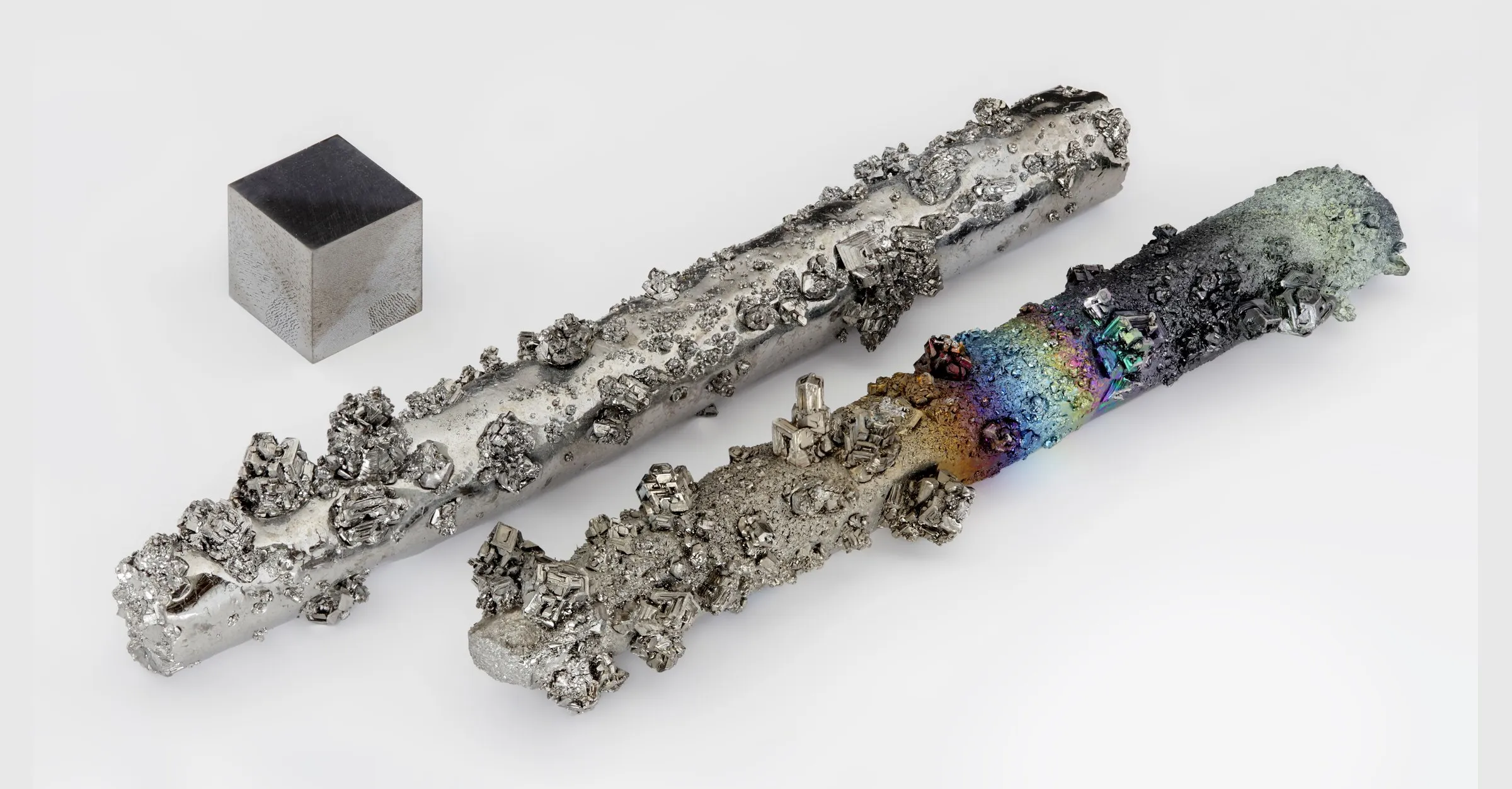
Tungsten metal is pressed, not poured
Tungsten melts at about 3,420 °C, the highest melting point of any metal, and nothing about that number is usable in a foundry (Plansee, tungsten). The metal is made the other way round: the salt is converted to oxide, the oxide is reduced with hydrogen to powder, and the powder is pressed and sintered below the melting point. The reduction of ammonium paratungstate in hydrogen has been studied on its own terms, with attention to the intermediate oxides that form along the way (tungsten powder by hydrogen reduction).
Two consequences for anyone specifying tungsten metal. The certificate a powder buyer receives describes particle size, oxygen content and apparent density, and those describe the powder rather than the deposit it came from. And density, grain size and porosity belong to pressing and sintering: the same starting powder can be made into materials that machine differently and wear differently.
Carbide is a different industry
About 60% of tungsten consumed in the United States is used in cemented carbide for cutting and wear parts, in construction, metalworking, mining and oil and gas drilling. The rest is used in alloys and specialty steels, in electrodes, filaments and wire, and in chemicals (USGS, tungsten).
A carbide purchase is specified by the carbide grain size and the cobalt content, not by the purity of the tungsten metal that went into it, because the buyer is not buying metal. Carbide powder is pressed with cobalt as the binder and sintered, and the grain size sets hardness against toughness.
The substitution story runs on both cost and performance. The USGS lists molybdenum carbide, niobium carbide and titanium carbide, ceramics and cermets, and tool steels as substitutes for cemented carbide, and notes that most of them reduce rather than replace the quantity used, at some cost or some loss of performance. Density drives a different set of end uses: the USGS names applications that need high density or radiation shielding, where tungsten alloys compete with lead and depleted uranium.
Where the tonnage comes from
World mine production was 85,000 tonnes of tungsten content in 2025, up from 82,000 tonnes in 2024 (USGS, tungsten). China produced 67,000 tonnes, about 79% of the total. Vietnam produced 3,000 tonnes, Kazakhstan 2,400 as the Boguty deposit started, North Korea 2,000, Russia 2,000, Bolivia 1,700, Rwanda 1,300, Australia 1,000, Austria 840, Spain 800 and Portugal 700.
Reserves concentrate the same way: China holds 2,500,000 tonnes of a world total above 4,700,000 tonnes. American imports in 2025 were about 1,700 tonnes of ore and concentrate and 10,000 tonnes in other forms, against net import reliance of more than 50%. Over 2021 to 2024 the largest single origin was China at 26%, then Germany at 14%, Bolivia and Vietnam at 8% each.
Outside China the picture is a set of restarts. Kazakhstan’s Boguty deposit went from nothing to 2,400 tonnes in one year, Russia’s 2024 figure was revised on a government report, and its 2025 estimate is 2,000 tonnes. In Canada and the United States several projects received awards under Title III of the Defense Production Act, including projects in Nevada, New Brunswick and Yukon, and in October a Kazakh-American joint venture was announced to develop tungsten resources.
The 2025 price move had two documented causes. The United States raised tariffs on several Chinese tungsten products to 50% at the end of 2024 under section 301(b), and China’s February 2025 controls followed. The USGS reports both, then reports the price rise, without separating the two.
Six questions a tungsten certificate does not answer
None of these is settled by the assay figure at the top of the certificate. Each one changes what the document means.
- Is this figure per tonne or per metric ton unit? The difference is a factor of a hundred, and the concentrate and APT series are quoted on the unit.
- Is the basis the oxide or the metal? Tungsten trioxide carries 79.30% tungsten by mass, so a price per kilogram of oxide is not a price per kilogram of metal.
- Which form is on the invoice: ore, concentrate, APT, oxide, carbide, powder or machinable solid? The tariff and the licence list both turn on that answer.
- If it is a solid, which composition entry and which shape? The item is a list of characteristics that must all be satisfied, so a single missing one takes the material out of it.
- For powder, what are the particle size, the oxygen content and the reduction route? Those decide what pressing and sintering can produce.
- For carbide, what are the grain size and the cobalt content? Purity of the input metal is not the purchase specification at that point in the chain.
One question belongs to the quotation rather than the material: which month it comes from, and where in the policy sequence. Concentrate ran from $266 to $551 per mtu inside 2025, so a figure carried across the year describes a different market.
Methodology
Production, trade, price, tariff, reserve and stockpile data come from the USGS 2026 mineral commodity summary for tungsten (February 2026), which reports 2025 as an estimate and attributes its concentrate assessment to Rotterdam in-warehouse. The per-kilogram conversions use a 10 kg metric ton unit and a tungsten fraction of 79.30% in tungsten trioxide, and are this page’s arithmetic from that series. The controlled items are read from the Chinese announcement of 4 February 2025 and from the consolidated list in force since 1 December 2024, both in the original. APT composition is a supplier specification; the melting point and the reduction route are the producer’s and the literature’s, cited where used. Nothing here is a live quotation.
Sources
U.S. Geological Survey, Mineral Commodity Summaries 2026, chapter on tungsten (February 2026). https://pubs.usgs.gov/periodicals/mcs2026/mcs2026-tungsten.pdf
商务部、海关总署公告 2025 年第 10 号(对钨、碲、铋、钼、铟相关物项实施出口管制),2025-02-04。 https://www.mofcom.gov.cn/zwgk/zcfb/art/2025/art_e623090907fc4e1092f0a4db72f57b95.html
商务部、工业和信息化部、海关总署、国家密码局公告 2024 年第 51 号(《两用物项出口管制清单》,2024-12-01 施行)之 1C117.c。 https://www.mofcom.gov.cn/zcfb/dwmygl/art/2024/art_e56833e346534981b250bae772d0cbce.html
Buffalo Tungsten, “Units of Trade”(metric ton unit = 10 kg)。 https://buffalotungsten.com/news/
Advanced Materials, Ammonium Para Tungstate specification, WO3 > 88.5%。 http://www.advancedmaterials.us/74C-APT-01.htm
Plansee, tungsten material data (melting point 3,420 °C)。 https://www.plansee.com/en/materials/tungsten.html
“Study of the formation of tungsten powder by hydrogen reduction of ammonium paratungstate”, Materials Research Express, 2020。 https://doi.org/10.1088/2053-1591/ab6763