
By Robin WenReviewed
High-Purity Gallium: 4N and 7N Are Two Trades
Gallium is made twice, in two different industries. China controls the first stage; the second stage decides what a wafer can be grown from.
On this page
Gallium has no mine. High-purity gallium begins as a trace element in bauxite, at an average concentration of about 50 parts per million, and it is recovered because an alumina refinery is already handling the liquor it dissolves in. The US Geological Survey puts world resources of gallium in bauxite above one million tons, which is a large number attached to a metal that nobody prospects for (USGS, Mineral Commodity Summaries 2026).
That single fact arranges everything else in this market. Gallium output is not limited by ore bodies. It is limited by how much alumina the world refines, and by whether the refineries running that alumina bother to switch on the recovery circuit. In 2024 the world produced 848 tons of primary low-purity gallium; the estimate for 2025 is 900 tons, against an estimated capacity of 1,700 tons. My reading of that gap is that idle capacity, not geology, is what a buyer is actually exposed to.
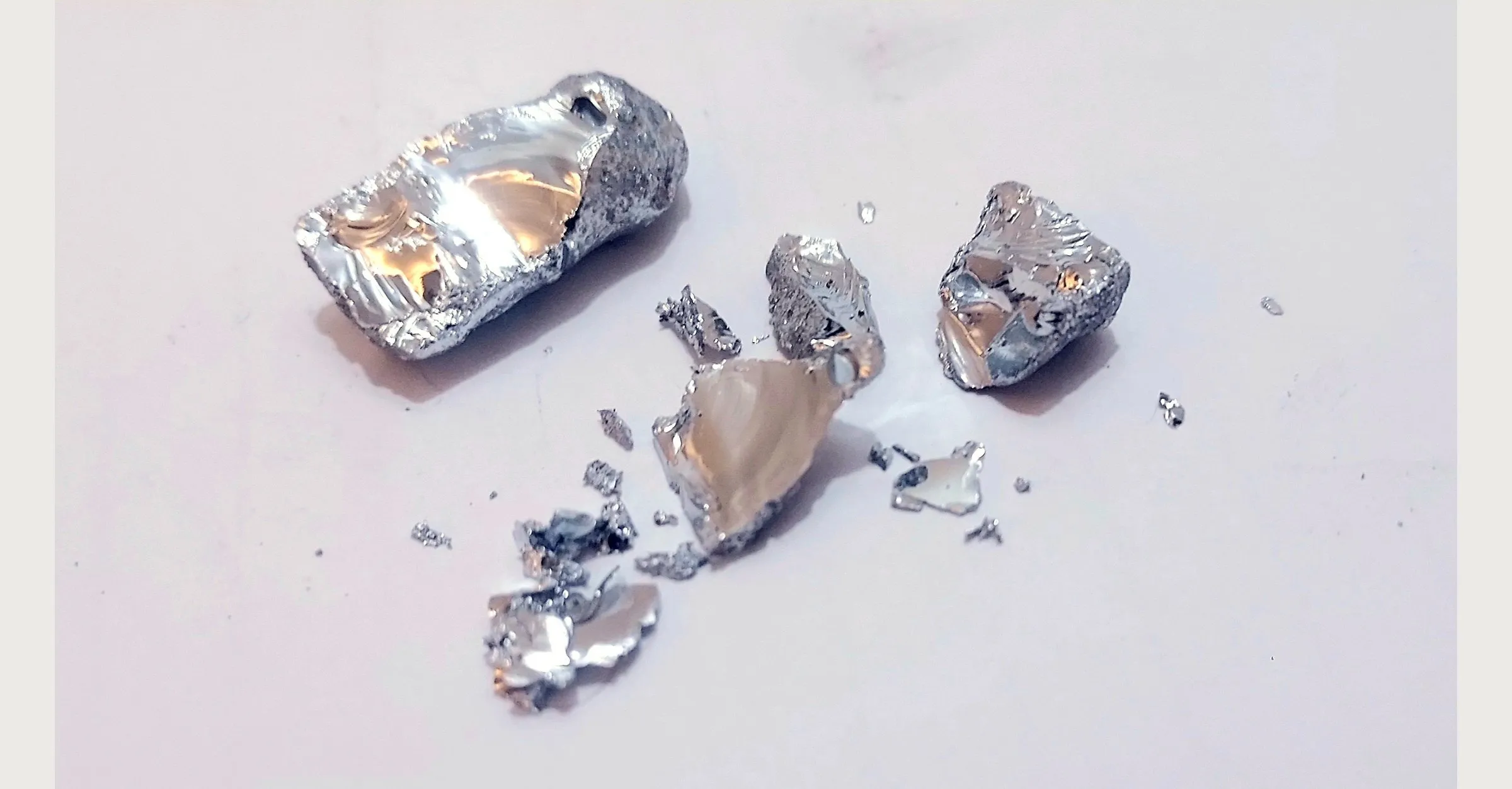
Gallium metal is mostly a by-product of alumina refining
The United States has not recovered primary gallium metal since 1987 and reports 100% net import reliance. Reported consumption was about 19 tons in 2025, a rounding error next to world output and a reminder that consumption statistics measure the last user, not the material’s importance.
Most of the world’s primary gallium comes out of the Bayer circuit used to refine bauxite into alumina, with a smaller share from zinc-processing residues. What remains outside China is thin, and the record is mostly one of exits:
| Country | Status | Date, or 2024 output |
|---|---|---|
| Germany | stopped primary production | 2016 |
| Hungary | stopped primary production | 2015 |
| Kazakhstan | stopped primary production | 2013 |
| Ukraine | most likely stopped | 2022 |
| Russia | producing | 6 tons |
| Japan | producing | 3 tons |
Every entry in that table is a USGS estimate or record (USGS 2026).
China accounts for 99% of primary low-purity production on that measure. The figure describes primary low-purity output and nothing else: it carries no information about refined material, recycling or stockpiles.
Where the four nines come from
Gallium metal leaving a Bayer circuit is not yet a product anyone buys. The gallium has to be taken out of the circulating liquor and refined before it is sold. A 2024 review of the refining literature states the reason plainly: gallium extracted from Bayer liquor carries a high impurity load, and ultra-purification cannot be accomplished in a single step (Ghosh and Mani, Crystal Research and Technology, 2024). The trade counts purity in nines, and each additional nine removes another factor of ten in impurity:
| Grade | Purity |
|---|---|
| 4N | 99.99% |
| 5N | 99.999% |
| 6N | 99.9999% |
| 7N | 99.99999% |
The volume is small enough to be counted in hundreds of tons and large enough to matter to a defence programme.
What matters for anyone specifying high-purity gallium is that 4N is a floor and not a destination. Gallium nitride and gallium arsenide growth take high-purity gallium at 6N and 7N, which a 2024 review in Crystal Research and Technology describes as “a highly demanding material needed for the growth of gallium-based group III-V semiconductor compounds and optoelectronic devices” (Ghosh and Mani, 2024). The gap between 4N and 7N is three orders of magnitude in impurity content: 100 parts per million against 0.1. The certificate changes character at that point. At 4N, a certificate is a commercial document. At 7N, it is a measurement of a specific element list by a specific method, and a buyer who does not know the method has bought a number.
Four nines buys a commodity; seven buys a charge
The American consumption split shows why both markets can be described with one word. Integrated circuits took 73% of reported US gallium consumption in 2025 and optoelectronic devices 26%, with gallium arsenide producing compound semiconductor wafers for ICs and for optoelectronic devices such as laser diodes, LEDs, photodetectors and solar cells, and gallium nitride serving both ICs and optoelectronics (USGS 2026).
Follow the material into a crystal-growth furnace and the specification changes from purity to compatibility. A charge has to melt cleanly, sit in a crucible without reacting, and deliver a doping-relevant impurity profile. The crucible end of that problem is its own supply chain, which is why high-purity quartz shows up in a gallium discussion at all, and why the substrate question leads back to high-purity alumina and sapphire for the LED-era route. Compound substrates remain a separate business from the silicon wafers used in logic, which is why high-purity silicon is treated as its own guide. The metal is one input among several, and it is the input that gets quoted by weight.
Refining is a second industry
The step that takes 4N to 7N is metallurgical, not chemical. Zone refining passes a molten band along an ingot and lets impurities segregate into the liquid; repeated passes push them to one end. A 2025 review in ACS Omega records the benchmark: fifty passes on 5N2 gallium, with mechanical stirring during directional solidification, produced 7N2 material at 99.999992%, with total impurities across 24 elements reduced to 77.7 parts per billion by glow-discharge mass spectrometry (Zhao et al., ACS Omega, 2025).
Two limits are worth carrying into a purchase conversation. Zone refining is not suitable for impurities whose distribution coefficient is close to one (Zhao et al., 2025), and Ghosh and Mani state that ultra-purification “cannot be accomplished by a single step” (Ghosh and Mani, 2024). And the process is a service with yields: the ingot’s middle is the product, the tail is where the impurities went, and that tail is scrap that has to be sold or reworked.
In theory, high-purity metals up to 8N can be obtained (Zhao et al., 2025). That figure is a theoretical ceiling. The industrial question is narrower: which refiner can hold 6N or 7N across a production run, and what method will they let you use to confirm it.
Price is three numbers wearing one word
Three figures circulate as “the gallium price”, and they are not the same measurement:
| Figure | What it measures | Level |
|---|---|---|
| US import customs value, metal | annual average of what entered the country | $580/kg in 2025, $439 in 2024, $277 in 2021 |
| Spot assessment outside China | a single dated transaction market | $1,850/kg in April 2026 |
| Inside-China price | the domestic market, which held steady | not disclosed here |
The average customs value of US imports of gallium metal was $580 per kilogram in 2025 on USGS estimates, up from $439 in 2024 and $277 in 2021 (USGS 2026, citing US Census Bureau data for tariff code 8112.92.1000). That is an annual average of the metal that entered the United States.
Outside China, the spot assessment reached a record $1,850 per kilogram in April 2026, more than 200% above the start of 2025, while prices inside China held steady; CSIS calls the result a bifurcated market (CSIS, 11 May 2026, citing Fastmarkets).
Those three numbers describe different things and should not be placed on one chart as if they were a sequence. What they do establish is a market cleared less by grade than by destination. Chinese exports of unwrought gallium fell 94% in 2025 from 2024 levels, and the US import mix shifted accordingly: China’s share of US unwrought gallium imports dropped below 5% in 2025 from about 38% in 2022, with the remainder coming primarily from Germany, Japan, Taiwan, South Korea and Slovakia. CSIS describes those suppliers as recyclers rather than primary producers, while USGS still credits Japan with 3 tons of primary output in 2024 (CSIS 2026).
Impurities, and what a gas-mass report proves
A purity figure is a subtraction. It says nothing about which elements remain, and the remaining ones are what a device sees. Glow-discharge mass spectrometry answers the better question, element by element, and it is the reason the 77.7 ppb figure above is more useful than “7N” on its own.
That document now has a second life as a regulatory one. China’s 2023 export licensing regime, introduced in Ministry of Commerce and Customs Notice No. 23 and in force since 1 August 2023, covers gallium metal and a list of compounds including gallium nitride, gallium oxide, gallium phosphide, gallium arsenide, indium gallium arsenide, gallium selenide and gallium antimonide, in forms that include wafers, powders, scrap and epitaxial wafers (MOFCOM/Customs Notice No. 23). An applicant must submit a technical description or test report, plus end-user and end-use certification. The certificate has become part of the export file. Notice No. 23 no longer stands on its own: it was repealed on 1 December 2024, and the same gallium items were reissued as entry 3C001 of China’s consolidated dual-use list, one of eleven announcements repealed that day (which eleven) (Announcement No. 51 of 2024).
The list is also a warning against reading “gallium” as a single item. A purchase order for substrates sits inside the same regime as an order for metal, and the licensing question follows the material downstream.
Recycling postpones the dependency
Recycling is real and it is small in a specific way. USGS records no old-scrap recovery in the United States and describes substantial quantities of new scrap from gallium-arsenide device manufacturing being reprocessed to high-purity gallium at one facility in New York. Neo Performance Materials, the main North American supplier, has said its business growth is restrained by limited gallium scrap supply (CSIS 2026, quoting the company’s results).
My reading, and it is an inference rather than a published finding: gallium scrap is not household waste, it is manufacturing offcut, and manufacturing offcut is generated where the devices are made. A recycler in Germany or Japan converts the same material stream that a Chinese refinery started. Recycling shortens the distance between the mine and the fab. Secondary recovery still depends on a primary circuit having produced the scrap in the first place.
Specifying high-purity gallium you can verify
For a buyer, the practical content of all this fits on one page of a purchase order.
Specify the grade together with the analytical method, and ask for the element list rather than the total. Ask which circuit the metal came from: bauxite liquor, zinc residues or recycled scrap. And confirm that the end-use paperwork the exporter must file matches what your process actually does, because a mismatch surfaces at the border rather than at goods-in.
One more item belongs on the list, and it is the one that changes with the calendar. On 3 December 2024, China’s Ministry of Commerce issued Notice No. 46, which prohibited exports of dual-use items to US military users or for military end use and stated that licences for gallium, germanium, antimony and superhard materials destined for the United States would in principle not be granted (MOFCOM Notice No. 46). On 9 November 2025, Notice No. 72 suspended the second paragraph of that document until 27 November 2026 (what that suspension does not change; MOFCOM Notice No. 72).
The suspension covers that paragraph and nothing else. The first paragraph, on military end use, was not suspended, and the licensing requirement itself is untouched; what has changed is the instrument behind it, since the 2023 announcement was repealed in favour of entry 3C001. With the suspension expiring at the end of November 2026, any contract written today that assumes a stable licensing environment is underwriting a policy decision the buyer does not make. That is the ordinary condition of buying a by-product whose output is decided inside someone else’s refinery.
Methodology
The production, capacity, consumption, import-value and scrap figures come from the USGS Mineral Commodity Summaries 2026 entry for gallium, which reports 2025 estimates; the underlying import values are US Census Bureau data. The policy dates and wording come from the four Chinese ministry notices cited above, read in the original. Price behaviour outside China, export volumes and the US import mix come from CSIS commentary published on 11 May 2026, which cites Fastmarkets assessments and Chinese customs data; I used those data citations and did not adopt the article’s four hypotheses about Beijing’s motives, which are offered there as speculation and cannot be checked from outside.
Two gaps remain. There is no public series for Chinese domestic gallium prices that I could obtain, so the level of the internal market is described rather than quantified. And no public data shows what share of Chinese alumina refineries run a gallium recovery circuit at any given time, which is the variable that would convert the capacity figure into a supply forecast. The 77.7 ppb result is a laboratory benchmark from a single published study, not a statement about production averages.
Sources
- US Geological Survey, Mineral Commodity Summaries 2026: Gallium, 2026. https://pubs.usgs.gov/periodicals/mcs2026/mcs2026-gallium.pdf
- Ministry of Commerce and General Administration of Customs, Notice No. 23 of 2023 on export controls on gallium- and germanium-related items, 3 July 2023, effective 1 August 2023. https://www.mofcom.gov.cn/zcfb/dwmygl/art/2023/art_52b9a321087f402bb3d310d18b07967e.html
- Ministry of Commerce, Ministry of Industry and Information Technology, General Administration of Customs and State Cryptography Administration, Announcement No. 51 of 2024 publishing the consolidated dual-use export control list, in force 1 December 2024; annex 2 lists the eleven announcements repealed the same day, Notice No. 23 among them. https://www.mofcom.gov.cn/zcfb/dwmygl/art/2024/art_e56833e346534981b250bae772d0cbce.html
- Ministry of Commerce, Notice No. 46 of 2024 on strengthening export controls on certain dual-use items destined for the United States, 3 December 2024. https://www.mofcom.gov.cn/zwgk/zcfb/art/2024/art_3d5e990b43424e60828030f58a547b60.html
- Ministry of Commerce, Notice No. 72 of 2025 adjusting the implementation of Notice No. 46 of 2024, 9 November 2025. https://www.mofcom.gov.cn/zwgk/zcfb/art/2025/art_5c68985a6b1a46778e2e8dbff1bb1601.html
- P. Zhao, J. Qiu, H. Liang, Y. Jiang, F. Huang, N. Wang and Y. Zhu, “Latest Research Progress in High-Purity Material Purification Technology”, ACS Omega 10(33): 36804-36823, 26 August 2025. https://doi.org/10.1021/acsomega.5c03602
- S. Ghosh and K. Mani, “A Review on the Zone Refining Process Technology toward Ultra-Purification of Gallium for GaAs/GaN-based Optoelectronic Device Applications”, Crystal Research and Technology, 17 June 2024. https://doi.org/10.1002/crat.202300347
- A. Powers-Riggs, B. Hart and M. P. Funaiole, “The U.S.-China Trade Truce Has Not Solved the Gallium Problem”, CSIS Commentary, 11 May 2026. https://www.csis.org/analysis/us-china-trade-truce-has-not-solved-gallium-problem