· Robin Wen · Industry & Manufacturing · 15 min read
EnerVenue's First Factory Was Built to Be Copied
EnerVenue chose Changzhou over Kentucky because a new cell needs machines and suppliers that do not yet exist. It plans to copy the result.
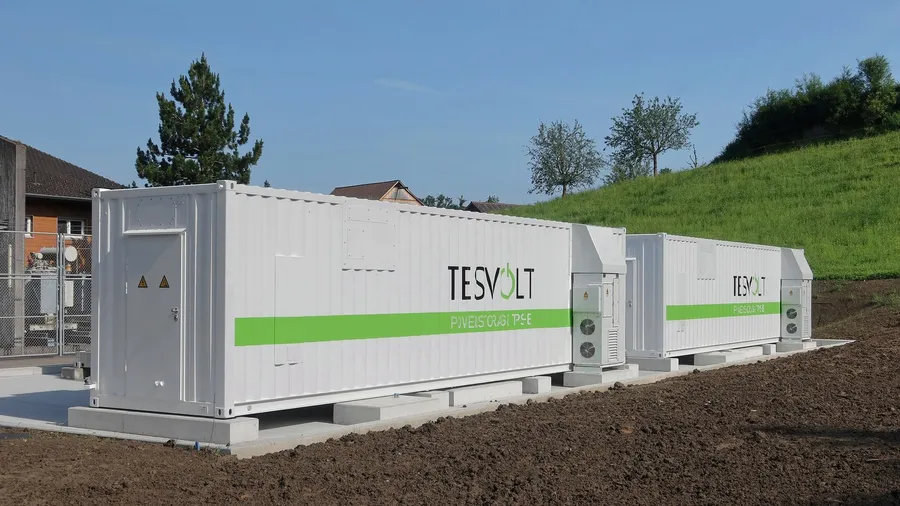
Photo: Grid-scale battery storage, Tesvolt TPS-E, Rheineck, Switzerland · Kecko · CC BY 2.0 · Wikimedia Commons · cropped to 1.91:1
On 24 September EnerVenue started production at a battery factory in Changzhou, in eastern China. In its own account the plant is the first high-volume manufacturing line built anywhere for its cell, a water-based nickel-hydrogen battery the company calls the aqueous metal cell. Ground was broken in April; the first conforming cell came off the line at the end of September. Phase one is rated at 250 megawatt-hours a year, rising to 1 gigawatt-hour in 2027, with about 300 cells a day once the line reaches full speed in November.
Two days earlier, Reuters reported that the same company had given up on Kentucky. EnerVenue announced a plant there in 2023: $264 million for a first phase and 450 jobs. It abandoned the project a year later. Henning Rath, who became chief executive in April, told Reuters the decision to manufacture in China instead of the United States came down to skills and supply-chain depth, “particularly in Changzhou,” which bills itself as China’s new energy capital. “The secret sauce is this industrial cluster,” he said, citing the density of hydraulics, pneumatics and automation specialists, and engineers able to iterate quickly on what he called a “first-of-its-kind” line.
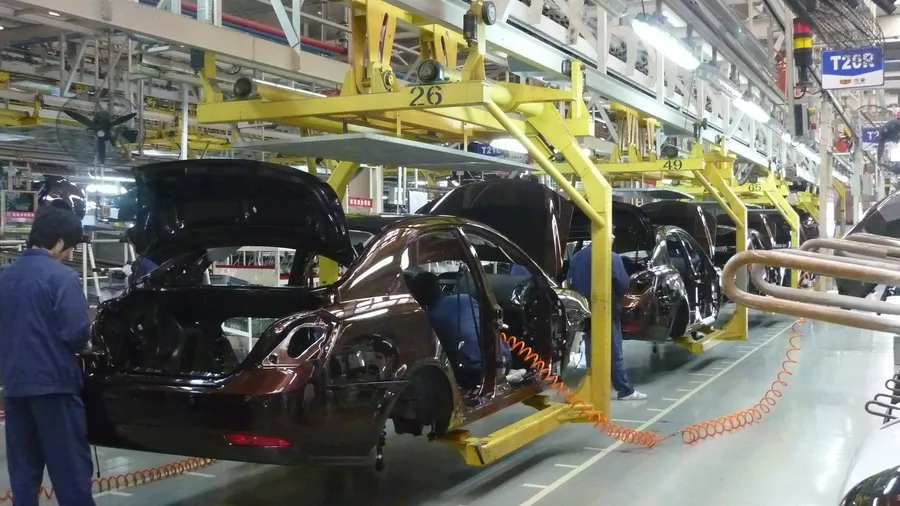
The Changzhou plant is about 95 per cent automated, the company’s estimate, and will employ roughly 400 people by the end of the year. Those two numbers sit next to a third: the plant cost between $20 million and $50 million, a range Rath gave Reuters while declining to disclose the figure. The most automated factory in this story is also the one whose location turned on the price and availability of engineering labour. Read together, the three numbers describe a mechanism, which is worth unpacking.
A line that had to be invented before it could be bought
In the company’s account, nobody sells the machines that make this cell, and every machine on the Changzhou line was designed for the first time: a stacking machine that assembles the electrode stack under a vision system that learns from what it sees; a winding process that wraps each cell in fibreglass with the tension controlled from the inside out; automated guided vehicles that move cells between stations, so that a cell crosses the floor without being handled. Each cell passes 41 quality checks at 11 test and measure stations before it leaves the building, for weld integrity, leak tightness and performance. Every machine was engineered and validated on EnerVenue’s research line six kilometres away, before it was committed to the production floor. The plant occupies about 20,000 square metres, with room in the same building for a second phase of the same size.
Read that as a description of the work rather than of a building, and the shape of the problem changes. A company that has to build its own tooling is running a development programme with a factory attached, and hiring people to operate machines is the easy part. The task is to find people who can change a machine that turns out to be slightly wrong, and to do that repeatedly, on a floor where every station is new. Adding automation to a first-of-its-kind process does not reduce that dependence. It increases it.
The company’s head of production, TJ Hua, put the same point in one line in the launch release: “Anyone can make one good vessel. The job is making the ten-thousandth one exactly the same.”
What the floor manager added
A floor manager at the plant told Reuters two details about how the line was actually supplied. Local suppliers often develop equipment without payment until a design is adopted, he said, unlike foreign vendors, which tend to ask for money upfront. And graduate engineers earn about 12,000 yuan a month, or roughly $1,800, well below US salaries.
These are the details that explain the automation ratio. A supplier that builds before it is paid is lending the customer its engineering time and its working capital against a design that may not be adopted. That is a form of financing, and it is the kind a startup proving an unproven process needs most; who extends that credit, and on what terms, is the same question that shapes payment terms across Chinese industry. An engineer at $1,800 a month makes the iteration loop cheap enough to run many times a week. Together, the two facts describe a cost structure: not the cost of hands on the line, which the robots have taken, but the cost of the people and firms that make the line work.
That distinction matters, because on this line automation and labour cost are not rivals. The robots and the engineers who adjust them are bought from the same market. EnerVenue’s chief executive attributes the location to skills and supply-chain depth, and the floor manager’s two details show what those words mean in practice: engineering labour that is inexpensive, and suppliers who absorb development risk. China’s manufacturing robot density reached 567 units per 10,000 employees in the International Federation of Robotics’ World Robotics 2025 report, third worldwide behind South Korea and Singapore, and Chinese factories installed 354,000 industrial robots in 2025, or 59 per cent of the global total. Routine assembly has not been the basis of the country’s manufacturing cost structure for years. The live question is who pays for the learning curve.
Kentucky, and the money it would have taken
Kentucky was not abandoned because a rule changed. In Reuters’ account, Rath called the attempted project “a valuable learning experience,” but the technology was not yet ready, and the company went on to redesign both the battery and the factory. His explanation of why it could not be proved at home is the sentence to keep: without building in China, it would be “very difficult with the capital available” to prove the manufacturing process at a commercial scale.
The object of that sentence is proving the process rather than making cells. Proving a process is a development cost, and it is the same subject as the suppliers who build before they are paid. A young company with a chemistry nobody else makes has to fund its own learning curve. In Kentucky it would have had to do that around a $264 million first phase and a site built for a design that was still changing. In Changzhou it built a line costing $20 million to $50 million, on a floor whose machines could be validated six kilometres away on an existing research line, and it took an order for 11 megawatt-hours of product while the line was still ramping.
Government support was limited to permitting, certification and site selection, Rath told Reuters. Policy now pulls in both directions and neither is settled. It is unclear whether cells made in China will qualify for US clean energy tax credits; the 2025 tax law kept the credits for storage while adding restrictions on Chinese content and ownership. China, meanwhile, is trimming its own end of the industry. In September, Reuters reported, citing the financial news outlet Cailianshe, that approvals for new energy-storage battery factories had been suspended temporarily while authorities review existing and planned capacity, with projects that have not broken ground held up and those already under construction unaffected. The policy could be adjusted. The cluster is not a policy-free zone, and both governments are still deciding how much of it they want to shape.
The sizes, and what they measure
The numbers that circulate around this plant measure different things, and the differences are the point.
| Figure | What it measures | Source |
|---|---|---|
| About 95% automated | The company’s estimate of how much of the process runs without people, reported by Reuters | Reuters |
| About 160 battery companies | Firms active in the city of Changzhou. A 50–100 km radius is described separately by the company as one of the most complete battery supply chains in the world | EnerVenue |
| $83/kWh | The cost of the battery based on active materials, in a 2018 paper whose authors replaced a platinum catalyst with a nickel-molybdenum-cobalt alloy. Not a cell or system price | PNAS |
| 30,000 cycles, 30 years | Design targets for the fourth-generation cell. No field record at scale yet | EnerVenue |
| 250 MWh a year | Nameplate capacity of phase one: potential output, not contracted sales | EnerVenue; Environment+Energy Leader |
Two rows carry most of the weight. The $83 figure is the one most likely to be read as a price, and it is not: it is an active-materials estimate from 2018, in a paper about a laboratory cell, and the product EnerVenue sells is a 30-year containerised asset whose price it does not publish. The 250 MWh row is where a reader should slow down. Environment+Energy Leader noted that the figure represents potential production rather than confirmed output or contracted sales. The company’s first multi-megawatt-hour commercial order, announced a day before the launch, was for 26 containerised units totalling 11 megawatt-hours at an oilfield in northern China, with three units shipping in December 2026 and the remaining 23 in March 2027.
None of that makes the claim wrong. It sets its size. The market the company is aiming at is real and large: US utility-scale battery storage ended 2025 at 43.6 gigawatts, added 8.3 gigawatts in the first half of 2026 to reach nearly 52, and operators plan another 54 over the next two and a half years, according to the Energy Information Administration. The IEA projects global data-centre electricity consumption to double to about 945 terawatt-hours by 2030 in its Base Case, which is the demand EnerVenue sells safety and duration into. Against that, stationary-storage battery packs fell to 70 dollars per kilowatt-hour in 2025, the lowest-priced battery segment for the first time, in BloombergNEF’s survey. EnerVenue’s pitch is that it competes on the energy an asset moves over thirty years rather than on the price of a kilowatt-hour.
The technology’s pedigree is the strongest part of the case and also the oldest. NASA first used nickel-hydrogen batteries on the Hubble Space Telescope in 1990. The six original units were designed to run for five years and were all still working when astronauts replaced them 19 years later, by the agency’s own account. Six more powered the International Space Station from 2000 for more than 18 years. The cost improvement that made a terrestrial version thinkable came from work led by the company’s founder, the Stanford materials scientist Yi Cui, and it consisted of removing the platinum catalyst from the anode.
Where this goes after 2027
Rath’s own description of China is not the language of a permanent home. China is the “factory of factories,” he told Reuters, and “an important stepping stone” towards global production. EnerVenue plans to open similar factories in North America, the Middle East and Europe from 2028, with sites to be chosen next year. Asked whether it would build in the United States, he said: “We want to play in the North American market. It depends a little bit now on legislation and regulation.”
My reading is that this is where the argument should be narrowed. The claim that survives the evidence is not that battery manufacturing has moved to China and cannot come back. It is that, for a company that has to invent its own machines and pay for its own learning curve, Changzhou is currently the cheapest place in the world to run that programme. It is strong enough that Rath made building in China a precondition of taking the job. It is also a claim about a stage of production, not about a permanent national position. The company says it intends to copy the recipe out.
Four things would move this from a launch to a fact about the industry. The first is yield: the 41 checks per cell are an inspection count, not a yield, and the company has disclosed neither. If the line reaches 1 gigawatt-hour next year and no yield figure appears, the absence will be the number that matters. The second is whether the 2028 factories open. The third is whether a US plant appears at all, and whether cells made in China qualify for the clean energy credits; those are the two questions Rath folded into one answer about legislation and regulation. The fourth is whether China’s own pause on new storage-factory approvals becomes permanent.
A fifth would change the shape of the story rather than its details. One Western company building its first factory in this cluster is a case. A second would make it a pattern.
Methodology
Almost everything about the Changzhou plant comes from the company that owns it, and should be read that way. The construction schedule, the automation of the line, the 41 checks, the six-kilometre research line, the capacity targets, and the pilot and order details all come from EnerVenue’s own releases; the company is an interested party, and its releases give no yield figure, no contract value and no field performance data. The location argument, the cost range, the automation estimate, the two details from the factory floor, and the 2028 plans come from Reuters’ interview with Henning Rath and a floor manager at the plant. The technology’s history comes from NASA and from a 2018 paper in PNAS; the $83 per kilowatt-hour estimate in that paper is based on active materials, and is labelled that way wherever it appears here. The market and industry figures come from the Energy Information Administration, the International Energy Agency, the International Federation of Robotics and BloombergNEF.
Sources
- EnerVenue, “EnerVenue opens the world’s first high volume production line for the Aqueous Metal Cell”, 24 September 2026 — the company’s own launch release. The Wujin site, the April ground-breaking, the first conforming cell, 250 MWh in phase one rising to 1 GWh in 2027 and multiple gigawatt-hours by 2028, about 300 fourth-generation cells a day at full automation, the 20,000-square-metre plant with room for a second phase, every machine designed for the first time, the 41 checks across 11 stations, the six-kilometre research line, the products, the Changzhou cluster and the 160 companies, the Jintan pilot and the $300 million Series B — enervenue.com
- EnerVenue, “EnerVenue’s first multi-megawatt-hour commercial order”, 23 September 2026 — the company’s own announcement. The 11 MWh order, 26 Energy Prism containers, the northern China oilfield, the December and March shipping dates, and the Jintan 150 kWh installation in service since November 2025 — enervenue.com
- Reuters, David Kirton, “US battery startup that ditched Kentucky for China opens factory as Trump-Xi meet”, 22 September 2026 — wire service, from interviews with the chief executive and a floor manager. The decision on skills and supply-chain depth, “the secret sauce is this industrial cluster”, the first-of-its-kind line, the capital constraint, the precondition Rath set in April, about 95% automation and about 400 workers, the $20 million to $50 million range, permitting and certification as the extent of government support, suppliers who build before they are paid, the 12,000 yuan graduate salary, the 2023 Kentucky announcement at $264 million and 450 jobs and its abandonment a year later, the redesign of both battery and factory, the tax-credit uncertainty, and the 2028 plans — reuters.com
- Reuters, “China pauses approvals for battery storage manufacturing projects, Cailianshe reports”, 7 September 2026 — wire service, attributing to the Chinese financial news outlet Cailianshe. The temporary suspension of approvals for new energy-storage battery factories, the review of existing and planned capacity, the exemption for projects already under construction, and the possibility that the policy is adjusted — reuters.com
- Environment+Energy Leader, Kaleigh Harrison, “EnerVenue’s 30-Year Battery Faces a Commercial Test”, 29 September 2026 — industry publication. That the plant was built in about 25 weeks, that the 250 MWh figure is potential production rather than confirmed output or contracted sales, the 41 checks across 11 testing stations, the machinery built for electrode stacking and vessel assembly, the first multi-megawatt-hour order, and the competitive context — environmentenergyleader.com
- NASA Spinoff, “Hubble Battery Tech Holds Power on Earth”, 11 February 2025 — government agency. NASA’s first use of nickel-hydrogen batteries on Hubble in 1990, the six original 125-pound units, the five-year design life and their still working 19 years later, the six units launched to the International Space Station in 2000 and their more than 18 years of service, and the removal of platinum from the anode as the cost improvement — spinoff.nasa.gov
- W. Chen et al., “Nickel-hydrogen batteries for large-scale energy storage”, PNAS 115(46):11694–11699, 2018 — peer-reviewed paper. The replacement of the platinum catalyst with a low-cost nickel-molybdenum-cobalt alloy, and the estimated cost of about $83 per kilowatt-hour based on active materials — pnas.org
- International Federation of Robotics, World Robotics 2025 — industry statistical body. Robot density of 1,220 units per 10,000 employees in Korea, 818 in Singapore, 567 in China, 449 in Germany and 446 in Japan — ifr.org
- International Federation of Robotics, “Five Million Robots now Operate in Factories Globally”, 24 September 2026 — industry statistical body, World Robotics 2026. The global operational stock of five million industrial robots in 2025, China’s 354,000 installations and 59% share of global deployments, and the 55% share of domestic suppliers in China — ifr.org
- US Energy Information Administration, “Battery storage capacity averaged 70% growth over the last three years”, 7 August 2026 — government statistics. The 43.6 GW of operational utility-scale battery storage at the end of 2025, the 8.3 GW added in the first half of 2026 to nearly 52 GW, and the 54 GW of further capacity that operators plan over the next two and a half years — eia.gov
- International Energy Agency, Energy and AI, April 2025 — intergovernmental agency. The projection that global data-centre electricity consumption more than doubles to about 945 TWh by 2030 — iea.org
- BloombergNEF, 2025 Lithium-Ion Battery Price Survey, 9 December 2025 — research provider. That stationary-storage battery packs fell to $70 per kilowatt-hour in 2025, the sharpest decline of any segment and the first year stationary storage was the lowest-priced segment — about.bnef.com