· Robin Wen · Industry & Manufacturing · 17 min read
Japan's Ceramic Chokepoint, and the Rare Earths Behind It
Chip tools depend on Japanese ceramic parts whose rare earths are separated in China. How long that lever holds depends on qualification throughput.
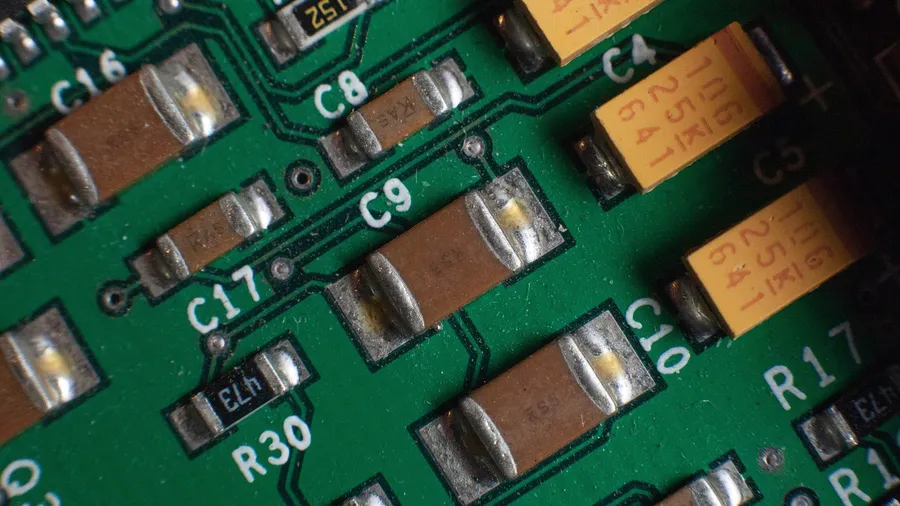
Photo: Multilayer ceramic capacitors on a printed circuit board · Giovanna 27 · CC BY 4.0 · Wikimedia Commons · cropped to 1.91:1
Inside a plasma etcher, nothing mechanical holds the wafer in place. It lies on a ceramic disc that grips it electrostatically while the chamber fills with plasma and the temperature cycles over hundreds of degrees. That disc is an electrostatic chuck, made of fine ceramics, the industrial class that ends up inside semiconductor equipment rather than tableware. It also wears out, and that property is worth holding on to: service life is two years or less, so whoever owns the tool buys another one.
Most of them come from Japanese suppliers. Chinese export controls have run in the other direction for well over a year, and as far as the public record shows no comparable Japanese restriction covers these components. The question usually asked about that position is why not. The answer that circulates is that dependence runs both ways. That answer is right, and it is nearly always left at the level of a metaphor, which conceals the useful part: the two dependencies are not gripping each other at the same point, and only one of them is currently switched on.
Japan has reached for this kind of lever once before. In July 2019, it restricted exports to South Korea of three semiconductor materials — hydrogen fluoride, photoresist and fluorinated polyimide — replacing bulk export licences with individual ones, one required for each shipment, with each contract reporting its end-user, product specifications and technology (Chemical & Engineering News, 9 July 2019; USITC working paper, October 2019; Makioka and Zhang, VoxEU, 27 April 2023). South Korean production of the same chemicals rose after the measure, and Korean sourcing shifted towards the United States, Belgium and Taiwan (Makioka and Zhang, 2023).
Every two years, a new one
Numbers for this corner of the industry have to be handled carefully, which means being explicit about where they come from. The most complete figures I could reach are not independent statistics. They sit in a sell-side research note published on 7 April 2025 about a Chinese-listed supplier, relaying figures from Frost & Sullivan and QYResearch cited in that company’s listing documents. On that basis, the ten largest suppliers of semiconductor ceramic electrostatic chucks held about 92% of the world market in 2023, the three names it gives being Shinko Electric, NGK Insulators and Nippon Tokushu Toryo (NTK); elsewhere in the same note TOTO and the American supplier Entegris appear on its list of manufacturers in this market, and it puts NTK first globally. Wafers 300 mm across account for 77.52% of chuck demand, and the top four suppliers of 300 mm chucks together exceed 92.53%, with the American equipment makers Applied Materials and Lam named among those four. Ceramic heaters, the parts that hold a wafer and heat it evenly while a film grows on it, were tighter still at about 91% for the top five in 2022, including Sumitomo Electric, Kyocera and NGK (Shanxi Securities, 7 April 2025). No single supplier’s share appears anywhere in this piece, because the per-company numbers to be found disagree with one another by multiples of several. That concentration is Japanese-led rather than exclusively Japanese: the note itself puts two American companies in the top four for the segment that carries most of the demand.
Neither part is cheap. The same note puts a chuck at 12.7% of an etcher’s purchased raw materials, and a ceramic heater at 12.5% of a chemical-vapour-deposition tool’s and 12.2% of a physical-vapour-deposition tool’s. My reading is that it is the replacement cycle, not the price, that carries most of the argument here. Because a chuck lasts under two years, substituting an alternative is not one re-engineering project but a purchase that comes round again, and each round is another opportunity for a Chinese entrant to be qualified into a tool already running.
One item usually attached to this list does not survive checking. Versions of the argument circulating in Chinese add a material called MFC, with Kyocera and NEC said to hold over 95%. The abbreviation covers two different products. The macro fibre composite, the piezoelectric material that works as both actuator and sensor, was invented at NASA in 1999 and has been commercialised worldwide since 2002 by Smart Material in Germany under a NASA licence (Smart Material). The mass flow controller that meters process gas into a chamber is something else. Horiba, whose own news release put its share at roughly 60% as of December 2021 on its internal research, which makes it a company’s own count rather than a survey; Kyocera does make piezoelectric actuators used in those controllers (Horiba; Kyocera). I could not trace the 95% figure to any origin. Correcting it strengthens rather than weakens the claim underneath: Japan’s position in gas handling survives, under the right product name and without a number nobody can source.
Where the other end is
“Rare earths” is the usual answer for what China holds, and it is uninformative, because the elements are mined in several countries and the concentration is somewhere else along the line.
After ore is mined, the individual elements have to be separated from one another and refined into usable material, and that is where China sits at about 91% of the global stage, with a footnote placing the figure on the magnet rare earths neodymium, praseodymium, dysprosium and terbium (IEA, 2025). For scale on mining, which is the less useful figure for this argument, the US Geological Survey put Chinese mine production of rare earth oxides at 270,000 tonnes in 2025 (USGS, Mineral Commodity Summaries 2026). The interesting figure is how much of the world’s ore has to pass through one country before it becomes an element anyone can use.
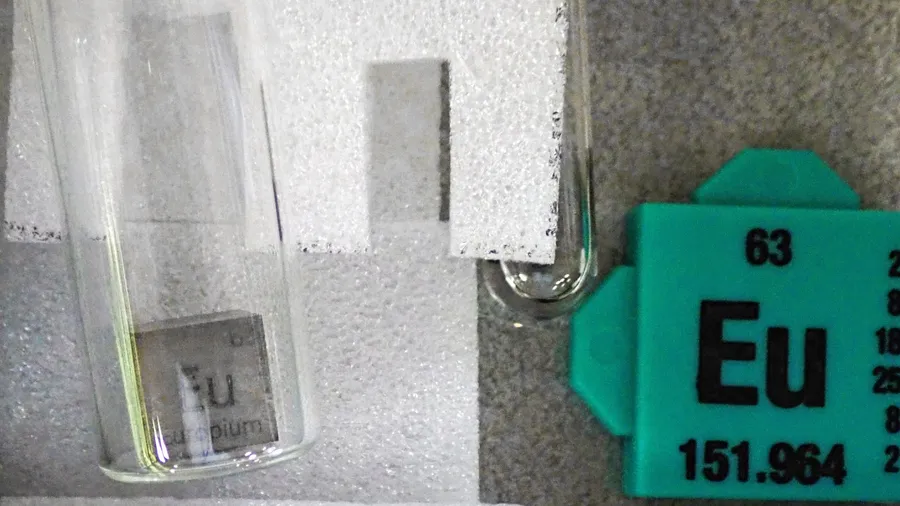
Two of those elements are already subject to Chinese export licensing. Notice 18 of 2025, issued by the Ministry of Commerce and the General Administration of Customs on 4 April 2025 and effective the same day, placed export controls on samarium, gadolinium, terbium, dysprosium, lutetium, scandium and yttrium, and its annexe names dysprosium metal, dysprosium alloys and terbium-dysprosium-iron alloy targets (MOFCOM, announcement 18 of 2025). That round remains in effect, though not unconditionally: the same USGS chapter records China beginning to issue general export licences to selected exporters. A later round in October 2025 extended controls to five more elements and was suspended for a year the following month; the April round was not (USGS, 2026). The distinction matters because a careless account would cite a restriction that has been switched off. The October round included europium, and that suspension is the reason the restriction touching a rare earth used in Chinese refrigeration research was described there as discretion rather than prohibition.
The joint between that list and the components above runs through cost, and it is a narrow one. Multilayer ceramic capacitors, the MLCCs that store charge and smooth voltage everywhere from handsets to AI servers, need ceramic powder below 120 nanometres and 99.99% pure for AI-server grades, and Chinese reporting on their cost structure states that automotive- and industrial-grade MLCCs add heavy rare earth oxides, naming europium oxide and yttrium oxide, at about 12% of material cost (36Kr, 9 June 2026). Of those two elements one is on the April list and one is not: yttrium, which is also used to stabilise zirconia, comes under notice 18; europium belongs to the October round that has been suspended. My reading is that this is the better joint, because it rests on elements that source names. Dysprosium and terbium sit elsewhere in this: notice 18 covers them, and the IEA groups them under magnet rare earths, but nothing I could find names them as the additive inside a capacitor dielectric.
One qualification belongs here too. The claim that every ceramic additive runs through rare earths is too strong: yttrium stabilises zirconia and heavy rare earth oxides go into capacitor dielectrics, and some widely used sintering systems need none at all. Narrowing that sentence is what lets the rest of it stand.
One chain, two links
Putting the halves side by side dissolves the symmetry.
| Stage | Who leads | Figure | Source |
|---|---|---|---|
| Rare earth separation and refining | China | about 91% of that stage | IEA, 2025 |
| High-purity ceramic powder for capacitor dielectrics | Japanese makers | more than 60% of the high-end powder market | 36Kr, 9 June 2026 |
| Finished ceramic components for chip tools | Japanese-led suppliers | top ten about 92% (chucks, 2023), top five about 91% (heaters, 2022) | Shanxi Securities, April 2025 |
| The same components, sourced inside China | Chinese makers, early | 19% in 2021 | same note |
Every row has a different denominator, so none of these can be added together or divided into one another. The last row is the narrowest and deserves the most careful reading: 19% was the share, in 2021, of advanced structural ceramic components used in Chinese-made semiconductor equipment that came from domestic suppliers, with overseas suppliers taking 81%. It measures what Chinese equipment makers buy, not anyone’s global standing.
What the table describes is two strong positions at different depths of one chain. China’s is at the entrance, where ore becomes separated oxide. Japan’s is further down, where material becomes a finished part able to survive a plasma chamber, and in the powder step just above it. My reading is that this is worth preferring to the metaphor because it is checkable: one party decides whether the material arrives, the other decides whether it arrives as something a fab can install. Whether the input has arrived also depends on permission rather than on price, and that is the same shape as the problem in chip-making tools, several links further along the supply chain.
Why nobody can put a date on it
The question this corner keeps raising is how long Chinese substitution takes, and I could not find a published number for it. My reading is that the absence is better explained as a property of what has to be substituted.
Start from the low base, that 19% in 2021, with its denominator. Then take the one Chinese maker that, by late 2024, could produce both electrostatic chucks and ceramic heaters, and its own regulatory filing from January 2026. Customer verification, it tells investors, runs through five stages: delivery for customer testing, under verification, verification passed, small-batch production, volume production. Heaters had reached volume production. Chucks had not: some models were at small-batch production, and the rest were still at or before the verification stages. In the most recent period it reports, it sold 17 chucks against a planned line of 2,500 a year, and its annualised order book covered about 12.8% of the 500 units of first-year output, which it attributes to domestic substitution of chucks proceeding while more models go through verification (Suzhou Kematek, prospectus for convertible bond issuance, January 2026, risk factors pp. 1-1-2 ff.).
That is a queue, and it is the clearest shape I have seen given to this question. On my arithmetic, the useful measure is not the year substitution arrives but the rate at which models clear those stages, so the figure to track annually is how many suppliers and how many models reach the far end. The 2,500 units of planned capacity against 17 units sold is not a forecast; it is one company telling its own investors that what it expects to run into is the pace of customer qualification, with capacity not the constraint.
The asymmetry therefore sits where it can be counted. China’s upstream lever is live today, and it reaches yttrium, one of the two heavy rare earth oxides this reporting names in capacitor dielectrics. The other, europium, sits on the October round that has been suspended. It does not have unlimited shelf life, because its value depends on how much verification queue is left, and that queue drains one model at a time.
The squeeze was demand
Capacitor prices did rise sharply through 2026, and it is tempting to read that as supplies being squeezed to force substitution. The evidence points elsewhere.
Murata raised prices 15 to 35% on AI-server and high-end automotive MLCCs from 1 April, its first broad increase in about three years. Samsung Electro-Mechanics raised prices 30% from 1 August on MLCCs sold through its distribution business, and from the fourth quarter it is extending increases to the OEM and ODM customers it supplies direct, with TrendForce putting those at 25 to 30% on consumer-grade X5R parts and 10 to 20% on the high-end X6S parts used in AI servers. Yageo moved on 1 July and Taiyo Yuden twice, in May and again on 1 September (Defiance ETFs, 8 September 2026; The Elec, 30 July 2026). What drove them was demand. Defiance ETFs and The Elec give the numbers that explain it: book-to-bill ratios of 1.30, 1.31 and 1.25 in June, the highest since the pandemic, on monthly shipments at five-year highs of about 140 billion units for Murata, 98 billion for Samsung Electro-Mechanics and 40 billion for Taiyo Yuden. Defiance places MLCCs third in an AI server’s bill of materials behind GPUs and memory, citing Goldman Sachs, and gives machine counts of roughly 6,500 MLCCs per current-generation accelerator board, about 12,000 for the next one, and near 440,000 in a full rack.
That rules out one reading and it is worth saying plainly, because it is the version most readers will have met: rising prices at Japanese and Korean makers are not evidence that anything has been cut off. The rare earth channel exists, one step over from where the commentary places it. Taiyo Yuden attributed its September increase partly to rising costs for barium titanate powder, nickel powder and rare earth additives, which is a real route from a Chinese licence into capacitor pricing, and it travels through the invoice rather than through a refused shipment. Whether that stays one company’s explanation or becomes an industry channel depends on whether other suppliers start using the same words.
Substitution can also be seen at work on this side, in powder rather than finished capacitors. Chinese reporting names Nippon Chemical as the leading supplier of high-purity MLCC dielectric powder and a supplier to Murata, puts domestic producer Guoci Materials (Sinocera) above 12% of the global powder market at 12,000 tonnes of annual capacity, and describes a second Chinese supplier of nickel powder down to 80 nanometres as a core supplier to Samsung Electro-Mechanics (36Kr, 2026). These are footholds at specific stages, not a completed substitution — the same shape as a capability that starts in one programme and turns up in another.
Three things would settle how much any of this is worth, and each has a number attached: how far the general export licences China has begun issuing reach in practice, whether yttrium and the other notice 18 elements move on them freely; how many Chinese suppliers and how many chuck models clear the fourth and fifth stages of that verification line each year; and how many manufacturers follow Taiyo Yuden in naming rare earth additives as the reason for a price rise.
One limit I would rather name than step around. None of this establishes why Tokyo has not reached for what it holds. A lever existing is one thing; the lever being the reason for restraint is a claim about intentions that these documents do not support, and an unremarkable alternative explanation is available, namely that Japanese suppliers’ customers are here and cutting off your largest market is bad business regardless of anything anyone holds upstream. The structural account survives either way. The specific claim that the rare earth position is why this chokepoint has gone unused remains a working hypothesis, and it should be presented as one.
Methodology
Every quantitative claim about Japanese suppliers’ shares of ceramic components comes from one Chinese sell-side note relaying market research through a listed company’s filings, cited as such in the text. That note has an interest in arguing that domestic substitution is coming, and it is not an independent audit. Per-company shares were excluded entirely, because the figures available disagree by multiples of several. Horiba’s market share is the company’s own assessment, dated December 2021. The 19% figure measures Chinese-made semiconductor equipment in 2021 and nothing broader, and the Kematek prospectus describes one supplier in early 2026, which is the closest thing to an industry assessment I could find and is not one. Two other things could not be established from anywhere I could open: how long full substitution would take in years, for which no public estimate appears to exist, and any Japanese restriction covering these ceramics, so that absence rests on nothing stronger than the absence of an announcement.
Sources
- International Energy Agency, “With new export controls on critical minerals, supply concentration risks become reality”, 2025 — intergovernmental agency. The roughly 91% share of separation and refining, footnoted as covering the magnet rare earths neodymium, praseodymium, dysprosium and terbium — iea.org
- Ministry of Commerce and General Administration of Customs of China, announcement 18 of 2025, on export controls for certain medium and heavy rare earth items, 4 April 2025, effective that day — primary regulation. The seven element categories including dysprosium and terbium, with dysprosium metal, dysprosium alloys and terbium-dysprosium-iron alloy targets named in the annexe — mofcom.gov.cn
- US Geological Survey, Mineral Commodity Summaries 2026, Rare Earths — government statistical series. Chinese mine production of 270,000 tonnes of rare earth oxides in 2025, and which rounds of export control remain in force, together with its condition that China had begun issuing general export licences to selected exporters — pubs.usgs.gov
- Shanxi Securities, research note on one listed advanced-ceramics supplier, 7 April 2025, relayed by Sina Finance — sell-side research relaying market research cited in a company’s listing documents. The roughly 92% top-ten concentration for electrostatic chucks in 2023 with three companies named, the roughly 91% top-five for ceramic heaters in 2022, the 300 mm shares with Applied Materials and Lam named among the top four, the consumable life of under two years, the material-cost shares, and the 19% domestic share in Chinese-made semiconductor equipment in 2021 — finance.sina.com.cn
- Suzhou Kematek, prospectus for issuance of convertible bonds to unspecified objects, January 2026, sponsored by CITIC Securities — company regulatory disclosure. The five stages of customer verification, which products had reached which stage, 17 chucks sold in the most recent period reported against 2,500 a year planned, and the 12.8% order coverage of first-year output — jjckb.cn
- 36Kr, republishing Chinese research on an MLCC price surge, 9 June 2026 — industry reporting. The sub-120 nm and 99.99% requirements for AI-server grades, the heavy rare earth oxides europium oxide and yttrium oxide that automotive- and industrial-grade MLCCs are said to add at about 12% of material cost, Nippon Chemical’s position, Guoci Materials (Sinocera) above 12% of the powder market, and the nickel powder supplier to Samsung Electro-Mechanics — eu.36kr.com
- Defiance ETFs, “MLCC Shortage 2026: Why Capacitor Prices Keep Rising”, 8 September 2026 — market commentary by an ETF issuer relaying TrendForce, The Elec and Goldman Sachs research. The price-increase timeline, Taiyo Yuden’s stated reasons, book-to-bill ratios, shipment volumes, per-board MLCC counts and the bill-of-materials placement — defianceetfs.com
- The Elec, “Samsung Electro-Mechanics to Raise MLCC Prices by 30% Starting in August”, published 30 July 2026 — Korean industry press, used as a direct check on the timeline and volumes — thelec.net
- Horiba, news release on mass flow controller production, December 2021 — company statement. Its roughly 60% share of the global mass flow controller market, on its own count — horiba.com
- Smart Material, macro fibre composite product page, and Kyocera piezoelectric actuator case study — company pages, used only to establish what the abbreviation MFC refers to in each sense — smart-material.com, global.kyocera.com
- Chemical & Engineering News, “Japan hits South Korea with controls on key electronic materials”, 9 July 2019 — trade press with editorial standards. The three materials placed under individual export controls, and Japan’s position as a major producer of the electronic grades — cen.acs.org
- US International Trade Commission, “The South Korea-Japan Trade Dispute in Context: Semiconductor Manufacturing, Chemicals and Concentrated Supply Chains”, Office of Industries working paper ID-062, October 2019 — government research publication. The 1 July 2019 announcement, the licence-per-shipment requirement, and the 12.6% share of Korean imports covered — usitc.gov
- Ryo Makioka and Hongyong Zhang, “The impact of export controls on international trade: Evidence from the Japan–Korea trade dispute”, CEPR/VoxEU, 27 April 2023 — academic policy column reporting a RIETI discussion paper. Individual licences in place of bulk ones with per-contract reporting, and the finding that Korean production of the affected chemicals rose while sourcing shifted to the United States, Belgium and Taiwan — cepr.org