· Robin Wen · Technology · 14 min read
Qualcomm Buys Huawei's Patents, and a Licence to Its Chip Workaround
Qualcomm is buying Huawei's US patents and licensing the chip architecture Huawei built without EUV. The controls run one way; the deal runs the other.
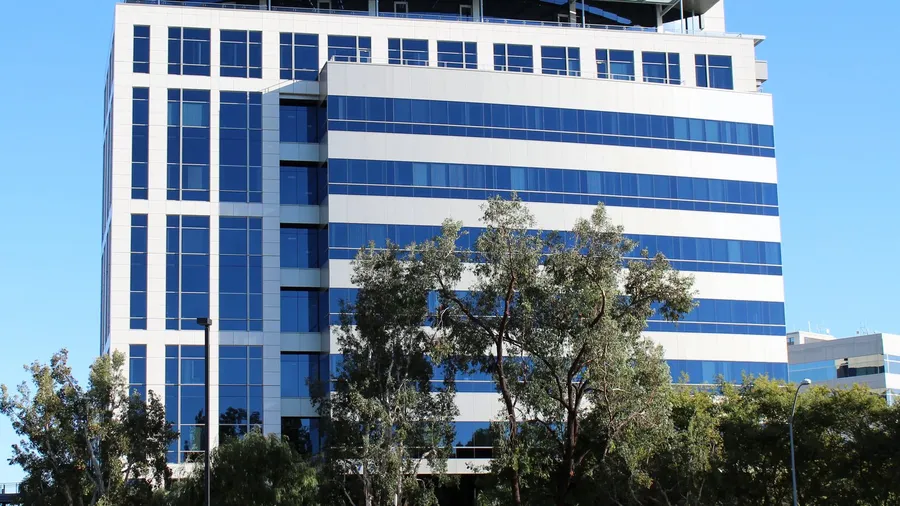
Photo: Qualcomm’s headquarters in La Jolla, San Diego · Coolcaesar · CC BY-SA 4.0 · Wikimedia Commons · cropped to 1.91:1
On 5 October Huawei and Qualcomm announced a multi-year patent licence agreement. The structure is ordinary for two companies whose patent relationship goes back to 2001: cross licences to patent portfolios covering 5G, computing, AI and networking. Two clauses are not ordinary. Qualcomm will purchase certain Huawei patents in the United States, in computing, AI, networking and other fields. And the licence covers patents behind LogicFolding, the chip architecture Huawei developed after it lost access to the lithography it needed to keep shrinking transistors.
That second clause is not in the announcement. It comes from a Huawei spokesperson, in a Bloomberg Law report published the same day, which adds near- and co-packaged optics to the list of technologies covered. The announcement’s own list runs to 5G, compute, AI and networking. LogicFolding is something else: a way of fitting more transistors onto a chip by stacking a circuit’s layers vertically rather than by printing smaller transistors. It exists because the smaller-transistor route was closed. “Shrinking past what the industry calls the 7-nanometre node requires extreme ultraviolet (EUV) lithography, which cannot be accessed,” the head of Huawei’s semiconductor unit wrote in a company paper in September.
So the deal and the controls point in opposite directions. Washington’s export controls restrict what American technology may go to Huawei. This agreement has the American company buying Huawei’s patents and, on Nikkei Asia’s reporting, paying to use its patents for the first time.
One direction, twenty-five years
Neither company has said which way the money will run in net terms, and this piece returns to that gap. What the public record shows is a long, one-way ledger.
Huawei made its first licensing payment to Qualcomm in 2001; its first licensing income came in 2011, from Motorola. Between then and now the fee moved one way. In 2018 Huawei stopped paying while it disputed the charge. In July 2020 Qualcomm settled and signed a new long-term global licence: Huawei paid $1.8 billion, covering royalties owed for 2019 under the old agreement and for the first half of 2020 under the new one, and the package included a cross-licence giving Qualcomm rights to certain Huawei patents.
That licence was not renewed. Qualcomm’s annual report for the fiscal year to September 2024 says it was then negotiating with key licensees, Huawei among them, whose agreements were due to expire early in its 2025 fiscal year. The next one, for the year to September 2025, records the consequence in one sentence: “Beginning in the second quarter of fiscal 2025, QTL revenues did not include royalties from Huawei, whose license agreement has expired.” Licensing revenue for the year was roughly flat. Huawei’s licensing revenue is small next to its hardware business, and in 2023 the company said it had paid out about three times what it had collected in royalties over the years.
In August 2026 Huawei signed a multi-year cross-licence with HP covering Wi-Fi patents, including Wi-Fi 7, with no financial terms disclosed. Six weeks later came Qualcomm.
What the licence is for
Moore’s law delivered its gains by making transistors smaller: smaller transistors switch faster and waste less energy. Shrinking below the industry’s seven-nanometre node normally requires EUV lithography, and Huawei cannot buy EUV machines. Its answer, presented by He Tingbo at the IEEE International Symposium on Circuits and Systems in Shanghai in May 2026, is to compress the time a signal takes to travel rather than the space a transistor occupies. The technique, LogicFolding, takes a circuit that used to sprawl across a flat plane and folds it into vertically stacked layers joined by dense vertical links, so signals take shorter routes.
The enabling step is 3D hybrid bonding: two wafers aligned, pressed and annealed until the copper pads on each face fuse into continuous metal. Huawei treats it as a manufacturing step rather than a packaging one. EE Times, describing the conference presentation, notes one hard constraint. The bonding pitch has to be less than three times the top metal pitch, which at roughly 720 nanometres means below 2 micrometres.
Huawei’s own measurements put the first folded mobile chip’s transistor density at 238 million per square millimetre, up from about 155 in the generation before, with power at matched performance down 66 per cent on the AI unit, 58 per cent on the graphics unit and 41 per cent on a CPU core. The first commercial chip built this way, the Kirin 9050 Pro, shipped inside a foldable phone in September. That is the easier half of the proof: a conference claim has become a product. Whether it holds in volume is the harder test.
Two ceilings sit beside the claims. The figures are Huawei’s, published by Huawei, and Tech Times noted at the launch that no independent auditor had verified any of them, and that at that density the chip would approach TSMC’s 3-nanometre process by stacking rather than by lithography, with no independent test of whether performance, power efficiency and yield match. The design toolchain is not ready either: no commercial software from Synopsys, Cadence or Siemens has been adapted to design this way, and Huawei’s own engineers have flagged the gap. TSMC, meanwhile, plans to make actual 1.4-nanometre chips in 2028, three years before Huawei’s stated target of a density equivalent to that node.
None of that settles whether the architecture is good. It does explain why the patents had a buyer.
The controls point the other way
Export controls are a restriction on what goes out. Since 2019 the United States has limited what American companies may sell to Huawei. In May 2024 the Commerce Department revoked the licences that had let Qualcomm and Intel ship some chips to Huawei. Qualcomm’s annual report is blunt about the consequence: “we do not expect to receive any further product revenues from Huawei.” The chip business with Huawei was closed by regulation. The licensing business closed when the licence expired.
The October agreement reopens the second channel and turns it around. Qualcomm is not taking Huawei’s licence the way it once did, as a supplier licensing the patents a handset maker needs. It is buying Huawei’s patents and licensing Huawei’s chipmaking technique. Bloomberg Law described the result as “a win for the Chinese company and its push to advance in overseas AI markets”.
There is a qualification, and it changes how the deal should be read. The announcement says the transaction “will close following receipt of the necessary regulatory approvals” and does not say whose. Nikkei Asia reported that it would trigger a review in the United States. For two companies in this position the omission is the substantive part: the reversal is not an escape from the control regime. It is a transaction the regime gets to examine.
The dates invite a story. Qualcomm lost its licence to sell Huawei chips in 2024; the patent licence lapsed; two years later it is buying Huawei’s patents. Nothing in the public record connects those facts as a bargain, and this article does not. What the sequence does show is narrower, and still notable. On Nikkei’s reporting, the American government that stopped Qualcomm selling chips to Huawei now gets to review the deal in which Qualcomm buys from it.
Missing from the announcement
The announcement is short, and its silences are systematic. Set beside the reporting that filled them in, the deal divides cleanly:
| In the announcement | In the reporting | |
|---|---|---|
| Technologies covered | 5G, compute, AI and networking | LogicFolding patents, and near- and co-packaged optics (a Huawei spokesperson, via Bloomberg Law) |
| Net payment direction | not stated | Qualcomm paying to use Huawei’s patents, and becoming the net payer (Nikkei Asia) |
| Approving authority | ”the necessary regulatory approvals”, with no authority named | a review in the United States (Nikkei Asia) |
Net payment direction and the reviewing authority are the two facts that decide what this deal means, and neither is in the companies’ own document. The disclosure gap runs deeper than this one transaction. Huawei does publish rate caps for some of its licensing programmes: in 2023 it set the ceiling at $1.50 per 4G handset, $2.50 per 5G handset and $0.50 per Wi-Fi 6 consumer device. Those are the programmes the company wants the industry to adopt. This agreement is not a handset programme, and no comparable rate is offered. The HP agreement six weeks earlier followed the same pattern: a cross-licence, no financial terms, and a statement from HP that it was a routine licence for widely used technology rather than the start of a commercial relationship.
The one number in circulation is $6.9 billion. Huawei says the new deal will push the total value of all its patent licensing agreements above that level once completed, and the figure sits in the same Reuters sentence as the deal, where it is easy to read as the deal’s price. It is the cumulative contract value of every licence Huawei has signed, in Huawei’s own account. For scale, the company reported $560 million of licensing revenue in 2022. What this transaction is worth, in either direction, has not been disclosed by either side.
Where the numbers would show up
Four things would move this from a signed document to a fact about the industry.
The first is the approval. If the review Nikkei reported concludes, the deal closes and the direction of payment becomes concrete rather than reported. If it stalls, the announcement reads differently in hindsight: a licence Huawei can sign but not yet rely on.
The second is Qualcomm’s next annual report. Its filings are the register that recorded Huawei’s royalties leaving QTL in 2025; if the new agreement restores them, that is where the change would be disclosed.
The third is an independent teardown of the Kirin 9050 Pro. The licence prices the patents. It does not establish that the architecture performs as claimed. A density and power measurement from someone who did not write the paper would turn a conference claim into a capability.
The fourth is whether anyone else signs the same way. Huawei’s licensing has been moving outward, to HP in August and to Qualcomm now. A third American company would make the pattern harder to read as a single opportunistic purchase.
Methodology
Almost everything here comes from the two companies or from their filings, and it should be read that way. The deal’s structure, the FRAND commitment and both executives’ statements come from a joint announcement by two interested parties. The financial history comes from Qualcomm’s annual reports; the dates 2001 and 2011 come from Huawei via Reuters. The claim that Qualcomm becomes the net payer, and the expectation of a review in the United States, come from Nikkei Asia’s reporting and are not in the announcement.
The technical account of LogicFolding rests on Huawei’s own material: a conference release from May 2026, and a September 2026 paper by the head of its semiconductor unit, which is a company preprint rather than peer-reviewed work. Its density and power figures have not been reproduced outside Huawei, and are labelled as Huawei’s wherever they appear. The independent reading comes from EE Times’ account of the conference and from Tech Times’ report on the chip’s launch, which is also the source of the observation that no independent auditor has verified the numbers.
Two limits are worth stating. Bloomberg Law’s report on the LogicFolding licence is behind a paywall, so only its opening paragraphs and the Huawei spokesperson’s list of technologies were readable, and the licence’s length, territory and exclusivity are unknown here. And Qualcomm’s annual report discloses the Huawei relationship in narrative rather than in figures, so no amount can be attached to the old agreement or the new one.
Sources
- Huawei, “Huawei and Qualcomm Announce Broad Patent License Agreement”, 5 October 2026 — joint announcement by both companies. The cross licences, Qualcomm’s purchase of certain Huawei US patents, the closing condition of necessary regulatory approvals, the FRAND commitment, and the statements by Alan Fan of Huawei and John Han of Qualcomm — huawei.com
- Reuters, Miyoung Kim, “Huawei agrees to a multi-year patent licensing deal with Qualcomm”, 5 October 2026 — wire service. The $6.9 billion cumulative contract value of Huawei’s patent licensing agreements, positive licensing revenue since 2021, the 2001 first payment and 2011 first income from Motorola, and Huawei’s rising R&D spending under trade restrictions that have limited its access to advanced chips and software — reuters.com
- Nikkei Asia, Cheng Ting-fang and Lauly Li, “Qualcomm to pay Huawei for first time in 5G, AI patent breakthrough”, 5 October 2026 — financial newspaper, attributing to Huawei. That Qualcomm would pay to use Huawei’s patents for the first time, that the deal would make Qualcomm the net payer for the first time, and that it would trigger a regulatory review in the United States — asia.nikkei.com
- Bloomberg Law, “Qualcomm Licenses Patents on Huawei’s LogicFolding Chip Tech”, 5 October 2026 — specialist financial and legal news service, quoting a Huawei spokesperson. That Qualcomm agreed to license patents underpinning Huawei’s LogicFolding technique, that the agreement spans near- and co-packaged optics and networks, and the description of the result as a win for Huawei — bloomberglaw.com
- Qualcomm, Annual Report on Form 10-K for the fiscal year ended 28 September 2025 — regulatory filing, the company’s own account. The May 2024 revocation of the export licence under which it sold 4G and certain other integrated circuit products to Huawei, the expectation of no further product revenues from Huawei, the exclusion of Huawei royalties from QTL revenues from the second quarter of fiscal 2025, and approximately flat licensing revenues and earnings for the year — sec.gov
- Qualcomm, Annual Report on Form 10-K for the fiscal year ended 29 September 2024 — regulatory filing, filed 6 November 2024. That Huawei was among the key licensees with which Qualcomm was still negotiating, and whose agreements were due to expire early in fiscal 2025, and that its licence to export 4G and certain other integrated circuit products to Huawei was revoked on 7 May 2024 — sec.gov
- Electronic Design, “Qualcomm Strikes Long-Term Licensing Deal to End Huawei Dispute”, 29 July 2020 — trade publication (James Morra). The settlement of the licence dispute, Huawei’s payment of $1.8 billion covering royalties for 2019 and the first half of 2020, the cross-licence giving Qualcomm rights to certain Huawei patents, and Huawei’s halt in royalty payments from 2018 — electronicdesign.com
- BBC, João da Silva, “US revokes licences for sales of chips to Huawei”, 9 May 2024 — news organisation. The revocation of export licences in May 2024, Intel’s and Qualcomm’s statements that they had been notified, and the exemptions granted since 2019 for technology unrelated to 5G — bbc.com
- Huawei, “Huawei announces royalty rates for its patent license programs”, 13 July 2023 — the licensor’s own announcement. The published rate caps of $1.50 per 4G handset, $2.50 per 5G handset and $0.50 per Wi-Fi 6 consumer device, 2022 licensing revenue of $560 million, and the statement that Huawei’s cumulative royalty payments were about three times its cumulative royalty collections — huawei.com
- Huawei, “HUAWEI Presents the Tau (τ) Scaling Law, Enabling Breakthroughs in Transistor Density and System Performance”, 25 May 2026 — the company’s own release, covering He Tingbo’s keynote at ISCAS 2026. The τ scaling law, LogicFolding, 381 chips designed and mass-produced over six years, Kirin chips adopting LogicFolding in autumn 2026, and the target of a transistor density equivalent to 14 Å (1.4 nm) by 2031 — huawei.com
- Tingbo He, “Huawei’s τ Chip Was Supposed to Melt?”, arXiv:2609.04287, 3 September 2026 — paper by Huawei’s semiconductor chief, a company preprint, not peer-reviewed. That shrinking below 7 nm requires EUV lithography “which cannot be accessed”, the mechanism of LogicFolding and wafer-to-wafer hybrid bonding, the rise in transistor density from about 155 to 238 million per square millimetre, and the power reductions at matched performance — arxiv.org
- EE Times, Echo Zhao, “From Shrinking Transistors to Compressing Time: Deciphering Huawei’s τ Law”, 26 May 2026 — independent industry publication, reporting He Tingbo’s conference presentation. The constraint that hybrid bonding pitch must be within three times the top metal pitch, the density trajectory, the quoted efficiency gains, and Huawei’s own acknowledgement of toolchain and thermal challenges — eetimes.com
- Tech Times, Ethan Ingamells, “Huawei Kirin 9050 Pro Launches: LogicFolding Moves From Roadmap to Silicon”, 7 September 2026 — technology news publication. The commercial launch of the first LogicFolding chip, the statement that every performance and density figure came from Huawei with no independent auditor having verified them, the comparison with TSMC’s 3 nm and 2028 1.4 nm plans, and the absence of commercial EDA support for the design method — techtimes.com
- Reuters, “China’s Huawei, US PC maker HP sign multi-year Wi-Fi patent deal”, 26 August 2026 — wire service. The multi-year cross-licence with HP covering Wi-Fi patents including Wi-Fi 7, the absence of disclosed financial terms, and HP’s description of it as a routine licence rather than a wider commercial relationship — reuters.com