· Robin Wen · Technology · 15 min read
China's Two Fusion Clocks Both Point to 2027
China is building two fusion devices that split what ITER was designed to do in one machine: a burning plasma, and a wall socket. Both land in 2027.
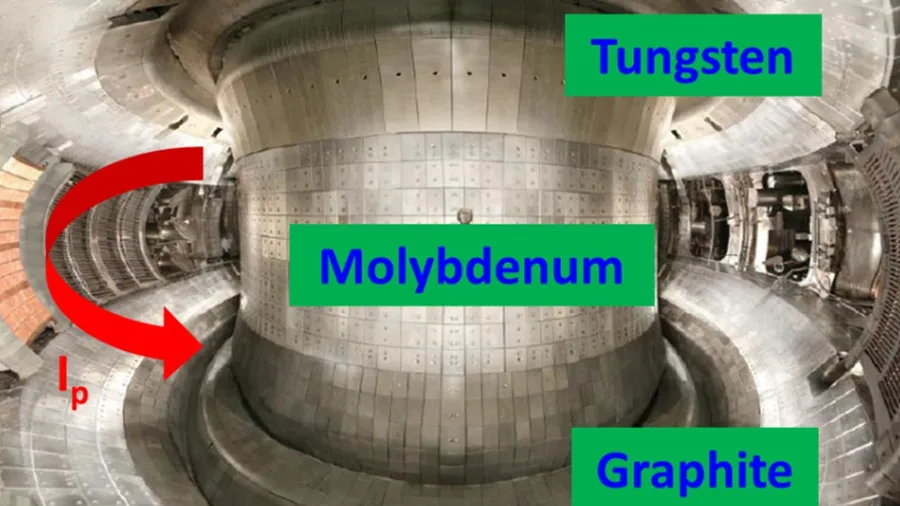
Photo: interior of the EAST vacuum vessel, with the in-vessel materials of the 2015 campaign labelled · Xiang Gao et al., EAST team · CC BY 3.0 · Wikimedia Commons · cropped to 1.91:1
On 1 October the project park for the Burning plasma Experimental Superconducting Tokamak was handed over in Hefei, ahead of schedule. The park is buildings. The machine inside it has entered the assembly stage its engineers call the four-ring fit: four segments of the vacuum vessel are in place, the first of its toroidal-field magnets has passed its tests, and the cold shield and the inner components are to be stacked over it from the inside outward. BEST is not a laboratory experiment in the ordinary sense. Its published plan is to be finished by the end of 2027, then to run deuterium-tritium burning-plasma experiments, to hold a long pulse steady, to reach a fusion power of 20 to 200 megawatts, and to produce more energy than it consumes. Its stated purpose is to demonstrate fusion electricity.
In Chengdu, a second machine is aimed at a different part of the same problem. HL-3, the Huanliu-3 tokamak, is where the ion temperature reached 117 million degrees Celsius in March last year, with the electron temperature at 160 million. Its operators describe that result as entering the burning-plasma experiment, and China National Nuclear Corporation’s chief fusion expert says a burning-plasma campaign is expected in 2027.
Both machines sit on one national ladder: an experimental device, an experimental reactor, an engineering demonstration reactor, then a prototype power station. That ladder has room for one of each. What the two programmes have done is divide the hardest rungs between them, and they are on different clocks.
The two ladders
BEST is designed by the Institute of Plasma Physics at the Chinese Academy of Sciences and built by a company called Fusion Energy (Anhui). Its predecessor is EAST, the superconducting tokamak on the same campus, which in January 2025 held a plasma above 100 million degrees in high-confinement mode for 1,066 seconds, a world record for that mode, following 30, 60, 101 and 403 seconds across the previous decade. Behind BEST, the institute says it is working on the design and preliminary research for a machine it calls CFEDR, a fusion engineering demonstration reactor.
The Chengdu track belongs to a different owner. HL-3 runs at the Southwestern Institute of Physics, which sits under China National Nuclear Corporation. In July 2025 CNNC moved its fusion business into a Shanghai company, China Fusion Energy, with registered capital of 15 billion yuan after seven shareholders committed about 11.5 billion yuan. CNNC holds 50.35 per cent. The company is described as the implementing entity, the financing platform and the coordinating body for CNNC’s fusion work. Its stated route is a pilot experimental reactor, then a demonstration reactor, then a commercial one: the same ladder as the Hefei programme, walked by a company with a balance sheet rather than by an institute with a budget line.
A temperature, and a wall socket
The division of labour shows in what each machine is asked to prove. HL-3 is a physics device. The number that matters in a tokamak is the triple product of density, temperature and confinement time, and the useful question is whether the plasma can heat itself. A burning plasma is one in which the helium nuclei produced by the fusion reactions supply more than half the heating. ITER’s own account of the physics states that this state of matter has never been produced in a controlled way on Earth. In March 2025 the Southwestern Institute reported simultaneous ion and electron temperatures above 100 million degrees for the first time in China, at 117 million and 160 million, with a jump in the triple product. Xinhua describes HL-3 as the only device in China, and a rare one internationally, able to run the burning-plasma experiments that would follow.
BEST is asked for a different kind of result: a working plant in miniature. Its research plan, published jointly by ASIPP and EUROfusion in November 2025, gives the machine a major radius of 3.6 metres against ITER’s 6.2, a central magnetic field of 6.15 tesla against ITER’s 5.3, and 140 to 142 cubic metres of plasma against ITER’s 830, with 50 megawatts of auxiliary heating and an initially licensed on-site tritium inventory of 110 grams. The project proposal behind it puts the total investment at 8.5 billion yuan, and the environmental impact assessment its builder filed gives the same figure, sourced in the document to that proposal, together with the scope it covers: the machine itself, the three buildings that house it and a reserved area for power-generation equipment.
The plan’s target is scientific breakeven, more energy out than in, before the end of 2030, at fusion powers in the tens of megawatts. Chinese official communications state the goal more broadly, as demonstrating fusion electricity; the builder’s filing to the environmental regulator goes further and describes it as the world’s first demonstration of fusion power generation, while the research plan itself is more careful, describing the testing of the heat-removal and extraction systems that such a demonstration would need. That is an engineering target set, and it is the rung the two programmes are missing between a physics result and an industrial machine, the crossing that decides whether a laboratory capability becomes something an industry can actually build.
What makes the split legible is the international comparison. ITER, the project in southern France with seven partners, was designed to do both jobs in one machine: to create a burning plasma, and to integrate the technologies a power plant would need. It is also explicit that it will not produce electricity, and that its own schedule puts the start of its deuterium-tritium phase in 2039, after a 2024 rebaselining that added EUR 5 billion at the level of the ITER Organization and moved the start of that phase later.
My reading is that the two Chinese machines are not two attempts at one question. Between them they take on the two things ITER was built to demonstrate inside a single device, and on their published plans both would have produced their result years before ITER reaches deuterium-tritium at all.
Who gets to call it first
Both programmes have a way to claim credit, and the claims are different. BEST’s 2027 milestone is a construction and integration milestone: the machine is assembled, in one piece, with its magnets and its inner walls. HL-3’s 2027 milestone is a physics milestone: a burning-plasma campaign on an existing device, which is why the official description of it is that it is the only Chinese machine able to run one.
The competition shows up in what each side says it is building next. The Hefei programme’s own account of CFEDR is that it aims at the world’s first fusion demonstration power station. The Chengdu programme’s vehicle is a company whose charter runs all the way to commercial application, in three steps, with 15 billion yuan of registered capital behind it. Two organisations, two roads, and the same title at the end of them: whoever gets fusion electricity onto a grid first.
So the duplication has a function. The two machines are chasing different physics questions, and the competition is over who gets the credit for a result and over which institution becomes the industrial owner of the technology. The national ladder was written to have one of each rung. It now has two candidates for the top of it.
The two sides do describe each other in public, though not as rivals. China National Nuclear Corporation’s chief fusion scientist, Duan Xuru, calls HL-3 complementary to EAST, the Chinese Academy of Sciences device, and in his capacity as a national political advisor he has called for a route for the country that runs from an experimental reactor now to a demonstration reactor around 2045 and commercial generation around 2050. That is later than the breakeven target the Hefei programme has put in its own plan for the end of this decade, and the two timetables sit in public statements side by side.
The part nobody has done
The thing both ladders depend on has not happened. ITER’s own statement of the position is that Q=1, the point at which the fusion power produced equals the power injected to heat the plasma, has never been achieved in a magnetic-confinement device, and that the world record remains the European tokamak JET, at 0.67 in the 1990s. The research plan for BEST puts the same point more bluntly: as of November 2025 there is no D-T tokamak operating anywhere in the world. The same ITER page draws a second distinction that matters here: that plasma breakeven is not the same as engineering breakeven, which counts the whole plant’s consumption rather than the heating systems alone.
The laser route has crossed the line, which is why the comparison is worth making carefully. In late 2022 the National Ignition Facility fired 2.05 megajoules of laser energy at a fuel capsule and got 3.15 megajoules of fusion energy out, a gain of about 1.5, and China’s nuclear energy report records a campaign at a gain of 4.13. Those numbers come from inertial confinement, where a fuel pellet is compressed by lasers, not from a tokamak, where a plasma is held in a magnetic field. The best magnetic result remains below one.
The fuel constraint bites next. Deuterium can be distilled from water; tritium cannot be mined in useful quantities at all. ITER’s own account puts the world’s accumulated stock of tritium from heavy-water reactors such as the CANDU type at no more than 20 kilograms in any given year, against a requirement for an industrial plant of about 70 kilograms per gigawatt of thermal power per year, bred inside the machine from lithium. That is the same shape of problem as the one in a Chinese refrigeration result built to avoid helium-3: the physics is the achievement, and the isotope supply decides whether it becomes a machine anyone owns.
It is worth being plain about what a 2030 demonstration is. Chinese coverage of the park handover puts the electricity demonstration in 2030, and the programme’s own account expects the first fusion lamp to be lit in China by then. That target depends on first reaching Q=1, which no magnetic-confinement device has reached. That dependency is my reading rather than something either programme has stated.
Three numbers would settle how much these firsts are worth. Whether HL-3 runs its burning-plasma campaign on the 2027 schedule its own chief expert has given. Whether BEST reaches output greater than input, which is the line its own research plan sets alongside the megawatts. And whether CFEDR moves from design review into construction, since that is the rung where a demonstration reactor becomes a programme with a site.
Methodology
Almost everything load-bearing here is Chinese and institutional, so it is worth saying what each source is. The milestones and timetables come from Xinhua, the Chinese Academy of Sciences, the National Energy Administration’s annual nuclear power report, and statements by the people who run the two programmes, which means they are the operators’ own accounts of their own progress rather than independent assessments. The ITER figures come from ITER’s own frequently-asked-questions page and its published baseline, which is the appropriate source for what ITER is designed to do and for what has not been achieved anywhere. The corporate facts about China Fusion Energy come from the investment announcements made by its listed shareholders, reported by Chinese financial media.
Cost is the one place where the record cannot be reduced to a single figure. ITER’s members contribute mostly in components rather than cash, and its own account notes that governments are not required to publish what most of those components cost them, so no total is quoted here. The closest audited quantity sits on one side of the project: the European Union’s external auditor records the European agency’s own estimate to complete its delivery obligations at EUR 25.8 billion in 2024 prices, against a contribution share of roughly 45 per cent of construction costs, on a baseline the ITER Council has not formally approved.
Sources
- Xinhua, “Handover of the compact fusion energy experimental device project park”, 1 October 2026 — state news agency. The park handover, the four-ring assembly stage, the components already delivered and installed, and BEST’s stated purpose — news.cn
- Chinese Academy of Sciences, “China launches international science plan in fusion”, 24 November 2025 — official institution, publishing BEST’s research plan. The 2027 completion target, the deuterium-tritium burning-plasma experiments, long-pulse verification, 20 to 200 megawatts, output exceeding input, and the demonstration of fusion electricity — cas.cn
- Xinhua, “‘Artificial sun’ sets world record of 100 million degrees for 1,066 seconds”, 21 January 2025 — state news agency. EAST’s record in high-confinement mode and the sequence of earlier milestones — news.cn
- Xinhua, “First ‘double hundred million degrees’: China Circulator-3 advances to burning experiments”, 28 March 2025 — state news agency. The 117 million and 160 million degree result, and the domestic-first wording — news.cn
- Science and Technology Daily, “Duan Xuru: China Circulator-3 expected to run burning-plasma experiments in 2027”, 8 March 2026 — official science newspaper, quoting CNNC’s chief fusion expert. The 2027 schedule and the rounded 120 million degree figure — stdaily.com
- Xinhua, “‘Artificial sun’ runs at 100 million degrees”, 27 March 2026 — state news agency. The description of HL-3 as the only device in China able to run burning-plasma experiments, and EAST’s 150,000-plus shots — news.cn
- National Energy Administration, China Nuclear Power Development Report 2026 — government annual report. The double-100-million-degree result in the national record, and the international comparisons cited above — nea.gov.cn
- Institute of Plasma Physics, Chinese Academy of Sciences, institutional profile — institutional self-description. The concurrent work on CRAFT, BEST and the design and preliminary research for CFEDR — ipp.cas.cn
- Science and Technology Daily, “Experts discuss the coordination of fission and fusion”, 26 April 2025 — official science newspaper, quoting Li Jiangang of the Hefei programme. The ladder from experimental device to prototype station, BEST’s 2027 completion, CFEDR’s aim at the world’s first fusion demonstration power station, and the expectation that the first fusion lamp will be lit in China by 2030 — stdaily.com
- Science and Technology Daily, “World’s first compact fusion energy experimental device begins batch delivery of TF coil cases”, 28 September 2026 — official science newspaper. BEST’s designers, its builder Fusion Energy (Anhui), and the “world’s first compact” description — stdaily.com
- Securities Times, “More than ten billion yuan of capital enters, the national team arrives”, 22 July 2025 — financial newspaper. The establishment of China Fusion Energy in Shanghai, the 11.5 billion yuan committed by seven shareholders, registered capital of 15 billion yuan, CNNC’s 50.35 per cent, and the pilot-demonstration-commercial route — stcn.com
- ITER, frequently asked questions — the project’s own statements. The Q≥10 definition, the record of Q=0.67 at JET, that Q=1 has never been achieved in a magnetic-confinement device, that ITER will not produce electricity, the 830 cubic metre plasma volume, the classification of burning plasma, the 2022 laser shot, and the tritium figures — iter.org
- ITER, “In a Few Lines” and “New baseline to prioritize robust start to exploitation”, 2024 — the project’s own statements. Deuterium-tritium operation beginning in 2039, the EUR 5 billion addition at the level of the ITER Organization with the note that member governments are not required to publish what their in-kind contributions cost them, and the change of first-wall material from beryllium to tungsten — iter.org, iter.org
- 21st Century Business Herald, “Controlled nuclear fusion, fast-forwarded”, 2 October 2026 — financial newspaper. The industrial read on BEST after the park handover, the 2030 date for the electricity demonstration, and the gap it is meant to fill between experimental and demonstration reactors — 21jingji.com
- J.P. Qian and Ye.O. Kazakov, BEST Research Plan, 1st Edition: Missions and Pathways to Realisation, ASIPP and EUROfusion, 27 November 2025 — the machine’s own research plan, prepared jointly by the institute building it and the European fusion consortium. The major radius of 3.6 m, central field of 6.15 T, plasma volume of 140–142 m³, 50 MW of auxiliary heating, the initially licensed 110 g tritium inventory, completion by the end of 2027, the Q≥1 target before the end of 2030, the statement that no D-T tokamak is operating anywhere, and the parameter table setting BEST against ITER and CFEDR — euro-fusion.org
- Fusion Energy (Anhui) Co. Ltd., Environmental Impact Assessment Report for the Compact Fusion Energy Experimental Device, January 2024 — the builder’s regulatory filing, prepared with the China Institute of Atomic Energy. The total project investment of 8,505.92 million yuan, which the document sources to the project proposal, and the engineering description of the machine, its heating systems and its tritium plant — ie.ah.cn
- China CPPCC Daily, “The hard road to China’s artificial sun”, interview with Duan Xuru, 7 January 2026 — state-affiliated newspaper, interviewing the chief fusion scientist of China National Nuclear Corporation. His description of the HL-3 and EAST devices as complementary, and the route he has called for as a national political advisor: experimental reactor now, demonstration reactor around 2045, commercial generation around 2050 — rmzxw.com.cn
- European Court of Auditors, annual report on the financial year 2024 for the joint undertakings, October 2025 — the European Union’s external auditor. The European domestic agency’s estimate to complete its ITER delivery obligations at EUR 25.8 billion in 2024 prices, up by around EUR 4.2 billion on the previous year; the European share of construction costs at about 45 per cent and each other member’s at about 9 per cent; and the note that the 2024 baseline was endorsed as a working plan without prejudice to overall costs, and was not formally approved — eca.europa.eu