· Robin Wen · Industry & Manufacturing · 13 min read
The Hardest Metamaterial Test Is a Train
China's 400 km/h CR450 uses acoustic metamaterials to hold cabin noise down. The same material family sits on the J-35. The train is the harder case.
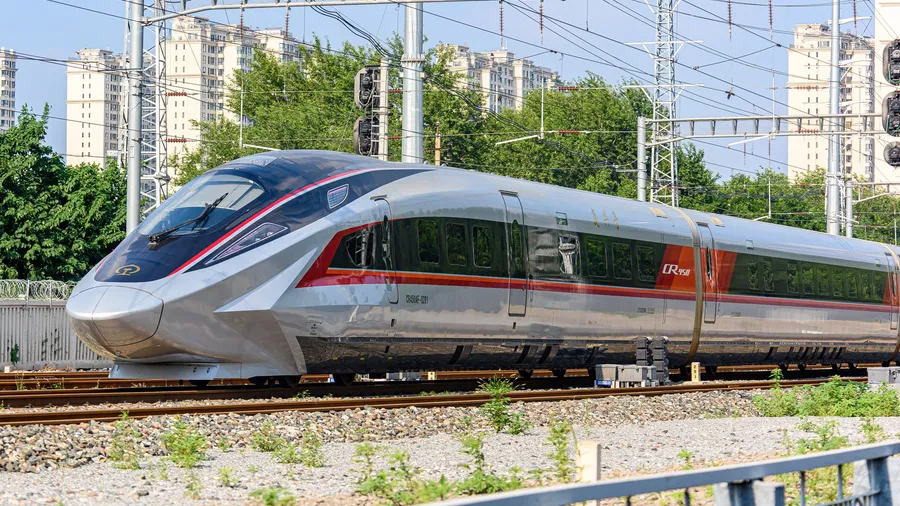
Photo: CR450AF-0201, Dongguantou Nanqiao, 4 July 2025 · N509FZ · CC BY-SA 4.0 · Wikimedia Commons · cropped to 1.91:1
A metamaterial is not a substance. It is an arrangement.
The working definition is an artificial composite whose properties come from its designed internal structure rather than its chemistry: periodically arranged units, tuned so that waves behave in ways the ingredient materials do not allow on their own. Chinese sources phrase the same idea as properties that natural materials do not possess. The idea was proposed in 1964 by the Soviet physicist Viktor Veselago. A wave meeting a metamaterial is not merely absorbed. It is re-routed, by geometry.
That distinction matters for prices. A radar-absorbing coating takes a hit and degrades; a metamaterial is a structure that can carry load and stay put. And in acoustics, the useful part is the low end of the spectrum, which is exactly where the ordinary porous absorber is weak.
The train already has it
On 30 December 2024, People’s Daily ran its account of the CR450, the Fuxing-series trainset built for 400 km/h commercial service, whose two prototype sets had rolled out the day before. Buried in the list of weight-saving measures is the sentence that matters here. The noise reduction, the paper said, uses “floor dampers, acoustic metamaterial resonance units, acoustic metamaterial sound-absorbing partitions and high-damping interior panels”, among other new materials and structures.
That is not a research note. It is the state railway’s own account of hardware that went on the train.
Four months later, at the fourth National Metamaterials Conference in Shenzhen, Chen Yanfeng of Nanjing University collected an award for acoustic metamaterial research. His summary of what his group had built: a low-frequency, broadband, light, thin, tough and strong high-performance sound-absorbing and noise-reducing material, “successfully applied to the CR450 trainset, 1,000 kV UHV power stations and large aircraft” and other major equipment.
What the number is, and what it is not
The figure circulating around this story in Chinese commentary is a reduction of five to six decibels. I could not find a source for it, and the sourced figures are different in kind. They are also easier to defend.
Writing in March, China Daily relayed China State Railway Group’s own specification for the trainset: at 400 km/h, interior noise is kept within 68 decibels, energy use below 22 kilowatt-hours per kilometre, emergency braking under 6,500 metres. Decibels are logarithmic, which is why the size of a number in this field is easy to misread: a three-decibel cut halves acoustic energy.
People’s Daily gives the comparison that makes the noise figure mean something. Raising speed by 50 km/h would normally add two to three decibels. The CR450 came in two decibels lower, which puts its cabin on a par with a 350 km/h CR400.
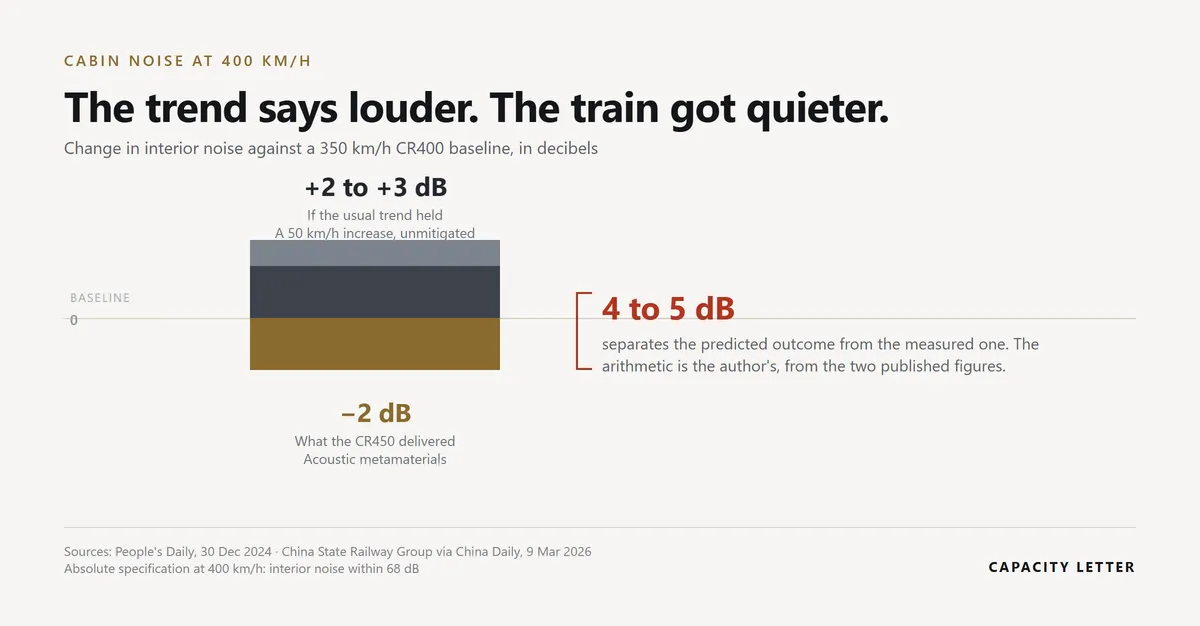
Illustration: Capacity Letter. Change in cabin noise at 400 km/h measured against a 350 km/h CR400 baseline. Both figures in the arithmetic come from People’s Daily (30 December 2024); the 68 dB absolute specification in the footer comes from China State Railway Group via China Daily (9 March 2026). The 4 to 5 dB span is the author’s arithmetic from the two People’s Daily figures.
My reading: measured against the trend the physics predicts, that is a swing of four to five decibels. Not five to six, and stated as a swing rather than as a single reduction.
Why the low end is the hard part
China’s Institute of Acoustics sets out the split in a public explainer from 2020: high-frequency noise goes to absorbing material, which is passive; low-frequency noise goes to active control. Why the low end resists passive treatment at all is a matter of mass, and that part is mine rather than the Institute’s. Absorbing a long wave takes something heavy in its way, and mass is what a train trying to lose weight cannot spare. The Institute’s own answer was an active headrest, speakers in the seat firing an inverted wave, and it reported ten decibels of cancellation in a semi-anechoic chamber.
That was an experiment, not a product. Which is the point.
Mass is where the two design goals collide. The CR450 also had to shed weight: carbon fibre, magnesium, topology optimisation, more than ten per cent off the trainset. A lighter body is a louder body. Neither goal could be bought at the other’s expense. The paper puts a year and a half and more than 300 schemes into the noise work alone, against a programme total of more than 200,000 kilometres of line testing and more than a thousand simulations and as many bench tests.
The railway did not solve this alone. People’s Daily records CRRC Sifang working with a ship research institute on low-frequency vibration, and CRRC Changchun running more than ten whole-vehicle tests in an acoustic laboratory with Southwest Jiaotong University.
The other end of the same family
The military claim is easier to find and easier to overstate. On 27 September 2025, CCTV reported on the J-35 carrier fighter and attached characteristic numbers to it. The network’s own sentence, as relayed by Chinese technology outlets, attributes the aircraft’s low observability to “its special airframe shape and our country’s unique metamaterial technology.”
Shape comes first in the broadcast’s own sentence. That is not where the emphasis landed afterwards: one of the Chinese write-ups of the disclosure put “our country’s unique metamaterial technology” in its headline. The commentary then converts a metaphor into arithmetic, reading a human palm as roughly 0.015 square metres and concluding a radar cross-section at or below 0.01 square metres, against 0.05 to 0.065 for the F-35C. That conversion is the commentators’ work, not the broadcast’s.
Nor is the underlying idea a Chinese invention. The same relayed account notes metamaterial radomes on the F-22, sensors enclosed in metamaterial domes on Sweden’s Visby-class corvettes, and a fully enclosed stealth mast built from metamaterial on the US Navy’s San Antonio-class amphibious ships.
Structural electromagnetic material is an established line of work.
The maintenance argument is the industrial one. Conventional stealth coatings absorb radar energy and convert it to heat, and they age; the relayed account repeats the figure that a B-2 needs its coating renewed about every seven years, at a cost in the tens of millions of dollars. A metamaterial structure that doubles as an airframe component is described as close to maintenance-free, which is what makes it interesting to a customer who has to keep aircraft flying rather than merely deliver them.
What interests me is not the number. It is that the same reasoning shows up in a 2024 paper from the 705th Research Institute of China State Shipbuilding Corporation, on damping the power cabin of a torpedo. The authors open by saying conventional damping performs badly against the torpedo’s low and medium frequency vibration, and propose cantilever local-resonance units instead, designed to two frequencies, about 950 and 1,140 hertz, matched to the cabin’s vibration peaks.
Notably, the paper reports what happened when they built it. Simulation put the best attenuation at 8.26 decibels. The bench test put the best figure at 3.
The crossing runs both ways
Here is the part the retellings miss. The direction of travel is not one-way.
A rail builder reached sideways into marine acoustics: CRRC Sifang, working with a ship research institute, on the low-frequency vibration problem. A shipbuilding institute, meanwhile, is publishing acoustic metamaterial research aimed at torpedo quieting, using the same physics and a different customer. The electromagnetic side of the family follows the same pattern: Nanjing University’s Chen works on sound, while Kuangchi’s Liu Ruopeng, whose team the conference report credits with 6,003 applications and 4,088 grants, works on the structures that go on airframes.
Two branches of physics, two research groups, one materials family, and no single programme owning it.
That is the fact worth extracting from the video this piece came from. The idea that a high-speed train is receiving hand-me-downs from a fighter is not what the record shows. What the record shows is a capability that has become generally available across programmes, which is a different and larger claim.
| The fighter | The train | |
|---|---|---|
| What the material does | redirects radar returns | absorbs low-frequency cabin noise |
| Physics | electromagnetic | acoustic |
| The materials work | Kuangchi, Shenzhen | Nanjing University |
| Who the buyer is | naval and land air arms | a national railway network |
| What the buyer must weigh | observability, and its upkeep | unit cost, weight, decades of service |
| Origin of its headline figure | a broadcaster’s characterisation | the operator’s own specification |
The comparison is the author’s. The figures in it are sourced in the text above.
What a train proves that a fighter does not
Which brings me back to the number I trust least and the number I trust most.
The torpedo paper’s eight decibels did not survive contact with a test bench. That is normal, and it is the reason the CR450 figure carries weight. The 68-decibel specification comes from a trainset that has since cleared all type tests and a 600,000-kilometre operational assessment. Testing had earlier put a single train at 453 km/h and two passing each other at a combined 896 km/h. Six hundred thousand kilometres is the distance the National Railway Administration requires of a new model, over one year. Final inspection and certification are what remain.
The programme behind it is not small. China State Railway Group began basic research on 400 km/h operation in 2018, started development in 2021, published the overall technical conditions in 2022 and began building the prototypes in 2024. By the time the sample sets appeared, the project had produced, on the paper’s account, the first standards system anywhere for a 400 km/h commercial trainset.
The J-35’s low observability reached the public as a broadcaster’s characterisation. The CR450’s quiet cabin is the operator’s own published specification, and the operator’s prototypes have since completed the assessment the regulator requires of a new model: 600,000 kilometres over a year.
My reading is that a figure an operator publishes is a figure an operator can be held to, and that this is the harder test of a material.
So my argument is narrower than the one the video makes and, I think, harder to knock down. The interesting event is not that a stealth material reached a train. It is that the same materials family has surfaced at a naval research institute, at an airframe supplier and on a railway, and that the railway is the customer with the tightest constraints.
A country can produce a metamaterial sample with a laboratory. Putting one on a train that a railway will buy, and keep buying, takes an industry.
What would change my mind: if the acoustic metamaterial hardware turns out to be a development-phase item that did not reach production cars, or if conventional porous absorbers prove to match it in the same weight and thickness. Either would leave the military claim standing and cut the civilian one down to size.
Methodology
This piece began from a Chinese-language video commentary and does not rest on it. Every load-bearing figure is taken from a named source fetched directly, and the source’s role is stated in the list below.
Two things I could not establish. The video cites a CCTV report of 27 September under a programme name that differs from the one used by the write-up I have, which places the broadcast in CCTV-4’s China News. I have written the date and left the programme name to that source rather than treating it as confirmed. And the five-to-six-decibel figure the video opens with has no traceable origin; I have used the railway operator’s own specification instead and said where the arithmetic is mine.
Where a judgement is mine rather than a source’s, I have marked it. That high-frequency noise goes to absorbing material while the low end goes to active control is the Institute of Acoustics’ explanation. The further reason the low end resists passive treatment at all, the mass argument, is mine. That CRRC Sifang working with a ship research institute is evidence of a two-way crossing is my reading.
Sources
- People’s Daily, “The fastest high-speed train, the CR450, is here”, 30 December 2024, page 2 — state press, reporting its own interviews with China State Railway Group, CRRC Sifang, CRRC Changchun, the China Academy of Railway Sciences and the Institute of Acoustics. The list of CR450 noise-reduction hardware, the two-decibel figure, the 300-scheme programme, the 2018-to-2024 programme timeline, the 400 km/h standards-system claim, and the Sifang and Changchun collaborations — paper.people.com.cn
- China Daily, “China’s CR450 high-speed train moves a step closer to commercial operation”, 9 March 2026 — English-language press, relaying China State Railway Group: 68 decibels interior at 400 km/h, the 300,000 km assessment figure as of March 2026 (superseded — see source 8), 453 km/h and 896 km/h test figures, design finalisation expected in 2026 — global.chinadaily.com.cn
- Nanjing University, “Fourth National Metamaterials Conference held; Kuangchi wins a top-ten industrialisation award”, 17 May 2025, reprinting Science and Technology Daily — university website, reporting on-site remarks. Chen Yanfeng’s acoustic metamaterial applied to the CR450, 1,000 kV power stations and large aircraft; Liu Ruopeng’s 6,003 applications and 4,088 grants — nju.edu.cn
- Sun Xuyang, Zhou Jingjun, Wang Qian, Zhang Zhimin, “Vibration reduction method for the power cabin of torpedoes based on acoustic metamaterials”, Journal of Unmanned Undersea Systems, 2024, 32(6): 1072–1081 — peer-reviewed paper, 705th Research Institute, China State Shipbuilding Corporation. Designed resonances near 950 and 1,140 hertz, simulation attenuation up to 8.26 decibels, bench test up to 3 — doi:10.11993/j.issn.2096-3920.2024-0063
- Institute of Acoustics, Chinese Academy of Sciences, “High-speed rail noise? Answer it with a special sound wave”, 22 December 2020 — research-institute explainer by Feng Yuwei, Key Laboratory of Noise and Vibration Research. High-frequency noise handled by passive absorbing material, low-frequency by active control; ten decibels of cancellation in a semi-anechoic chamber, at experiment stage — ioa.cas.cn
- China.com, “CCTV rarely discloses J-35 key parameters”, 30 September 2025, relayed via Jinri Redian — secondary retelling of the 27 September 2025 CCTV broadcast. The full metamaterial definition, the 1964 Veselago attribution, the airframe-shape-then-metamaterial sentence, the palm comparison, the F-35C figure, and the F-22, Visby and San Antonio-class antecedents — m.tech.china.com
- Tencent News, “On the J-35’s stealth performance: the story keeps getting more interesting”, 30 September 2025 — Chinese military commentary; records the foreign outlet that rendered the palm as a sparrow’s palm — view.inews.qq.com
- Caixin Global, “China Takes World’s Fastest Train One Step Closer to Market”, 10 August 2026 — English-language financial press. The 600,000-kilometre operational assessment, the National Railway Administration’s 600,000-kilometre one-year requirement for new models, and China State Railway Group’s 5 August statement that assessment continues on the Xiong’an-Shangqiu line — caixinglobal.com