· Robin Wen · Industry & Manufacturing · 16 min read
BYD's Spanish Double First Is Two Different Markets
BYD leads both plug-in segments in Spain, 767 cars over Tesla in battery cars and far more in hybrids. The EU tariff covered only one of them.

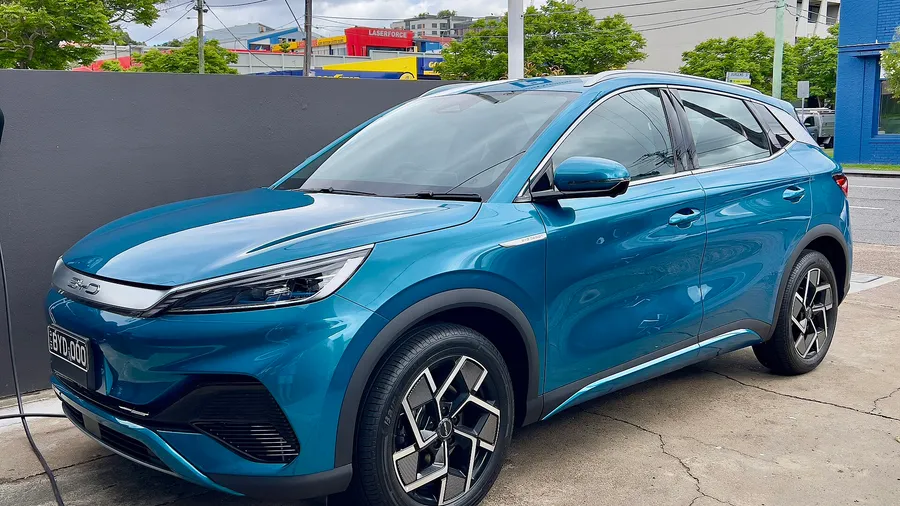
Photo: BYD Astara dealership, Alcobendas, Madrid, June 2025 · Zarateman · CC0 · Wikimedia Commons
On 7 October, Cinco Días, the business paper of the El País group, reported that Chinese manufacturers had taken 37.9 per cent of Spain’s plug-in car registrations in the first nine months of 2026, on 82,405 vehicles. The figures were compiled by Ideauto, the research arm of ANFAC, the national car industry association. In the same data, BYD led both halves of that market at once: 14,233 battery-electric cars, ahead of Tesla’s 13,466, and 20,151 plug-in hybrids. The paper called it the absolute owner of the Spanish plug-in hybrid market (Cinco Días, 7 October).
Both leads are real. They are not the same kind of lead.
Two Firsts, Two Markets
Start with the sizes. In battery-electric cars, BYD’s margin over Tesla was 767 units, out of its own 14,233. That margin narrowed late in the summer: at the end of August it was 2,210, with BYD on 11,943 and Tesla on 9,733 (Cinco Días, 8 September). Read the two sets of numbers together and Tesla sold about 3,733 battery cars in September against BYD’s roughly 2,290. On my arithmetic, the American brand out-sold the Chinese one by about 1,400 cars in Spain in September, eating most of the gap it had lost earlier in the year.
Plug-in hybrids are a different order of contest. To August, BYD had sold 18,007, over one and a half times Mercedes-Benz’s 10,473 and more than two and a half times Ebro’s 6,871; by the end of September it was 20,151. BYD’s combined plug-in total, 34,384 cars, is about 42 per cent of the 82,405 that Chinese brands sold across both segments, on my arithmetic.
| Spain, January to September 2026 | Battery-electric | Plug-in hybrid |
|---|---|---|
| Chinese brands’ share | 31.5% | 43.5% |
| BYD registrations | 14,233 | 20,151 |
| BYD’s nearest rival | Tesla, 13,466 | Mercedes-Benz, 10,473 (January to August) |
Sources: Cinco Días, 7 October for the nine-month figures and the shares; Cinco Días, 8 September for the Mercedes-Benz figure, which runs to August, the latest the paper has published. The plug-in hybrid column therefore mixes periods, because the sources do. Set August against August and BYD’s hybrid margin over Mercedes-Benz was 7,534 cars, against 2,210 in battery-electric cars.
The base matters, because the sceptical reading of any share gain is that the market shrank. It did not. The electrified market grew 36.9 per cent over the nine months and reached 23.8 per cent of all new registrations (Cinco Días, 7 October). Chinese brands took a rising share of a pool that was itself expanding. In 2025 they accounted for 10.2 per cent of the whole Spanish market, fuel cars included, and in February 2026 they were at 12.5 per cent against 8.73 per cent a year earlier (Cinco Días, 7 January; Europa Press, 9 March). BYD arrived in Spain only in the spring of 2023.
Scale like that is also what sets a carmaker’s terms with the firms behind it, a subject this site looked at in the Chinese supply chain.
Where the Tariff Stops
The European Union’s countervailing duty on cars built in China came into force on 30 October 2024, at rates from 7.8 per cent for Tesla’s Shanghai plant to 35.3 per cent for SAIC, for five years (European Commission, Implementing Regulation (EU) 2024/2754). Those rates sit on top of the standard 10 per cent base duty (Cinco Días, 7 October). The scope is the part worth reading twice. The measure covers new battery-electric vehicles, defined as propelled solely by electric motors, including those with an internal combustion range extender. A parallel plug-in hybrid, whose engine can drive the wheels, sits outside that definition and pays only the 10 per cent base rate.
That scope line is visible in the Spanish numbers. Chinese brands hold 43.5 per cent of the plug-in hybrid segment against 31.5 per cent of the battery-electric one, and the two are bundled into the 37.9 per cent headline. The taxed half is the weaker half.
Rules drawn along a technical parameter tend to get walked around. The MATCH Act drew one at a different parameter, and the shape is the same. Here the parameter is the drivetrain, and the market’s answer was to buy the other one.
Spain gives the plug-in hybrid a second push of its own. The DGT, the traffic authority, gives any plug-in hybrid with at least 40 kilometres of electric range the same zero-emissions label it gives a battery car (DGT; Cinco Días, 8 September). That label is what municipal policy runs on: in Madrid a zero-emissions car parks in the regulated green and blue bays without a time limit and without paying the fee, and enters the central low-emission zone freely (Ayuntamiento de Madrid). The 40-kilometre threshold sets the battery a plug-in hybrid needs before it earns the label. The dealers’ association said in December that the Chinese brands were going to sell hybrids in bulk (Cinco Días, 7 January).
The tariff is being renegotiated while it operates. In January the Commission published guidance that lets Chinese exporters offer a minimum import price in place of duties, with commitments on sales channels, cross-compensation and future investment in the EU; the first undertaking, from Volkswagen’s Anhui joint venture for the Cupra Tavascan, was accepted in February (European Commission, 12 January; eletric-vehicles.com, 9 October). Brussels is not holding the line so much as redrawing it.
A Spanish Badge on a Chinese Kit
Look at who stands behind BYD on the untaxed side. Cinco Días puts Ebro second in the plug-in hybrid ranking. Ebro is not a Chinese brand. It is a Spanish one, dormant since 1987 and revived by the Spanish company EV Motors with Chery as its partner (Cinco Días, 7 January; Cinco Días, 8 September). Its cars are built on Chery platforms in China, shipped as knocked-down kits, and reassembled at the old Nissan plant in Barcelona (Cinco Días, 7 October). The S700 is a Chery Tiggo 7 Pro underneath and the S800 a Tiggo 8 Pro Max, and the joint venture’s published plan runs to 50,000 vehicles a year in 2027 and 150,000 from 2029 (electrive, April 2024).
The word second needs a frame. Read across every brand rather than the China-linked group, and Mercedes-Benz, on 10,473 plug-in hybrids to August, and Audi, on 8,546, both sit ahead of Ebro’s 6,871. Second place belongs to the Chinese cohort, which is the one the paper was ranking, and Ebro is counted in it because the cars are Chery’s. Its plug-in sales rose 402 per cent to August (Cinco Días, 8 September).
The crowd underneath is where the winnowing has started. Counting Chinese brands and brands heavily dependent on China, including Volvo and Smart, 30 marques sold cars in Spain this year, and half of them have not reached 100 units (Cinco Días, 7 October). Above that line the investment is concrete. Chery has said it will weld and paint Omoda and Jaecoo models in Barcelona rather than only assemble them, and Geely has agreed to buy a third of Ford’s Almussafes plant in Valencia (Cinco Días, 7 January; Cinco Días, 7 October).
Spain is the entry door partly because it has been the permissive one. Chinese brands hold roughly double their European average share here, the country keeps attracting car and battery plants, and other member states regard that with suspicion (Cinco Días, 7 January; Cinco Días, 7 October). Assembly is where a new product’s supply chain usually starts before the parts follow, which is the logic behind a battery factory built to be copied.
The Window Brussels Is Closing
On 9 October, two days after the Spanish report, the EU’s trade commissioner, Maroš Šefčovič, said in Beijing that the two sides had reached a shared understanding to halve China’s exports of hybrids and plug-in hybrids to the bloc over four years, a reduction of several million cars (Reuters, 9 October; The Guardian, 9 October). The Chinese readout of the same talks is a list of 16 agreed outcomes and carries no figure, no percentage and no timetable for hybrids (eletric-vehicles.com, 9 October). Both texts exist. Only one carries a number, and it is the commissioner’s. EU leaders were due to take it up at their summit on 15 October.
The pressure had been building for a year. Monthly EU imports of Chinese hybrids rose from about 3,800 in October 2024, when the battery-car duty began, to about 50,000 in July 2026, according to Financial Times figures relayed by the trade press (eletric-vehicles.com, 9 October). In the year to September, plug-in hybrid imports into the EU rose 86 per cent while their prices fell 20 per cent, and more than half of them came from China (Reuters, 9 October). Brussels first asked Beijing in September to cap hybrids at about 15 per cent of the EU market. China refused, calling a voluntary export restraint a breach of WTO rules, and the Commission weighed a safeguard that would have admitted a quota at the normal 10 per cent tariff and charged heavily above it (eletric-vehicles.com, 9 October). A month after rejecting the cap, Beijing accepted an understanding whose European author describes the effect as a halving. Šefčovič called the sequence a first: China agreeing to restrain exports without waiting for a dispute to be declared (The Guardian, 9 October).
Brussels has a second instrument in the drawer. The Industrial Accelerator Act, proposed by the Commission and not yet law, would tie public support to a made-in-Europe test: a vehicle assembled in the EU with at least 70 per cent European components, batteries excluded. It still needs the Parliament and the Council. The European Parliament’s draft raises that bar to 75 per cent, and it is the gate for purchase subsidies such as Spain’s Auto+ (El País, 25 September; JTEKT, April 2026). The same draft would require European battery cells for a car to qualify, and it names the plants that could supply them: Volkswagen’s planned Valencia site and the CATL–Stellantis plant in Zaragoza (El País, 25 September). New capacity of that kind faces a qualification queue before it faces a capacity gap, a pattern this site keeps finding.
For Ebro, the rule that will decide the plant’s future is the content test: whether a car built from Chinese kits can clear it.
Three Numbers Worth Watching
Three numbers will settle how this reads in a year.
The first is the Chinese share of Spain’s plug-in hybrid segment, 43.5 per cent for January to September. If the October understanding acquires an enforcement mechanism, that number should fall in 2027. If it does not, the reduction is a statement and the share keeps climbing.
The second is what happens at Zona Franca in Barcelona. Ebro’s line assembles. Chery has said the Omoda and Jaecoo models will be welded and painted there, which is the difference between a badge and a factory. A content test is where that distinction stops being a figure of speech.
The third is BYD’s margin over Tesla in battery cars, which fell from 2,210 in August to 767 in September. One month is not a trend. But that is the lead the tariff was written to prevent, and it is the thinner of the two.
My reading would change if the Spanish hybrid share keeps rising after a workable cap is in place, which would put the binding constraint somewhere other than the tariff’s product scope. It would change the other way if Ebro’s Barcelona line becomes a car plant rather than a kit line, because then the Spanish badge would be carrying Spanish work.
Methodology
Two limits apply. The registration figures are Ideauto’s, published by Cinco Días; Ideauto is a research arm of ANFAC, the industry association, so the numbers carry the association’s segment definitions, and the vehicle total behind the 43.5 per cent hybrid share is not published, which is why that count appears here as my subtraction rather than as a source figure, and the 767 and 2,210 margins over Tesla are subtractions of the same kind. The October understanding between Brussels and Beijing has no published figure: the “half” and the “several million cars” are the European Commission’s characterisation of an understanding whose Chinese text contains neither. Where the tariff’s scope and rates are described, they come from the text of Commission Implementing Regulation (EU) 2024/2754.
Sources
- Cinco Días, “China se come el mercado español de coches electrificados: concentra el 38% de las ventas hasta septiembre”, 7 October 2026 — the core source, carrying Ideauto data: the 37.9 per cent Chinese share on 82,405 plug-in registrations; the 31.5 per cent battery-electric share on 31,614 units; BYD’s 14,233 battery cars and Tesla’s 13,466; BYD’s 20,151 plug-in hybrids and the paper’s phrase for its position; the 43.5 per cent hybrid share; the description of Ebro’s dependence on Chery; the Omoda, Jaecoo and MG hybrid counts; Geely’s 3,530 deliveries and the Ford Almussafes deal; the 30 China-linked brands and the half below 100 units; the 36.9 per cent growth of the electrified market and its 23.8 per cent share — cincodias.elpais.com
- Cinco Días, “BYD destrona a Tesla en España: es la que más eléctricos e híbridos enchufables vende hasta agosto”, 8 September 2026 — the comparison base: BYD’s 11,943 battery cars to August against Tesla’s 9,733; the Spanish battery-electric market at 83,122, up 34.2 per cent; BYD’s 18,007 plug-in hybrids; Mercedes-Benz at 10,473 and Audi at 8,546; Ebro’s 6,871 hybrids, up 402 per cent; BYD’s combined 29,950; the zero-emissions label covering plug-in hybrids; BYD’s 2023 entry — cincodias.elpais.com
- Cinco Días, “Las marcas chinas tiran del mercado automovilístico: concentran más de una de cada diez ventas en España”, 7 January 2026 — 2025 baseline: 1.148 million Spanish registrations, up 12.9 per cent; 26 Chinese brands at 10.2 per cent of the market and 11.5 per cent including Volvo and Smart; the Chinese brands’ concentration in electrified models; the dealers’ association on hybrids and on Spain’s share being about double the EU’s; Chery’s plan to weld and paint Omoda and Jaecoo in Barcelona — cincodias.elpais.com
- European Commission, “EU Commission imposes countervailing duties on imports of battery electric vehicles (BEVs) from China”, 12 December 2024, on Implementing Regulation (EU) 2024/2754 — primary legal text: the product scope, the range-extender inclusion, the five-year term, the rates for BYD (17.0 per cent), Geely (18.8 per cent), SAIC (35.3 per cent), Tesla Shanghai (7.8 per cent), other cooperating companies (20.7 per cent) and non-cooperating companies (35.3 per cent), all on top of the standard 10 per cent, applicable from 30 October 2024 — trade.ec.europa.eu
- European Commission, “Commission issues Guidance Document on submission of price undertaking offers for battery electric vehicles from China”, 12 January 2026 — primary policy document: minimum import prices per model and configuration, sales channels, cross-compensation and future investment in the EU — policy.trade.ec.europa.eu
- Reuters, “China, EU reach hybrid vehicle trade understanding, keep talks alive in EV dispute”, 9 October 2026 — wire report on the shared understanding to cut several million hybrid and plug-in hybrid cars over four years, the EU leaders’ summit on 15 October, plug-in hybrid imports into the EU rising 86 per cent in the year to September while their prices fell 20 per cent with more than half now coming from China, China’s 30 per cent share of plug-in hybrid import value in 2025, and the agreement to keep discussing price undertakings — reuters.com
- The Guardian, “China agrees to ‘halve’ hybrid car exports to EU in landmark deal”, 9 October 2026 — corroborating report on the halving, the 16-point package, and Šefčovič’s statement that this was the first time China had accepted to moderate exports without an earlier trade dispute — theguardian.com
- eletric-vehicles.com, “China Stocks Surge as EU and Beijing Avoid Hybrid Tariffs for Now”, 9 October 2026 — trade-press aggregation: the Chinese readout containing no figure, percentage or timetable; the monthly rise in EU imports of Chinese hybrids from about 3,800 in October 2024 to about 50,000 in July 2026, attributed to the Financial Times; the September request for a 15 per cent cap and the safeguard considered afterwards; the February acceptance of the first price undertaking, from Volkswagen’s Anhui joint venture; BYD’s European share more than doubling to 2.4 per cent in the first half, from ACEA — eletric-vehicles.com
- El País, “La Eurocámara plantea reforzar el escudo del coche eléctrico frente a China: el 75% del vehículo tendrá que ser local”, 25 September 2026 — report on the Parliament draft raising the European-components test to 75 per cent, batteries excluded, as the gate for purchase aid such as Spain’s Auto+; the requirement of European battery cells; and the named candidate plants, Volkswagen’s in Valencia and CATL–Stellantis in Zaragoza — elpais.com
- JTEKT Europe, “Industrial Accelerator Act: what it means for the automotive industry”, 8 April 2026 — industry summary of the Act as proposed by the Commission on 4 March 2026: the made-in-Europe test of assembly in the EU plus at least 70 per cent EU components excluding batteries, the current scope limited to electric and hybrid vehicles, and the fact that the Parliament and Council have still to approve it — jtekt.eu
- electrive.com, “Chinese car manufacturer Chery kicks off production in Barcelona”, 22 April 2024 — trade press on the joint venture: the Ebro S700 based on the Chery Tiggo 7 Pro and the S800 on the Tiggo 8 Pro Max; the plan for 50,000 vehicles a year by 2027 and 150,000 from 2029; about 1,250 jobs — electrive.com
- Europa Press, “Las marcas chinas ocupan en febrero una de cada diez ventas en Reino Unido, Italia y España”, 9 March 2026 — agency report on Chinese brands taking 12,148 cars and 12.5 per cent of the Spanish market in February 2026, up 58.5 per cent year on year, against 8.73 per cent a year earlier — europapress.es
- Dirección General de Tráfico, “Distintivo ambiental” — the issuing authority: the zero-emissions label goes to battery-electric, range-extended and plug-in hybrid vehicles with at least 40 kilometres of electric range and to fuel-cell vehicles, while plug-in hybrids below that range receive the ECO label; the DGT describes the classification as an instrument of municipal policy for traffic restriction and for tax and mobility benefits — dgt.es
- Ayuntamiento de Madrid, “Servicio de Estacionamiento Regulado (SER). Vehículos Cero Emisiones” — a concrete municipal case for what the label buys: holders of zero-emissions vehicles need no authorisation to park in the regulated green and blue bays, may park without a time limit and without paying the fee, and have free access to the central and Plaza Elíptica low-emission zones — sede.madrid.es