· Robin Wen · Industry & Manufacturing · 18 min read
Two Nuclear Clocks, One Scarce Isotope
Two labs have built a thorium-229 nuclear clock. What separates them is isotope spent per crystal, and whether the next crystal agrees.
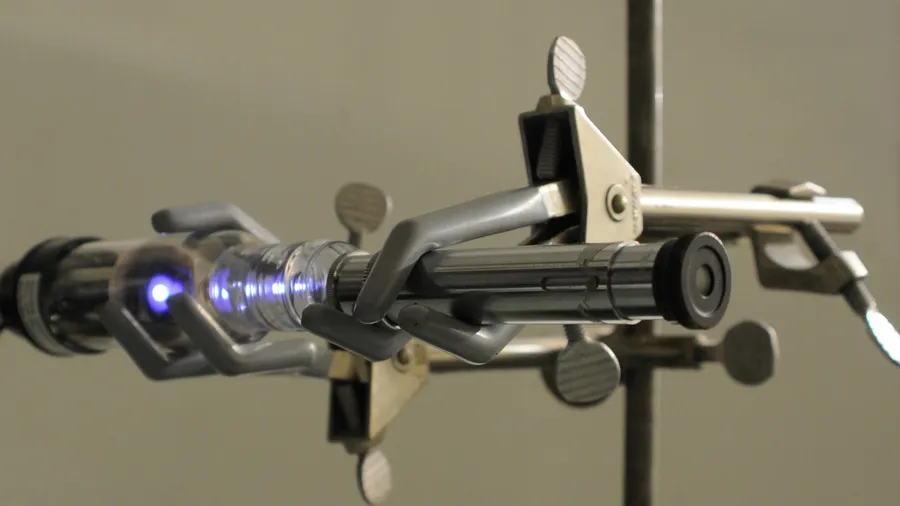
Photo: Thorium emission lamp and its spectrum · National Institute of Standards and Technology · Public domain · Wikimedia Commons · cropped to 1.91:1
On 7 October, Nature published two papers, both posted as preprints in June, and both reporting the same thing: a clock that keeps time with a transition inside an atomic nucleus rather than between the electron shells of an atom. One came from a group at Tsinghua University led by Ding Shiqian (Tsinghua University, 7 October). The other came from TU Wien and PTB, Germany’s national metrology institute (Toscani De Col et al., Nature, 7 October). Nature’s own commentary called the two, jointly, the first implementations of a nuclear clock (Kawasaki, Nature, 7 October). The Tsinghua paper is more specific: it describes its own device as the first thorium-229 nuclear clock, and the Vienna result as a near-simultaneous independent report (Huang et al., Nature, 7 October).
Every clock needs an oscillation. In today’s most advanced atomic clocks, the oscillation is a visible-light wave absorbed when an electron moves between two energy levels. A nuclear clock uses a jump between energy levels of the nucleus itself: the same idea moved one layer down, and the reason anyone bothers is that a nucleus is roughly five orders of magnitude smaller than the electron cloud around it and couples far more weakly to stray electric and magnetic fields (the outline is in this 2026 review).
The transition itself sits at 2.0204×10¹⁵ Hz, two thousand trillion ticks a second (Toscani De Col et al.).
For a reader deciding how much to care, two numbers from a Chinese-language summary of the two papers are the useful starting point. Measured over a day of running, both clocks drift by the equivalent of about one second in three million years. Today’s best atomic clocks are quoted at one second in forty billion (China Science Daily, 25 June). Being second-best in precision, however, is not the same as being second-best in kind, and the interesting part of these two results is elsewhere.
Why the nucleus
Atomic clocks have been the world’s timekeepers since the first caesium clock ran in 1955, the current second is a count of caesium-133 oscillations adopted by the General Conference on Weights and Measures in 1967, and the optical clocks that followed now sit around the 10⁻¹⁸ level in uncertainty, which is where the forty-billion-years comparison comes from (Photonics 13(2), 141).
Moving from the electron shell to the nucleus buys three things, and the papers are explicit about all three.
The first is isolation. Atomic energy levels are governed by electromagnetism, and the electron cloud is a large antenna for anything electrical or magnetic in the laboratory. Nuclear levels are governed by the strong interaction, and the nucleus is small enough that outside fields couple to it far more weakly. That is why an optical clock needs a vacuum chamber, laser cooling and a carefully controlled thermal environment, and why these two clocks were both built inside a solid crystal at or near room temperature.
The second is that thorium-229 is, so far, the only nucleus this works for. Nuclear transitions usually sit between keV and MeV, far higher than electronic binding energies, which makes them difficult to excite directly with light. Thorium-229’s first excited state needs 8.4 electronvolts, which is a wavelength of 148.4 nanometres, and the reason is a near-cancellation between the Coulomb and nuclear contributions to the two states’ binding energies. That same near-cancellation makes the transition unusually sensitive to any change in the constants that govern those forces, which is why nuclear clocks get proposed as dark-matter detectors as well as timekeepers.
The third is that the sensitivity is bought with a material. Doping microgram amounts of thorium into a crystal host gives you an ensemble of nuclei answering to the same laser at once, and a large gain in signal-to-noise ratio over a single trapped ion (Toscani De Col et al.). The bill arrives as spectrum: the lattice shifts the line, and the line is inhomogeneously broadened. A January 2026 paper from the JILA group in Boulder and TU Wien measured that broadening and found it grows with the doping concentration and is limited by the host crystal’s own properties (Ooi et al., Nature 650, 72). The same group identified an operating temperature, 196 kelvin, at which the first-order temperature sensitivity of the transition vanishes.
The missing part was a laser
The nuclear transition was measured with pulsed lasers, beginning with the first laser excitation of a nucleus in April 2024, and this is where the field stalled. A pulse can tell you where the line is. It cannot hold a clock, because the thing you have to stabilise is a continuous wave, and the 2024 source’s linewidth was around 10 gigahertz against an intrinsic nuclear line that the Photonics review puts in the millihertz range.
So the decade’s real obstacle was a light source: 148.4 nanometres, continuous, narrow, and at a usable power. Two groups built one in 2025, by routes about as different as two ways of making the same wavelength can be.
| Route | Group | Vacuum-ultraviolet power | Method |
|---|---|---|---|
| Cadmium vapour | Tsinghua (Xiao et al., 2026) | 100 nW | four-wave mixing in hot metal vapour |
| Cascaded doubling | PTB (Lal et al., 2025) | 1.3 nW in a single pass | three doubling stages in a crystal |
The light itself has to travel in vacuum, because air absorbs at this wavelength. The Tsinghua source is tunable from 140 to 175 nanometres and came with a linewidth below 100 hertz (Xiao et al., Nature 650, 852). The PTB paper reports its single-pass power and quotes its driving laser at about 100 kilohertz, used without active frequency stabilisation (Lal et al., Optica 12, 1971). The two preprints went up within days of each other in July 2025, and the Tsinghua release describes its version as the first continuous-wave source at 148 nanometres. What the numbers establish is a gap in power, and a stated linewidth on one side only; precedence is a matter of days either way. The clock paper in October quotes a 10 μW source from the same cadmium-vapour route, against the 100 nW of the laser paper eight months earlier.
The United States noticed the component before either clock existed. In February 2025 DARPA announced SUNSPOT, a programme to develop nothing but a coherent vacuum-ultraviolet laser for a thorium nuclear clock, and its programme page is candid about the motive: precision clock networks underpin navigation and communications, and optical clocks promise resilience “in GPS-denied conditions” (DARPA). Tsinghua’s release notes that its 148-nanometre output came before SUNSPOT was set up (Tsinghua University, 12 February); the same work was funded by China’s National Natural Science Foundation (NSFC, 12 February).
My reading is that this is the part of the story with a buyer. The clock is a demonstration that the light works.
1.4 micrograms
The other scarce input is the isotope, and here the Chinese team’s account contains the number I would put at the top of the file. The Tsinghua release says the team used 1.4 micrograms of thorium-229 for a single growth, produced a millimetre-scale high-quality crystal first time, and used about one two-hundredth of the isotope the European team used per growth, because there was no room for trial and error (Tsinghua University, 7 October). The paper’s own wording is that the small isotope amount, dictated by the severe scarcity of thorium-229, left essentially no room for iterative growth optimisation (Huang et al.).
Those are the team’s own figures, and they point at a constraint that has nothing to do with geology. Thorium is not rare. Thorium-229 is, and the reason is that its production chain already has a customer. A peer-reviewed 2026 review of the field describes the available supply as dominated by targeted alpha therapy, a cancer treatment built on actinium-225 and its decay daughter bismuth-213, and calls the isotope’s availability an absolute bottleneck, noting that purity requirements are exceptionally stringent and that few facilities can produce it (Photonics 13(2), 141).
The producer says the same thing from the other side. Oak Ridge National Laboratory, which supplies most of the world’s actinium-225 for the Department of Energy’s isotope programme, holds a thorium-229 inventory left over from past nuclear programmes and processes it to recover the radium-225 that decays into the actinium. It reports that demand for that isotope already outweighs production (ORNL, 26 March 2021).
The clock’s supply problem is not that the element is scarce. It is that the material the clock needs is the feedstock for a cancer drug whose demand is already ahead of supply, which is the same shape as the constraint on helium-3 for refrigeration.
Then the crystal itself became the measured limit.
| Tsinghua (Huang et al.) | TU Wien and PTB (Toscani De Col et al.) | |
|---|---|---|
| Fractional frequency instability | 5×10⁻¹³/√(τ/s) | 3×10⁻¹²/√(τ/s) |
| Crystal | Th:CaF₂, millimetre-scale | Th:CaF₂, millimetre-scale, at 294.7 K (±0.5 K, no servoing) |
| Laser used | 10 μW, from the same group’s cadmium-vapour source | 148 nm continuous wave, compared against a Yb⁺ ion clock |
| Reported reproducibility | two independently grown crystals differ by 2.8×10⁻¹³, in fractional terms | about 5×10⁻¹³ between runs on different days |
The last row is the one to read twice, and it is the reason I would not describe either result as a working frequency standard yet. The Vienna paper reports that the line centre moves by up to 1.7 kilohertz depending on where the laser crosses the crystal, well above the 0.13 kilohertz expected from statistics, and conjectures that local strain from structural inhomogeneity causes those shifts. The Boulder and Vienna collaboration had already measured, across two differently doped crystals and seven months, a reproducibility of 220 hertz, or 1.1×10⁻¹³. The Tsinghua paper’s claim is that its own two crystals agree at the 10⁻¹³ level and match earlier measurements made on other crystals with different equipment.
So the two clocks are at the same order on the metric that decides whether a clock can be copied. The Vienna paper traces its own run-to-run movement to the crystal; the Tsinghua paper reports its two crystals agreeing and does not nominate the crystal as a limit. My reading is that the next step is a materials problem either way: getting a material to work once is a laboratory result, and getting it to work the same way in the next batch is the kind of qualification problem that decides whether an instrument ships (a lesson this site has run into before).
Where the gap is
None of this makes the nuclear clock the best clock. It is not close yet.
At one second of averaging, the Tsinghua clock reaches 5×10⁻¹³ and the Vienna clock 3×10⁻¹² (Huang et al.; Toscani De Col et al.). An aluminium-ion single-ion clock reported by NIST in July 2025 reaches 3.5×10⁻¹⁶ with an uncertainty of 5.5×10⁻¹⁹, as the Photonics review records. All three instability figures are fractional frequency terms at one second of averaging, so they can be put beside each other. On my arithmetic, the Tsinghua clock is about three orders of magnitude off the aluminium clock and the Vienna clock about four.
What the nuclear clock has going for it is the ceiling. The transition’s lifetime approaches an hour for a bare nucleus in vacuum, which corresponds to a potential resonance quality factor of about 10¹⁹, and the Vienna paper works out what its own hardware would need to reach: a crystal path ten times longer with a one-microwatt laser would give 10⁻¹⁵/√(τ/s), and a thousand-hertz linewidth with a high-stability cavity and a hundred picowatts would give 10⁻¹⁶/√(τ/s), which the authors describe as the level of state-of-the-art optical atomic clocks. That is a projection from the group that is currently behind on stability, and it is the more useful estimate for that reason.
One thing the papers do not do is change the second. The definition is a decision of the General Conference on Weights and Measures, and it still names a caesium transition. A working nuclear clock is a candidate for whatever comes next, not the arrival of it.
What a nuclear clock would be used for
The Chinese announcement is careful about tense: a solid-state nuclear clock has potential advantages in miniaturisation and engineering, and is expected in future to offer a practical option for the precision timing that satellite navigation and deep space exploration require (Xinhua, 7 October). The Tsinghua release adds tests of fundamental physics, since a transition this sensitive to the constants of nature is a way of checking whether they hold still.
The light source has its own customers. The February paper names aluminium-ion optical clocks, angle-resolved photoemission and high-resolution vacuum-ultraviolet spectroscopy; the university’s release adds vacuum-ultraviolet metrology for semiconductor materials and process control, including chip inspection (Tsinghua University, 12 February).
I read the Chinese sources cited here looking for a military application, and did not find one stated.
The defence argument is documented, but it is being made on the other side, by the agency that is paying for the laser. SUNSPOT’s own framing is about navigation and communications that survive when satellite navigation does not, and about packing that precision into something portable. The Vienna team’s paper lists DARPA among its funders; the paper does not say which programme the grant belongs to, and I have not confirmed it.
The fundamental-physics use, by contrast, has already produced a result. The Vienna group ran its clock as a dark-matter search, looking for periodic wobbles in the transition energy over timescales from twenty seconds to a day, and reported constraints that compete with the best atomic-clock comparisons for coupling to photons and go beyond earlier measurements for coupling to the strong force and quarks.
If the light source turns into an industrial instrument for chip metrology, that will be a harder test than the clock, and a more consequential one (the pattern this site keeps finding). The clock’s job was to prove the light.
Next numbers
Three numbers will decide how this reads in five years, and all three are cheap to watch.
The first is reproducibility measured by someone outside these two groups. The existing figures come from the same collaborations that built the clocks, and a standard is a number that other people’s equipment can find again.
The second is the mass of thorium-229 per crystal, and whether the isotope gets cheaper. What moves it is the cancer-therapy production of actinium-225, a schedule with nothing to do with clocks.
The third is whether the projected 10⁻¹⁶ arrives. That would put a solid-state clock at the level of the best optical clocks while keeping what makes it different: no laser cooling, no single trapped ion, and a crystal the size of a grain of rice, with the light, as always at this wavelength, travelling in vacuum.
What would make me drop the argument that this is a manufacturing problem rather than a physics one: if the 1.7-kilohertz spread across a crystal turns out to be an artefact of a fixable optical alignment rather than a property of the material, or if the ion-trap route, pulling thorium out of the crystal and holding single ions instead, reaches optical-clock stability first. The physics was settled in 2024, when the transition was first excited with a laser. What has been settled since is the supply of light and the behaviour of the crystal, and that is where the next move is.
Methodology
Three limits apply. The Tsinghua clock paper is open access and I read it in full, including its inter-crystal frequency comparison; the Vienna paper I also read in full. My account of the isotope supply chain rests on a peer-reviewed 2026 review and on Oak Ridge National Laboratory’s own account of why it holds a thorium-229 inventory, rather than on any disclosure by the two clock teams. And the 1.4-microgram and one-two-hundredth figures are the Tsinghua team’s own account of its crystal growth, not an audited record; I have labelled them as the team’s throughout.
Sources
- Huang, B.; Yan, G.; Xiao, Q. et al., “A nuclear clock synchronized to ²²⁹Th”, Nature, 7 October 2026 — peer-reviewed paper, full text read. The 5×10⁻¹³/√(τ/s) instability, the 10 μW cadmium-vapour source, the description of its own device as the first thorium-229 nuclear clock and of the Vienna work as near-simultaneous, the 1.4 μg single growth with no room for iterative optimisation, the 2.8×10⁻¹³ inter-crystal frequency difference, and the reference stability below 10⁻¹⁵ at 1,000 s — doi.org and arXiv:2606.08870
- Toscani De Col, L.; Riebner, T.; Morawetz, I. et al., “A thorium-229 optical nuclear clock with feedback loop”, Nature, 7 October 2026 — peer-reviewed paper, full text read. The 3×10⁻¹²/√(τ/s) instability, the room-temperature CaF₂ crystal at 294.7 K, the ~5×10⁻¹³ day-to-day reproducibility, the 1.7 kHz spread of line centres across crystal positions and the conjecture that local strain causes it, the transition frequency of 2.0204×10¹⁵ Hz, the ~10¹⁹ quality factor, the 10⁻¹⁵ and 10⁻¹⁶ projections, the dark-matter constraints, and the DARPA grant number in the acknowledgements — doi.org and arXiv:2606.04997
- Xiao, Q.; Penyazkov, G.; Li, X. et al., “Continuous-wave narrow-linewidth vacuum ultraviolet laser source”, Nature 650, 852–856, 11 February 2026 — peer-reviewed paper, abstract and arXiv version read. The 100 nW output, the linewidth below 100 Hz, the 140–175 nm tuning range, and the four-wave mixing route in cadmium vapour — doi.org and arXiv:2507.19449
- Lal, V.; Okhapkin, M. V.; Tiedau, J.; Irwin, N.; Petrov, V.; Peik, E., “Continuous-wave laser source at the 148 nm nuclear transition of Th-229”, Optica 12, 1971–1974, 2025 — peer-reviewed paper, abstract and arXiv full text read; the published Optica text was blocked by a CAPTCHA. The 1.3 nW single-pass vacuum-ultraviolet power, the driving laser’s linewidth in the order of 100 kHz used without active stabilisation, and the cascaded-doubling route — doi.org and arXiv:2507.17719
- Ooi, T.; Doyle, J. F.; Zhang, C.; Higgins, J. S.; Ye, J.; Beeks, K.; Sikorsky, T.; Schumm, T., “Frequency reproducibility of solid-state thorium-229 nuclear clocks”, Nature 650, 72–78, 28 January 2026 — peer-reviewed paper, abstract read on PubMed. The 196(5) K optimum operating temperature, the 220 Hz (1.1×10⁻¹³) reproducibility between two differently doped crystals over seven months, and the concentration-dependent inhomogeneous linewidth limited by the host crystal — doi.org and PubMed 41606322
- Tsinghua University Department of Physics, “Physics department’s Ding Shiqian team develops the nuclear clock first internationally”, 7 October 2026 — institutional release from the participating institution. The team composition, the 1.4-microgram single growth and the one-two-hundredth comparison with the European team, the “no room for trial and error” statement, and the near-order-of-magnitude stability advantage over the European team — phys.tsinghua.edu.cn
- Tsinghua University Department of Physics, “Ding Shiqian team develops the vacuum-ultraviolet source for a nuclear clock”, 12 February 2026 — institutional release. Output above 100 nW, linewidth far below 100 Hz, 140–175 nm tunability, the cadmium-vapour four-wave mixing route, the statement that the team achieved 148 nm continuous-wave output before DARPA’s SUNSPOT programme was launched, and the source’s other applications including vacuum-ultraviolet metrology for semiconductor materials and process control, including chip inspection — phys.tsinghua.edu.cn
- National Natural Science Foundation of China, “Chinese researchers develop a vacuum-ultraviolet source for the nuclear clock”, 12 February 2026 — government release corroborating the source’s specification, its grant numbers and the “core bottleneck” framing — nsfc.gov.cn
- DARPA, “SUNSPOT: Sources for Ultraviolet Nuclear Spectroscopy of Thorium” — US government programme page, solicitation HR001125S0008. The programme’s goal of a coherent vacuum-ultraviolet laser as the key enabling technology for a thorium nuclear clock, and its framing around GPS-denied navigation, compactness and beyond-GPS timing — darpa.mil
- Kawasaki, A., “Nuclear clocks tick for the first time”, Nature News & Views, 7 October 2026 — independent expert commentary from the National Metrology Institute of Japan, describing the two papers jointly as the first implementations of a nuclear clock. Read only as far as the paywall permits, which includes the author’s affiliation and opening paragraph — nature.com
- “Current Progress on ²²⁹Th Nuclear Clock”, Photonics 13(2), 141, 2026 — peer-reviewed review. The caesium definition of the second adopted by the 13th CGPM in 1967 and the first caesium clock of 1955, the 10 GHz linewidth of the 2024 pulsed excitation source against the millihertz-class intrinsic nuclear line, the 3.5×10⁻¹⁶ and 5.5×10⁻¹⁹ figures for an aluminium-ion single-ion clock reported by NIST in July 2025, and the dominance of targeted alpha therapy over the thorium-229 supply chain — mdpi.com
- Oak Ridge National Laboratory, “ORNL meets key FDA milestone for cancer-fighting Ac-225 isotope”, 26 March 2021 — US national laboratory account. The thorium-229 inventory recovered from past nuclear programmes, its periodic processing to recover the radium-225 that decays into actinium-225, the lab’s role as the bulk supplier of Ac-225 for the DOE Isotope Program, and the statement that demand outweighs production — ornl.gov
- Xinhua, “Chinese scientists develop a nuclear clock”, 7 October 2026 — state news agency report of the announcement, which is where the Chinese side’s application framing is written: a solid-state nuclear clock’s potential miniaturisation and engineering advantages, and its future use for the precision timing that satellite navigation and deep space exploration require. Link carries
nofollowunder this site’s source policy — news.cn - “The first nuclear clocks are here: about one second in three million years”, China Science Daily, 25 June 2026, carried on Tsinghua University’s news site — Chinese-language science news report, used for the one-second-in-three-million-years drift and the one-second-in-forty-billion-years comparison for today’s best atomic clocks. Cited as a secondary summary; where it conflicts with the two papers, the papers govern — tsinghua.edu.cn