· Robin Wen · Industry & Manufacturing · 17 min read
China's Airborne Wind Power Reaches 4,000 Metres
China's S4000 flew a floating power station to 4,000 metres, thirteen times the record. Its parts came from China's supply chain; its cost is unmeasured.
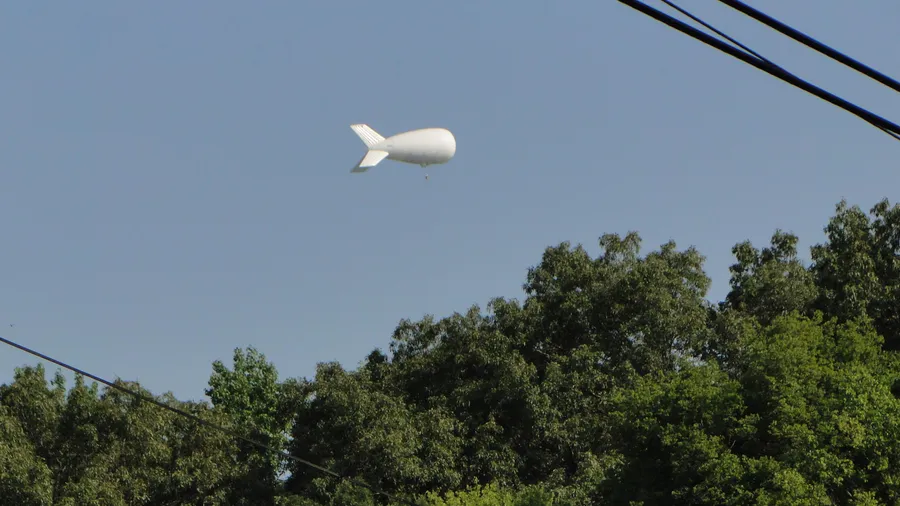
Photo: Tethered aerostat aloft, Redstone Arsenal, Alabama, 2009 · Kari Hawkins, US Army · Public domain · Wikimedia Commons · The S4000 itself is not pictured; no openly licensed photograph of it was found for this article.
In August 2026, a helium-filled envelope 67 metres long, 40 metres wide and 23 metres high rose from a test base in north-west China, held its position, generated electricity, and came back down. The system is called S4000, and it was built by Beijing Linyi Yunchuan Energy Technology. State media described the flight as the first time an airborne wind power system has generated electricity at 4,000 metres above sea level (Hunan Daily, 24 August). It carries more than a tonne of payload and delivers between 10 and 35 kilovolts (China Daily, 2 September).
Four thousand metres is the number to hold on to. A United States start-up holds the previous benchmark for this kind of machine: 297 metres, at 30 kilowatts (Xinhua, 18 November 2024; CCTV, 26 January). That is a gap of about thirteen times in altitude. The record is the developer’s and the broadcaster’s rather than a measurement body’s, and the company’s chief technology officer put the best non-Chinese altitude in the field at about 500 metres in March (Hunan Daily, 9 March). I have not found a competing flight at 4,000 metres.
The industry term is airborne wind energy: instead of building a taller tower, send the generating equipment up. Wind power scales with the cube of wind speed, and the air at altitude carries 5 to 10 kilowatts per square metre against less than 1 near the ground (Xinhua). The arithmetic has drawn engineers since the 1970s oil shock. What changed in the past few years is not the arithmetic but the components.
Why the height is the metric
A conventional turbine needs a heavy tower and a substantial foundation. A helium aerostat needs no tower, and its ground structure is simple, so it can be taken down and moved between sites. The company’s sequence runs from a 500-metre flight in October 2024, to 1,000 metres in January 2025, to a megawatt-class machine over the Gobi in September 2025, to a 2,000-metre grid-connected flight in Sichuan in January 2026 (Securities Times, 22 September 2025; Xinhua; CCTV, 26 January). The August flight extends that series.
| Machine | Flight altitude | Power | When |
|---|---|---|---|
| S500 | 500 m | above 50 kW | October 2024 |
| S1000 | 1,000 m | 100 kW | January 2025 |
| S1500 | megawatt class | over 1 MW design | September 2025 |
| S2000 | 2,000 m | up to 3.6 MW | January 2026 |
| S4000 | 4,000 m | not published | August 2026 |
Sources: Xinhua; Securities Times; Tsinghua University, 23 September 2025; Hunan Daily, 9 March; CCTV, 26 January.
The S4000 flight is described as a full cycle: ascent, station-keeping, a generation test and controlled recovery, with a design service life of 20 years (Science and Technology Daily, 22 August). A full cycle is a long way from a season. The company says the machine will now run long-duration high-altitude tests, and that the data will feed a larger S6000 rated at 5 megawatts (China Daily; PingWest, 24 August). My reading is that the 20-year figure is a design value with nothing behind it yet: no operator has published a multi-year service record, because the product has not existed that long.
The kite and the balloon
Two families of machine are chasing the same wind. One keeps the generator on the ground and flies a wing or a parachute that pulls a tether; the other hoists the generator itself. Makani, the Alphabet subsidiary, took the second route with a 26-metre flying wing rated at 600 kilowatts. Alphabet shut the project in 2020, and the reporting at the time recorded engineering shortfalls alongside a commercialisation path that had narrowed; the company then published its designs, patents and flight data (Google X; IEEE Spectrum, 2020).
Linyi Yunchuan’s machine does not fly in circles. The helium envelope sits still, with a ring-shaped duct around 12 bays of generators that funnels the airflow, and a tether that both holds the craft and carries the current. That is closer to a tethered kite than to an aircraft, except that the turbogenerators travel with it. It is also why a small company can do it at all: nothing has to land, take off or glide.
China is funding both families at once, which is the part that gets lost. While Linyi Yunchuan was climbing through its S-series, China Energy Engineering and Zhonglu took the ground-generator route, and in January 2024 a 2.4-megawatt demonstration project in Jixi, Anhui generated electricity, described in the party paper as the country’s first grid-connectable megawatt-class airborne wind project (People’s Daily, 22 January 2024). In November 2025 the same route opened a 5,000-square-metre wind-catching parachute over a test site in Alxa, Inner Mongolia (Xinhua, 12 November 2025). Two routes, two sets of sponsors, one grid to sell into. It is the habit of funding more than one candidate at once that this site noted in fusion.
What the record establishes is narrower than a verdict on the route: the airborne approach now has working hardware.
A fabric that decided the price
Four things have to work. A generator light enough to fly, an aerostat stable enough to loiter, a tether that carries power, and an envelope that survives the sky. The company did not develop most of them, and it says so.
Take the motors. A three-megawatt generator of conventional design is estimated to weigh tens of tonnes, which is useless on an aerostat. The chief executive, Dun Tianrui, told CCTV that the weight problem “was dissolved by the market, or by our country’s industrial system” before his team got to it, and that the motors were built with domestic partners and now weigh a few hundred kilograms (CCTV, 26 January). The S2000 carries twelve bays, three 100-kilowatt flat disc motors in each, for up to 3.6 megawatts. Tsinghua University’s electrical machines department designed the megawatt-class electrical system, including the high-power-density generator and the lightweight power conversion (Tsinghua University, 23 September 2025).
The aerostat comes from science. The Chinese Academy of Sciences’ Aerospace Information Research Institute has flown sounding airships since 2017, and a Type III Jimu-1 reached 9,032 metres in May 2022; the institute now works with the company (Chinese Academy of Sciences; PingWest). The tether rides on China’s power-cable industry: the chief executive points out that the country already runs 1,000-kilovolt direct-current links, against his own system’s under 100 kilovolts (CCTV, 26 January). Foreign industries built pieces of this before, and the pattern of an application living off a capability that grew up elsewhere is one this site keeps finding.
The envelope is the exception, because it had an incumbent. Skin material is 30 to 40 per cent of total system cost, and until recently it came from overseas firms, leaving the supply chain exposed to security concerns, long lead times and quality that could not be controlled; for the earlier S500 and S1500 machines a single set of envelope material cost close to 5 million yuan (Hunan Daily, 9 March; 21st Century Business Herald, 12 January). So the company built a plant in Zhoushan, Zhejiang, with two wide dry-lamination lines and a laminate of ultra-high-molecular-weight polyethylene fabric, an aluminised barrier and a weathering layer, stable from minus 50 to plus 65 degrees Celsius and rated for more than five years. Trial production began in December 2025 (21st Century Business Herald). The company says the base cut material cost by more than 40 per cent and shortened procurement by 60 per cent (Hunan Daily).
That is the sentence I would keep from this story, and it is the one the altitude record obscures. The achievement was assembly, not invention: a stack of parts that other industries had already paid to develop, plus the one gap where an incumbent could set its own price. A new product needs machines and suppliers that do not yet exist, and the usual answer is to build them yourself. The next test is the one this site keeps returning to in materials: not whether the first envelope works, but whether the thousandth does (and the qualification queue behind it).
Nobody has priced a kilowatt-hour
The cost figures on offer come entirely from the seller. Compared with a conventional onshore turbine, the company says, an airborne system needs no tower or heavy foundation, saves 40 per cent of material, and cuts the levelised cost of electricity by 30 per cent (Hunan Daily; Securities Times). At 3,000 metres, the company’s estimate puts the cost of electricity close to onshore wind. At 9,000 metres, it puts the theoretical annual utilisation above 8,000 hours and the cost an order of magnitude lower, or about 0.03 yuan per kilowatt-hour (Hunan Daily). The chief executive has put a date on the same figure: one-tenth of coal’s cost by 2028, which the interviewer rendered as three fen (CCTV, 26 January).
Each of those numbers is a projection, and the height attached to the last one matters. The three-fen estimate is a nine-kilometre figure; the S4000 flies at four.
The measured record is thinner. The January 2026 test in Sichuan delivered 385 kilowatt-hours and completed a grid-connection test (CCTV, 26 January; Chao News, 6 January). The company’s framing is about proving grid connection rather than producing useful energy, and on its ideal case a year of generation would supply nearly 3,000 households (CCTV, 26 January). It is the only delivered-energy figure I have been able to find.
For scale, China’s wind fleet generated 1.13 trillion kilowatt-hours in 2025, out of a national total of 10.58 trillion (National Bureau of Statistics, 28 February; National Energy Administration, 12 February). Airborne machines are nowhere near that, and I would not call the S4000 a commercial power plant. I would call it a component programme that has passed its flight tests, with an order book of nearly 500 million yuan for the two earlier models, which is a statement about intent rather than revenue (Hunan Daily).
Who buys the output
The company lists three uses. The first is grid supply, which is the hardest, because it competes on price with everything else on the system. The second is the market diesel currently owns: mines and outposts, islands, mountain communities and disaster zones, where a power station that can be moved between sites is worth more than a cheap kilowatt-hour (PingWest; 21st Century Business Herald; South China Morning Post, 25 August). The third is the low-altitude economy: a platform that stays up for long periods and generates its own power can carry radar, communications or monitoring payloads (PingWest).
The second use is where the technology has a defensible case today, and it is also why the altitude record is worth having. In the places the grid does not reach, the comparison that matters is a diesel generator and the fuel convoy behind it, rather than a wind farm.
Policy has moved in step, but less far than the coverage implies. The 15th Five-Year Plan for renewable energy, issued on 23 July 2026, lists “exploring and researching high-altitude wind power and other new forms of wind energy utilisation” inside a column on frontier technology and high-end equipment, alongside perovskite tandem cells and space-based solar (NDRC and National Energy Administration, 23 July 2026; English rendering). That is a research line, not a capacity target. The company, for its part, says its laboratory will support the drafting of national material standards for high-altitude wind power (Hunan Daily). Setting a standard begins with owning the thing the standard describes.
Next numbers
Three numbers will settle how this reads in five years, and all three are cheap to watch.
The first is station-keeping time. A full cycle in August is a flight test; the claim that matters is continuous loitering through weather, which the company says is the next campaign. The second is the Zhoushan plant’s actual output against its stated plan of 200,000 linear metres in 2026 and 600,000 in 2027 (Hunan Daily, 9 March; Chao News). The third, and the one to wait for, is an electricity cost measured by someone who is not selling the machine: the grid operator, an independent power producer, or a third-party engineering firm.
The emphasis here would change if the flown machines turn out to be near-bespoke, with each envelope a one-off and the flight campaign a demonstration rather than a production line, in which case the material plant is a cost centre and not a business. If instead the envelopes come off the line at a steady rate and the next flights are long, the interesting story will not be 4,000 metres at all. It will be the price of the fabric.
Methodology
Two limits apply. The performance figures for S4000 and its predecessors come from the developer and from Chinese state media relaying the developer’s account; no independent engineering assessment is public in the material I found, and the altitude record is a claim made by the developer and the broadcaster rather than by a measurement body. The cost figures, including the 30 per cent reduction and the three-fen estimate, are the company’s own calculations; I have marked them as such in the text. Where the renewable energy plan of 23 July 2026 is cited, it is the plan’s published text, which places high-altitude wind power under research exploration rather than under a generation target.
Sources
- CCTV News, “S4000 floating wind power system completes full-process release verification”, 22 August 2026 — state broadcaster report of the test and the 4,000-metre altitude. Carried by Science and Technology Daily
- CCTV, Face to Face interview with Dun Tianrui and Weng Hanke, 26 January 2026 — broadcaster interview, the single most useful source here: the 297-metre and 30-kilowatt foreign record, the 385 kilowatt-hours and grid test of 5 January, the twelve bays of three 100-kilowatt flat disc motors and the 3.6-megawatt maximum, the statement that the weight problem was solved by the domestic industrial system rather than by the company, the power density of about 10 kilowatts per kilogram, the ideal-case figure of nearly 3,000 households, the 1,000-kilovolt direct-current cable comparison, the plan to go above 4,000 metres, and the chief executive’s stated target of coal’s cost divided by ten by 2028, rendered by the interviewer as three fen — people.cctv.com
- Hunan Daily, “Linyi Yunchuan: building a power station at 2,000 metres”, 9 March 2026, carried on the Hunan Provincial Department of Industry and Information Technology site — provincial government site relaying the provincial party paper: the S500-to-S2000 flight history, the chief technology officer’s statement that non-Chinese floating altitude tops out at about 500 metres, the envelope’s 30–40 per cent share of system cost and the near-5-million-yuan procurement cost, the statement that foreign supply exposed the chain to security, lead-time and quality risk, the Zhoushan plant and its stated cost and lead-time reductions, the 30 per cent electricity-cost reduction, the 3,000-metre and 9,000-metre cost estimates, the near-500-million-yuan order book, the stated plan of 200,000 linear metres in 2026 and 600,000 in 2027, and the company’s stated intention to support national material standards — gxt.hunan.gov.cn
- Hunan Daily, “First in the world: Yueyang-built ‘power station in the air’ reaches 4,000 metres and generates electricity”, 24 August 2026, carried on the Hunan Provincial Department of Industry and Information Technology site — provincial government site: the S4000’s dimensions, 4,000-metre altitude, more than one tonne of payload, 10–35 kilovolt output, 20-year design life, and the state-media description of the flight as a world first at that altitude — gxt.hunan.gov.cn
- Xinhua, “High-altitude wind energy: a green energy field with promise?”, 18 November 2024, from Economic Information Daily — national news agency feature: the S500’s October 2024 flight to 500 metres, the 297-metre and 30-kilowatt benchmark held by foreign teams, the distinction between ground-based and airborne approaches, and wind power densities of 5–10 kilowatts per square metre aloft against below 1 near the surface. Carries
nofollowunder this site’s source policy — news.cn - Securities Times, “‘Asking the sky for electricity’ takes a key step: world’s first megawatt-class commercial airborne wind system completes Gobi test”, 22 September 2025 — financial press report: the September 2025 Hami test, the S1500’s 60 by 40 by 40 metre envelope and 12 × 100 kilowatt generators, the S500’s 50-kilowatt and S1000’s 100-kilowatt milestones, and the 40 per cent material saving and 30 per cent cost reduction claims — stcn.com
- Tsinghua University, “Megawatt-class high-altitude wind power system jointly developed by the Department of Electrical Engineering succeeds in Xinjiang test flight”, 23 September 2025 — university release from a participating institution: the S1500 specification, the 12 interconnected 100-kilowatt units, and the specific electrical design responsibilities of the Tsinghua team under Lu Chao, including the high-power-density generator and lightweight power conversion — tsinghua.edu.cn
- Chinese Academy of Sciences, “Reaching the summit of Everest: China sets a 9,032-metre world record for aerostat atmospheric observation” — national academy site carrying a China Youth Daily feature on the Aerospace Information Research Institute’s Jimu-1 airship, including the 2017 programme start, the 2019 flight to 7,003 metres, and the May 2022 flight to 9,032 metres — cas.cn
- People’s Daily, China Energy News, “China’s first grid-connectable megawatt-class high-altitude wind power demonstration generates electricity”, 22 January 2024 — official newspaper of the Communist Party: the 2.4-megawatt Jixi, Anhui demonstration project built with China Energy Engineering and Zhonglu, drawing on winds between 300 and 3,000 metres — paper.people.com.cn
- Xinhua, “World’s largest 5,000-square-metre high-altitude wind power parachute opens successfully”, 12 November 2025 — national news agency report: the Alxa Left Banner test of the ground-based, parachute-train approach led by China Energy Engineering, and the 300-metre-and-above operating principle. Carries
nofollow— news.cn - National Development and Reform Commission and National Energy Administration, 15th Five-Year Plan for Renewable Energy Development, 23 July 2026 — primary policy document: its frontier-technology column lists “exploring and researching high-altitude wind power and other new forms of wind energy utilisation” alongside perovskite tandem cells and space-based solar — ndrc.gov.cn; English rendering
- Google X, “Makani: a Google X moonshot” — developer’s own project record: the M600 prototype with a 26-metre wingspan and 600-kilowatt generating capacity, and the statement that the project was wound down in 2020 and its technology, designs and patents shared — x.company
- IEEE Spectrum, “Exclusive: airborne wind energy company closes shop, opens patents”, 2020 — independent trade reporting on Makani’s shutdown, recording both the technical shortfalls and the narrowed commercial case, and on the release of its patent portfolio — spectrum.ieee.org
- PingWest, “First high-altitude airborne wind verification lands: Linyi Yunchuan S4000 completes full-process release verification”, 24 August 2026 — company release, read as the company’s own account: the three stated application scenarios, the national footprint across Beijing, Changsha, Zhoushan, Yueyang and Chengdu Xinjin, and the statement that the team began technical exploration in 2017 — pingwest.com
- Chao News, “The future is here: a megawatt-class airborne wind system enters an urban application scenario”, 6 January 2026 — regional newspaper report from the test site: the 5 January ascent to 2,000 metres over Yibin, Sichuan, the 385 kilowatt-hours and grid-connection test, the chief executive’s statement that the power was being fed into the grid, the 20,000-cubic-metre volume and 3-megawatt aerodynamic maximum, the two application classes named by the chief technology officer, and the December 2025 start of trial production at the Zhoushan materials base — tidenews.com.cn
- 21st Century Business Herald, “Unlocking the wind resource above the sky”, 12 January 2026 — financial press feature: the airborne and ground-based technical routes and their early Western and Italian exemplars, Zhonglu’s participation through a subsidiary, the Zhoushan plant’s funding and purpose, the vice-president’s account of the near-5-million-yuan import cost and the stated 40 per cent cost and 60 per cent lead-time reductions, and China Energy Engineering’s 5-megawatt single-unit design with a roughly 500-kilowatt-hour generation cycle — 21jingji.com
- South China Morning Post, “China taps high-altitude winds for power generation by flying craft to 4,000m”, 25 August 2026 — English-language newspaper report corroborating the four-stage test, the helium envelope and tether, mobility between sites, and the disaster-zone use case — scmp.com
- National Bureau of Statistics, 2025 Statistical Communiqué, 28 February 2026, and National Energy Administration, 2025 renewable energy grid connection and operation, 12 February 2026 — official statistics used as background for the scale of China’s wind fleet: 10.58 trillion kilowatt-hours of total generation and 1.13 trillion kilowatt-hours from wind in 2025 — stats.gov.cn; nea.gov.cn