· Robin Wen · Technology · 13 min read
China's Route Around the Helium-3 Bottleneck
Chinese teams have twice reached the 100 millikelvin class without helium-3. The second result, in a metal, is the one that makes a refrigerator.
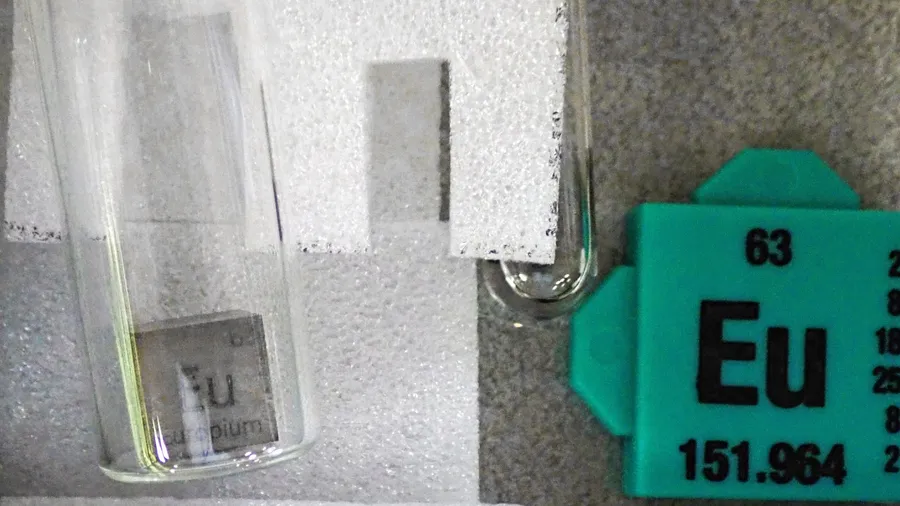
Photo: Elemental europium sample and element card · James St. John · CC BY 2.0 · Wikimedia Commons · cropped to 1.91:1
In December 1956, Chien-Shiung Wu and colleagues at the US National Bureau of Standards wanted to test a prediction by Tsung-Dao Lee and Chen-Ning Yang that parity is not conserved in the weak interaction. To see it, they had to line up cobalt-60 nuclei, which meant holding a sample at about three thousandths of a kelvin. They got there by demagnetising a crystal of cerium magnesium nitrate inside a magnet, and the parity symmetry did not survive the measurement (NIST, on the experiment).
That was 1956, and the demand for cold has grown since. Quantum processors, single-photon detectors and precision measurement instruments need it, and the mainstream way to supply it is dilution refrigeration, which depends on helium-3 (HFIPS, 2026; ISIS, 2026).
Two papers, one published on 10 January 2024 and the other online on 11 February 2026, both in Nature, describe a route that does not need it.
Two results, two years apart
The first came from a joint team at the University of the Chinese Academy of Sciences, the Institute of Physics and the Institute of Theoretical Physics in Beijing, and Beihang University (CAS, 12 January 2024). Their material was Na2BaCo(PO4)2, a cobalt-based magnet on a triangular lattice in which the cobalt ions behave as effective spin-1/2 moments (Zhong et al., PNAS 116, 14505, 2019). Cooled by adiabatic demagnetisation from 2 kelvin at 4 tesla, a single crystal of it reached 94 millikelvin (Xiang et al., Nature 625, 270–275, 2024). My arithmetic: 94 millikelvin is −273.056 °C, against absolute zero at −273.15 °C.
| Refrigerant | What it is | Floor reached |
|---|---|---|
| Gd3Ga5O12 (GGG) | garnet, the standard workhorse | 365 mK |
| Fe(SO4)2(NH4)2·6H2O | paramagnetic salt | 124 mK |
| CrK(SO4)2·12H2O | paramagnetic salt | 118 mK |
| Na2BaCo(PO4)2 | spin supersolid | 94 mK |
All four rows come from the same paper, measured under the same starting conditions; the paper’s own comparison also lists Er2Ti2O7 at 360 mK, which is not shown here.
The second paper is a different team on a different material, and I will come to why it matters more. It reports a metallic spin supersolid in EuCo2Al9, an alloy of europium, cobalt and aluminium, and an adiabatic demagnetisation floor of 106 millikelvin (Shu et al., Nature 651, 61–67, 2026).
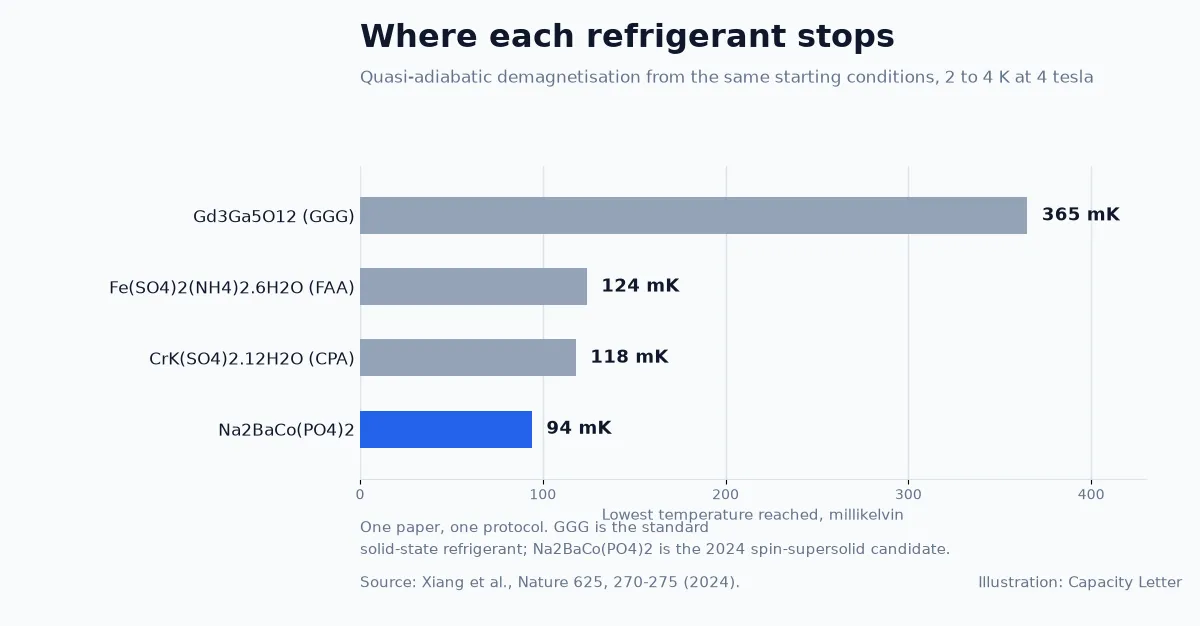
Illustration: Capacity Letter. Bars are the lowest temperatures reported in Xiang et al., Nature 625, 270–275 (2024), each from the same starting conditions of 2 to 4 kelvin at 4 tesla. The 2026 result on EuCo2Al9 is not on this chart: it is a different material, from a different paper, measured under different conditions, and the two numbers should not be read against each other.
The number that does the work
A magnet that only cools itself is not a refrigerator. Solid-state cooling has been stuck on exactly this point for decades.
The problem is heat transport. A cooling material has to absorb heat and then hand it to whatever is sitting on top of it, and the materials used for the job are poor conductors. The Hefei institutes’ own release compares the traditional magnetocaloric material to a block of wood: cold inside, unable to move that cold anywhere (Hefei Institutes of Physical Science, 14 February 2026). The usual workaround is to build a composite with metal in it, which adds complexity and eats into cooling power. An ideal refrigerant would be its own conductor.
That is the claim for EuCo2Al9. The same release puts its thermal conductivity in the 100-millikelvin range at about 100 mW/(K·m), one to two orders of magnitude above previously reported magnetocaloric materials, and says a pure-metal cooling module has been built. The Hefei release states that a Chinese invention patent covering the material has been granted; the number, ZL 202510617149.2, appears in the paper’s competing-interests statement (PubMed record for Shu et al. 2026).
My reading is that the useful half of this story is not the temperature. It is that someone demonstrated the two properties together in one material, and that the same paper’s neutron work was done at the ISIS source in Britain, where the instrument scientist Pascal Manuel described the magnetic structure of EuCo2Al9 as unambiguous in a way other candidate spin supersolids have not been (ISIS Neutron and Muon Source, 13 February 2026).
What it is for
The pitch is about the shape of the machine as much as its temperature. The Hefei release lists what the material is meant to supply: a stable, portable cold source for quantum chips and quantum metrology devices; a lightweight millikelvin environment for high-sensitivity single-photon detectors; and a self-supplied ultralow-temperature option for major space science missions (HFIPS, 2026). The British facility that collected the neutron data lists quantum computing and space among the uses it names (ISIS, 2026).
My reading is that the word carrying the argument in that list is portable. Dilution refrigeration is a technology you install, and its defining input is an isotope that, on the Department of Energy’s account, arrives from government stockpiles. A magnetocaloric material that carries both its own cooling capacity and its own heat path is closer to a component, and instruments that can be carried are a different product category from instruments that must be brought to a building.
That is a direction, not a deployment. The papers report a material’s floor and its thermal conductivity; the module is where the claim would have to survive contact with a customer.
What the cold actually does
Adiabatic demagnetisation is easy to state and easy to garble, so here is the mechanism.
A magnetic field is switched on, the spins line up, and the heat that alignment releases goes into a surrounding bath. Then the sample is isolated and the field is switched off. As the field falls, the spin system becomes more disordered and its entropy rises. The total entropy of an isolated sample cannot rise, so the extra entropy is taken from the atomic lattice, which pays for it by getting colder.
Nothing about that process creates cold out of disorder. The temperature falls because entropy moved from the lattice into the spins, and the material’s usefulness depends on how much entropy it can absorb per unit of field change.
That is where a spin supersolid earns its keep. A spin supersolid is a state in which spins order like atoms in a crystal and simultaneously retain a flowing, superfluid component. Near the point where that state gives way, the entropy change per unit of field is at its steepest, and the material keeps cooling instead of rebounding once it has settled into order. The 2024 paper measures that with the normalised magnetic Grüneisen parameter, whose peak is more than four times the value for the standard refrigerant GGG (Xiang et al., 2024).
The same paper is candid about the limit. Theory put the floor at about 71 millikelvin; the experiment reached 94. The authors attribute the difference to unavoidable heat leakage during a quasi-adiabatic measurement. A better insulated rig should get closer to the calculation.
The isotope, and who allocates it
Helium-3 is rare, and the number usually quoted for how rare is worth stating with its denominator. China’s Ministry of Science and Technology, describing lunar soil research in 2022, put the Earth’s helium-3 reserves at about 0.5 tonnes, against a helium supply that is overwhelmingly helium-4 (MOST, 21 June 2022). That is a figure for what exists in nature.
What actually circulates is narrower. The US Department of Energy’s isotope programme states that its entire helium-3 supply is a byproduct of tritium decay from defense programmes, separated at the Savannah River Site, and that peak federal demand of 70,000 litres a year in 2008 outstripped government supply. Recycling and substitute technologies brought projected federal demand below 6,000 litres a year, and the programme now describes the earlier shortage as mitigated (DOE isotope programme).
That last point cuts against the usual telling of this story, and it belongs in it. Helium-3 is not a commodity that a market clears; it is a stockpile drawn from defence tritium programmes and allocated by governments, which is why the same American source describes a solved problem while the Hefei release says China depends entirely on imports (HFIPS, 2026). My reading of those two statements together is that this is less a shortage than an allocation: paperwork for a lab in a country that recovers the stuff, and a permission slip for one that does not. That is the same shape as the problem in chip-making tools.
The other half of the swap
EuCo2Al9 has europium in it, and europium is a rare earth. That matters on the input side for a reason that has nothing to do with this research group.
China mined 270,000 tonnes of rare earth oxides in 2025, more than any other country, and in October 2025 it extended its export controls to cover europium along with holmium, erbium, thulium and ytterbium. The following month it suspended that round for a year, while the controls it imposed in April 2025 on samarium, gadolinium, terbium, dysprosium, lutetium, scandium and yttrium stayed in force (USGS, Mineral Commodity Summaries 2026, rare earths chapter). Europium is therefore not under restriction at the time of writing; it is under discretion.
I am not claiming the team picked its refrigerant to make a point about export policy; nothing in the record suggests that, and motive needs evidence. What I am saying is narrower and checkable: the substitution moves the constraint from an isotope China has to buy to an element whose export China gets to switch on and off. Whether that leaves the country better off depends on whether the material scales, and that is a manufacturing question, which is the kind this site keeps coming back to.
What the papers do not settle
A temperature floor is a property of a material. My reading is that the figure which decides whether this leaves the laboratory is the load curve: how much heat the device can hold, at a given temperature, before it warms up. The Hefei release says a pure-metal cooling module has been built and that applications are being pursued; the load curve is the number I would want next.
Two further things stay open. The 94 and 106 millikelvin results were produced by the same research community that announced them, and I have not seen an independent group report the same floor for either material. And the 2026 work was published in February; any assessment of it now is an assessment of a paper, not of a product line.
My judgment
The question this work answers is not how close to absolute zero a Chinese laboratory can get. It is who decides whether a lab can get cold at all.
At the bottom of the temperature range, the answer has been supply of an isotope recovered as a byproduct of defence tritium programmes. Two results have now shown that a solid-state route into the 100-millikelvin class exists, and the second one, the metal, addresses the reason the first one would not have shipped. That is a genuine change in the input list, and it is a bigger deal than the temperature. It is also, so far, a change at the level of materials rather than machines.
What would change my mind: if the thermal-conductivity advantage disappears once the material is packaged into a module; if helium-3 ceases to be allocated rather than sold and the import dependency stops binding; or if the europium content turns out to price the material out of any system that would use it. Any of those would leave the physics intact and cut the supply story down.
Methodology
One claim that circulates with this result could not be verified and has been left out: that the search for a helium-3 replacement was the 46th of the 125 questions Science published for its 125th anniversary in 2005. The list is real; I found no trace of that placement, and nothing in the argument depends on it.
The main limit on this piece is that both results come from Chinese state research institutions, and the press material describing them is written by the same groups. The full text of the 2026 paper sits behind a paywall, so my account of it rests on its abstract, the PubMed record and the independent write-up by the ISIS neutron facility in Britain. On the supply side I have used the US Department of Energy’s own account, which happens to undercut the scarcity framing rather than support it.
Sources
- Xiang, J. et al., “Giant magnetocaloric effect in spin supersolid candidate Na2BaCo(PO4)2”, Nature 625, 270–275 (2024) — peer-reviewed paper. The 94 millikelvin floor, the comparison figures for GGG, ETO, FAA and CPA, the four-fold Grüneisen peak, the 71-millikelvin calculation and the heat-leakage explanation — doi.org and arXiv:2504.11298
- Shu, M. et al., “Giant magnetocaloric effect and spin supersolid in a metallic dipolar magnet”, Nature 651, 61–67 (2026) — peer-reviewed paper, abstract and competing-interests statement read in full. EuCo2Al9, the 106 millikelvin floor, and patent ZL 202510617149.2 — PubMed 41673157
- Chinese Academy of Sciences, “Scientists discover the giant magnetocaloric effect of spin supersolidity”, 12 January 2024 — institutional release by the participating institutes. The 94 millikelvin result, the team composition, and the coexistence of diagonal and off-diagonal order in a spin supersolid — cas.cn
- Hefei Institutes of Physical Science, Chinese Academy of Sciences, “A Science Island team realises a metallic spin supersolid and a helium-3-free ultralow-temperature refrigeration breakthrough”, 14 February 2026 — institutional release by the first-listed institution. The thermal conductivity of about 100 mW/(K·m) and its one-to-two-order-of-magnitude lead, the pure-metal cooling module, the firm statement that China depends entirely on helium-3 imports, and the wood-versus-metal analogy — hf.cas.cn
- ISIS Neutron and Muon Source, “Super refrigerator offers an alternative to helium for cooling for quantum and space applications”, 13 February 2026 — independent national facility, whose WISH beamline produced the neutron data. The Pascal Manuel quotation and the facility’s own framing of the helium-3 constraint — isis.stfc.ac.uk
- Ministry of Science and Technology of China, “Chinese scientists: lunar soil glass is the key material trapping and preserving helium-3”, 21 June 2022 — government release relaying work by the Ningbo Institute of Materials Technology and Engineering. The 0.5-tonne figure for terrestrial helium-3 reserves — most.gov.cn
- US Department of Energy, National Isotope Development Center, “Supply and Demand of Helium-3 (He-3)” — government programme page. The tritium-decay origin at Savannah River, the 70,000-litre 2008 peak, the projected fall below 6,000 litres a year, and the mitigation of the shortage — isotopes.gov
- US Geological Survey, Mineral Commodity Summaries 2026, Rare Earths — government statistical series. China’s 270,000 tonnes of rare-earth-oxide mine production in 2025, the October 2025 extension of Chinese export controls to europium, holmium, erbium, thulium and ytterbium, and the one-year suspension of that round the following month — pubs.usgs.gov
- NIST, “The Reversal of Parity Law in Nuclear Physics” — government laboratory account of the 1956–57 experiment. Cooling to roughly 0.003 kelvin by demagnetising cerium magnesium nitrate to polarise cobalt-60 — nist.gov
- Zhong, R. et al., “Strong quantum fluctuations in a quantum spin liquid candidate with a Co-based triangular lattice”, PNAS 116, 14505 (2019) — peer-reviewed paper, the origin of Na2BaCo(PO4)2 as a material and of its first proposed interpretation, as a quantum spin liquid candidate rather than a spin supersolid — pnas.org