· Robin Wen · Finance & Markets · 15 min read
TSMC's Profit Jumped 69 Per Cent. Seoul Halted Trading the Same Day.
TSMC's profit rose 68.7 per cent and it guided revenue above $52 billion. Earlier that day, Seoul halted trading and Samsung fell nearly a tenth.
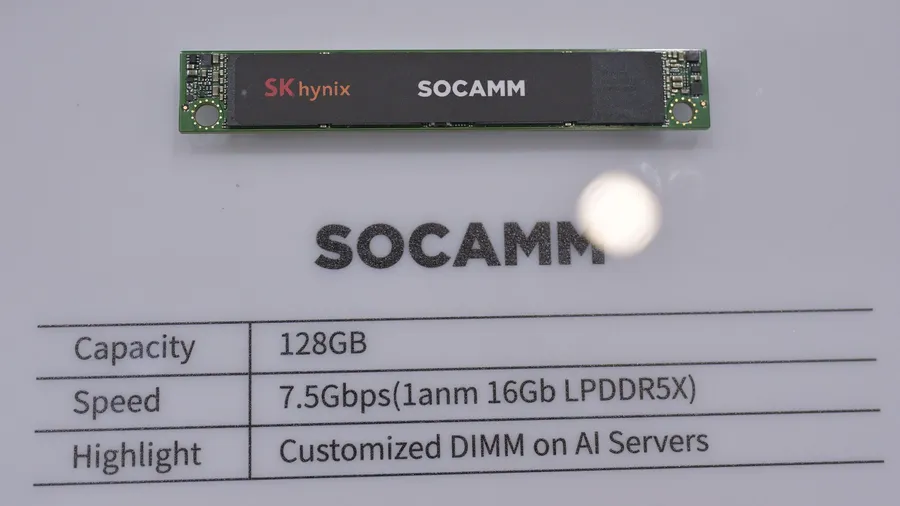
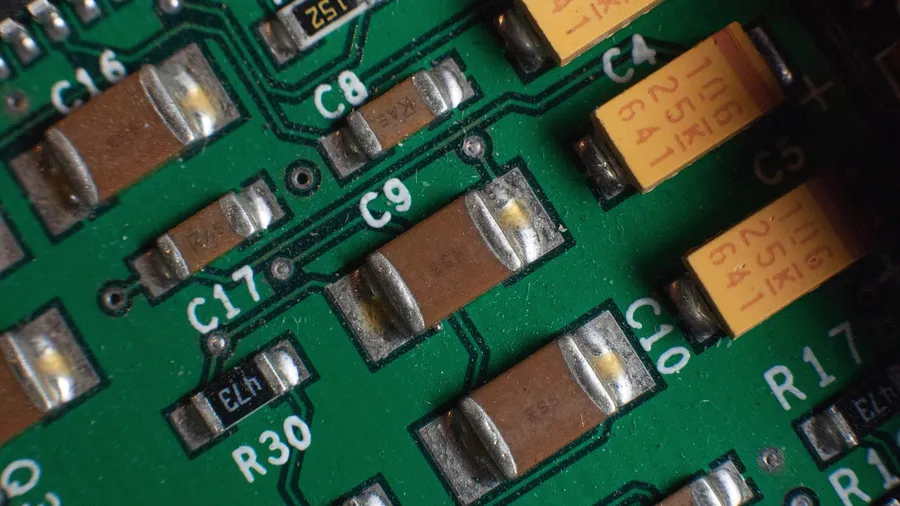
Photo: SK Hynix SOCAMM module, Computex 2025 · 4300streetcar · CC BY 4.0 · Wikimedia Commons
Trading in every share on Korea’s main board stopped for twenty minutes on 15 October. The trigger is arithmetic rather than judgement. Under Korea Exchange rules a notice goes out when KOSPI is more than 8 per cent below the previous close and the condition holds for a minute; a twenty-minute halt follows, during which existing orders can be cancelled but no new ones accepted (Korea Exchange). It was the tenth time in 2026 that the mechanism had fired on the KOSPI, and the sixteenth in the index’s history (Reuters, via Yahoo Finance, 15 October 2026).
The index had been down as much as 9.29 per cent that session. It closed 454.59 points lower, or 7.57 per cent, at 5,554.22, its lowest close since 7 April and a seventh consecutive decline, the longest run since September 2024. Samsung Electronics fell 9.5 per cent and SK Hynix 11.1 per cent.
That same day TSMC reported net income of NT$763.06 billion for the quarter, 68.7 per cent more than a year earlier, and revenue of NT$1,494.24 billion, up 50.9 per cent, on a gross margin of 66.4 per cent. Its guidance went the same way: fourth-quarter revenue of between $52.3 billion and $54.3 billion, against $46.72 billion in the third (TSMC, 15 October 2026).
A 68.7 per cent jump in quarterly profit and a trading halt in Seoul are not two readings of the same industry pointing in opposite directions. They are what one industry looks like when the price of money moves and the price of computing does not.
Where the Shock Entered
The month’s first number came from Washington, and it was about petrol. The US consumer price index rose 0.6 per cent in September on a seasonally adjusted basis and 3.7 per cent over the year, with the core measure at 0.3 per cent for the month and 2.6 per cent over the year. The gasoline index jumped 9.1 per cent in September and accounted for more than half of the monthly increase in the all-items index; the energy index rose 5.2 per cent after 2.1 per cent in August (Bureau of Labor Statistics, 14 October 2026).
That print did its work through expectations. Reuters’ closing account of the Korean session attributes the chip selloff to sticky US inflation data having raised bets of further rate hikes, and Xinhua’s Tokyo report says the selling was triggered by the stronger-than-expected September figure, which revived those expectations (Xinhua, 15 October 2026). Seo Sang-young, an analyst at Mirae Asset Securities, put the mechanism in one sentence: the market was reacting to whether capital raising would be sustainable and whether massive infrastructure investment would lead to real income, rather than to revenue growth in AI services itself.
Nothing there disputes that demand is strong. It says that the financing behind the demand has another price now, and that the asking price rose during the night of 14 October.
The evidence sits in the credit market, which moved first. Five-year credit default swap spreads on CoreWeave blew past 1,000 basis points, according to S&P LSEG data, and Oracle’s were quoted at 288 basis points by S&P Global Market Intelligence, a record for it and up from 260 a week earlier; SoftBank’s widened 24 basis points to 424. CoreWeave owes nearly $50 billion, again per LSEG, and its 2032 bonds changed hands at around 78 cents on the dollar on Tradeweb, for a yield just over 16 per cent. The pricing implies close to a 63 per cent chance of a credit event at CoreWeave within five years, against roughly 30 per cent a year ago. Spreads on Amazon, Alphabet, Meta and Nvidia reached record wides too, though Reuters notes they have risen far more slowly than Oracle’s. “CoreWeave is quickly becoming the AI trade’s canary in the coal mine,” said Kathleen Brooks of XTB (Reuters, via Central Oregon Daily News, 15 October 2026).
The company’s side of the argument deserves its place. In a memo seen by Reuters, chief executive Mike Intrator said markets can misunderstand and act irrationally, pointed to a revenue backlog of $104.2 billion and to more than $25 billion of net new customer commitments added in the third quarter, and said the failed IPOs and debt financings of rivals were bleeding into the narrative around CoreWeave (Reuters, via China Labour Bulletin, 15 October 2026). The backlog is the second-quarter figure; the commitments are separate. Both can be true at once, and the interesting part is that they are: a company can hold enough contracted revenue to cover its debts and still have to pay more than it expected to borrow the money to serve them.
What travelled from New York to Seoul was that repricing. CoreWeave’s shares fell about 15 per cent on Wednesday and roughly another 6 per cent after hours, and were down a further 6.8 per cent in premarket trading on Thursday. Its Philadelphia semiconductor index counterpart had already lost 4.3 per cent overnight. Asia opened into it. In Taipei, where TSMC’s own results were imminent, the company’s shares fell nearly 3 per cent to their lowest since late September and the Taiex lost 3.8 per cent (Reuters, via SquawkNews, 15 October 2026). Even the strongest asset in the chain was sold that day, which is what rules out the simplest explanation.
Two Countries, One Shock, Three Times Apart
The same session hit Japan at less than a third of the depth. Tokyo’s Nikkei 225 closed down 3,318.34 points, or 4.90 per cent, at 64,425.95, after briefly falling more than 5 per cent, its sixth straight decline and a cumulative loss of more than 6,200 points over that run. The broad Topix dropped only 97.44 points, or 2.38 per cent, to 3,999.34. Japanese media counted it as the index’s third-largest single-day fall in points, Xinhua reported, and the decliners were concentrated in nonferrous metals, electric appliances, and glass and ceramics products (Xinhua).
A gap of that size between a 225-stock index and a broad one is a measurement of concentration. Japan’s damage landed on the handful of heavy semiconductor and AI names that dominate its price-weighted average, while the rest of the market went about its business. Japan’s exposure to this supply chain runs far deeper than its index heavyweights, including the components that go into the tools themselves, and most of that did not move much.
Korea’s breadth tells the opposite story. Of 917 traded issues, 113 advanced and 789 declined, so this was a general liquidation rather than a rotation out of chips. Two things in the official account explain why it went further than Tokyo’s. Foreign investors sold a net 3.6 trillion won of shares, about $2.68 billion. And Mixo Das, head of Korea equity strategy at J.P. Morgan in Hong Kong, said the market was struggling to find a new buyer now that buyback programmes at Samsung and SK Hynix had run their course. Das adds, in the same breath, that over six to twelve months he expects those stocks to be substantially higher than they stood on 15 October.
The buyback point carries more weight than the selling does. A repurchase programme is a bid that is always present regardless of opinion, and the two chipmakers whose shares fell furthest that day had spent theirs. Any promise to resume them is a decision, not a standing order, and a decision can wait while a two-weekly inflation print gets digested. Seoul also arrived at this with a thinner cushion than it had in the summer. Reuters records index volatility, which had been stabilising since July on policy measures to curb a boom in leveraged single-stock exchange-traded funds, rebounding to its highest since late August (Reuters, via Yahoo Finance).
Korean government bond yields then did the one thing that decides between two diagnoses. The three-year fell 2.4 basis points to 3.861 per cent and the ten-year 4.9 basis points to 4.196 per cent. Money leaving equities went into local government debt, and stayed in the country. A funding crisis would have pushed those yields up. A repricing of equity risk does the opposite, and the won finished at 1,344.6 to the dollar, 0.17 per cent softer.
Nor did the session end exhausted. At its worst the KOSPI was down 9.29 per cent, and it closed down 7.57 per cent, so the deepest point of the day came and went inside the session.
The tenth firing of the year sets its own limit on how new any of this is. A circuit breaker fires on arithmetic at 8 per cent, so reaching it says less about this particular session than about how often the KOSPI has fallen 8 per cent in 2026. Whatever started the selling, this was already the seventh down session in a row when it happened.
What Would Settle It
Three things will decide how this reads a year from now, and none of them is a share price.
The first is whether AI-infrastructure debt still gets issued at all in coming weeks, and at what coupon. That is the direct test of whether this was one hot inflation print or a change in terms, and the market has already given it a number: CoreWeave’s implied five-year default probability went from roughly 30 per cent to close to 63 per cent in a year. Either it can borrow, in which case the chain above stops here, or it cannot comfortably do so, in which case projects get delayed regardless of how many GPUs customers want.
The second is whether the spending plans behind the wafers hold. TSMC’s own fourth-quarter guide, at a midpoint above $53 billion against $46.72 billion in the third, is the most immediate reading, and the composition matters as much as the total: 2-nanometre already accounts for 8 per cent of wafer revenue, with 3-nanometre at 33, 5-nanometre at 28 and 7-nanometre at 10, putting advanced nodes taken together at 79 per cent. If capacity plans are being cut, they surface here first in orders rather than in prices.
The third is the inflation itself, because headline and core were doing different things in September. A 3.7 per cent annual rate whose September increase was more than half attributable to the gasoline index is one problem; a core rate drifting up to 2.6 per cent over the year is a different and more durable one, since it is the kind that keeps the cost of long money high even after energy settles.
My reading is that the 15 October numbers describe a funding event that reached the wrong end of Asia’s supply chain, and the falsification is easy to state. If the large platforms cut their capital expenditure guidance while their own credit spreads narrow, then this was about customers after all, and the correct conclusion is the bearish one I have argued against here. That combination would move my reading towards customers, and towards the bearish account I have argued against above. What the evidence showed instead was narrower and more interesting: the demand chain held, and the funding chain got dearer.
Methodology
I have not given Samsung and SK Hynix’s combined weight in the KOSPI because no source I could check states it; the concentration argument rests on the breadth figures and on the divergence between Japan’s two indices. The default probability cited here is derived from CDS pricing and is a market-implied quantity, not a forecast and not a statement about CoreWeave’s condition, and CoreWeave appears as the sharpest available case of the credit repricing rather than as representative of AI infrastructure finance generally. Its $104.2 billion backlog is the second-quarter disclosure; the $25 billion of net new commitments is stated separately for the third quarter. TSMC’s figures are from the company’s own release. All index levels and stock moves are as reported by Reuters or Xinhua.
Sources
- TSMC, “TSMC Reports Third Quarter EPS of NT$29.43”, 15 October 2026 — primary source for all TSMC figures: revenue of NT$1,494.24 billion, up 50.9 per cent year on year and 17.6 per cent on the second quarter; net income of NT$763.06 billion and diluted EPS of NT$29.43, both up 68.7 per cent year on year; third-quarter revenue of $46.72 billion in US dollars, up 41.2 per cent; gross margin 66.4, operating margin 58.7 and net margin 51.1 per cent; wafer revenue mix of 8 per cent 2-nanometre, 33 per cent 3-nanometre, 28 per cent 5-nanometre and 10 per cent 7-nanometre, for 79 per cent advanced; fourth-quarter guidance of $52.3 billion to $54.3 billion revenue with gross margin of 65 to 67 per cent — pr.tsmc.com
- Korea Exchange, “Circuit Breakers in stock market” — primary source for the mechanism: notice when KOSPI falls more than 8, 15 or 20 per cent from the previous close and the condition lasts one minute; a twenty-minute halt at the first stage during which new orders cannot be placed but existing ones can be cancelled; each stage once per day and no halt within the final 40 minutes — global.krx.co.kr
- Reuters, “South Korea’s KOSPI closes at 6-month low as chipmakers slump on AI worries”, Cynthia Kim and Jihoon Lee, 15 October 2026 — the closing figures for Seoul: a close down 454.59 points, or 7.57 per cent, at 5,554.22, its lowest since 7 April; an intraday fall of as much as 9.29 per cent; a seventh straight decline, the longest since September 2024; the tenth circuit breaker of the year and sixteenth in the index’s history; Samsung down 9.5 per cent and SK Hynix 11.1 per cent after the Philadelphia Semiconductor Index fell 4.3 per cent overnight; 113 advances and 789 declines among 917 traded issues; foreign net selling of 3.6 trillion won, or $2.68 billion; LG Energy Solution down 4.6 per cent and Hyundai Motor 5.7 per cent; the won at 1,344.6; three-year treasury yields down 2.4 basis points at 3.861 and ten-year down 4.9 at 4.196; volatility highest since late August; the comments from Mirae Asset’s Seo Sang-young and J.P. Morgan’s Mixo Das; the emergency meeting of financial authorities — finance.yahoo.com
- Reuters, “AI credit jitters drive US tech default insurance to record highs”, Tom Westbrook and Amanda Cooper, 15 October 2026 — the credit layer: CoreWeave’s five-year credit default swap spreads blown out past 1,000 basis points, according to S&P LSEG data; Oracle quoted at 288 basis points by S&P Global Market Intelligence, a record and up from 260 a week earlier; SoftBank’s five-year spreads at 424, up 24 basis points, with no provider named in the report; nearly $50 billion owed by CoreWeave per LSEG; its 2032 paper at about 78 cents on the dollar on Tradeweb for a yield just over 16 per cent; an implied five-year default probability near 63 per cent against about 30 per cent a year ago; record-wide CDS for Amazon, Alphabet, Meta and Nvidia, which Reuters notes have risen far more slowly than Oracle’s; CoreWeave’s share falls of about 15 per cent, 6 per cent after hours and 6.8 per cent premarket; XTB’s Kathleen Brooks on the stock as the AI trade’s canary — centraloregondaily.com
- Reuters, “CoreWeave CEO seeks to calm staff after shares tumble 15 per cent”, 15 October 2026 — the company’s own argument: Mike Intrator’s memo that markets can misunderstand and act irrationally, that the backlog more than covers debt obligations and that rivals’ troubled IPOs and debt financings are bleeding into the narrative; the $104.2 billion second-quarter backlog against $99.4 billion in the first quarter; more than $25 billion of net new customer commitments in the third quarter; yields to maturity of 14.8 per cent on the 2032 notes and about 14.9 per cent on the 2031 notes — clb.org.hk
- US Bureau of Labor Statistics, “Consumer Price Index: September 2026”, 14 October 2026 — primary source for inflation: CPI up 0.6 per cent in September on a seasonally adjusted basis and 3.7 per cent over the year unadjusted; core up 0.3 per cent for the month and 2.6 per cent over the year; the gasoline index up 9.1 per cent and accounting for more than half of the monthly all-items increase; the energy index up 5.2 per cent after 2.1 per cent in August — bls.gov
- Xinhua, “Japan’s Nikkei suffers 3rd largest single-day point loss on AI, chip sell-off”, 15 October 2026 — Japan’s session: the Nikkei down 3,318.34 points, or 4.90 per cent, at 64,425.95, and the Topix down 97.44, or 2.38 per cent, at 3,999.34; a brief intraday fall of more than 5 per cent; a sixth straight decline totalling more than 6,200 points; nonferrous metals, electric appliances, and glass and ceramics products among the heaviest decliners; the September CPI print and the plunge in a large US data centre operator’s bonds identified as the triggers. This report covers Japan only and carries no Korean figures — chinaview.cn
- Reuters, “Emerging Markets: Asian currencies retreat after hot US inflation, S.Korean stocks slip 8%”, Nikita Maria Jino and Sameer Manekar, 15 October 2026 — the regional transmission: TSMC shedding nearly 3 per cent to its lowest since late September; the Taiex down 3.8 per cent to a near one-month low; the won’s fall to a two-week low of 1,352.84; Samsung and SK Hynix down almost 10 and 12 per cent respectively in their worst day since late July — squawknews.com